
Let's play a game. Imagine two neighbors on your block. One house is on fire, the other has a flooded basement, and somehow they keep making each other worse. That is a little like bipolar disorder and metabolic trouble: mood symptoms on one side, weight gain, insulin resistance, and inflammation on the other. A new review asks a pretty wild question: what if drugs built for diabetes and obesity could help with bipolar disorder too?
The paper looks at glucagon-like peptide-1 receptor agonists, or GLP-1 drugs, the family that includes semaglutide and liraglutide. Most people know them as appetite-taming, blood-sugar-lowering medications. But GLP-1 signaling does not just hang out in the pancreas waiting for lunch. Receptors show up in the brain too, which is why researchers have started eyeing these drugs as brain-active tools, not just metabolic ones (Drucker, 2024).
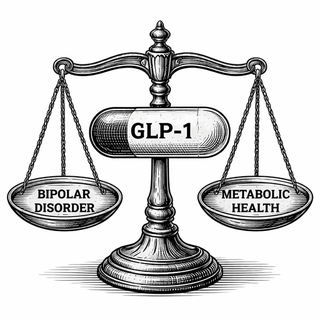
That matters because bipolar disorder is not only about mood swings in the cartoon sense. It often comes with cognitive problems, disrupted stress signaling, inflammation, and a nasty overlap with obesity and diabetes. On top of that, some treatments can push weight up. It is like trying to fix your roof while raccoons steal the shingles.
Why Bipolar Disorder Is Such a Tough Customer
Bipolar disorder is a chronic illness with episodes of depression, mania, or both, and it can keep causing trouble even between major episodes. A 2023 JAMA review makes the broader point clearly: current treatments help many people, but plenty still have incomplete recovery or heavy side-effect burdens (Nierenberg et al., 2023).
This is where the GLP-1 idea gets interesting. Researchers are not saying, "Aha, we found the bipolar button." The brain is never that polite. They are saying these drugs may influence several systems that already look suspicious in bipolar disorder: inflammation, insulin signaling, mitochondrial function, and the HPA axis, which is your body's stress command chain.
What the Review Actually Found
The review by Llach and colleagues pulls together preclinical studies, early clinical data, and real-world observations on GLP-1 drugs in bipolar disorder and related psychiatric settings (Llach et al., 2025). The preclinical side is the most encouraging so far. In mouse models, liraglutide reduced mania-like behavior, improved memory problems, and even seemed to boost lithium's effects. That is not proof for humans. Mice are useful, but they are also tiny drama students with tails.
Mechanistically, the story is plausible. GLP-1 receptor activation has been linked to reduced inflammatory signaling in the brain and body (Wong et al., 2024). These drugs also improve metabolic health, which matters because metabolic dysfunction and bipolar illness often travel as an unpleasant package deal. And since psychotropic-related weight gain can wreck long-term health and treatment adherence, any tool that helps on that front gets attention fast.
The catch is simple: human bipolar-specific evidence is still thin. Very thin. The review describes the case for promise, not proof.
So Should Anyone Get Excited?
Yes, but in the grown-up way. The interesting part here is not just mood. It is the possibility of a treatment that could help people with bipolar disorder who also struggle with weight gain, insulin resistance, or cognitive fog. In other words, this is less "new wonder pill" and more "maybe we can stop pretending the brain and body are divorced."
There is also some timely safety context. On January 13, 2026, the FDA said its review did not find evidence that GLP-1 receptor agonists increase suicidal behavior or ideation and asked for that warning to be removed from certain product labels. That cools down one of the louder worries in this area.
The Real Takeaway, Minus the Hype
This paper is intriguing because it treats bipolar disorder like the full-body condition it often is, rather than a problem trapped inside one moody corner of the brain. GLP-1 drugs might eventually help as add-on treatments for carefully selected patients.
But right now, the honest answer is still: maybe. A well-supported maybe, with decent biological logic and some encouraging early signals. Science is annoying like that. It insists on receipts.
If larger controlled trials pan out, this line of research could matter in a very real way. Not because it gives us a flashy headline, but because it hints at something better: treatments that respect the fact that mental illness does not stop at the neck.
References
- Llach CD, et al. Mol Psychiatry. 2025. https://doi.org/10.1038/s41380-025-03261-0
- Nierenberg AA, et al. JAMA. 2023;330(14):1370-1380. https://doi.org/10.1001/jama.2023.18588
- Drucker DJ. J Clin Invest. 2024;134(2):e175634. https://doi.org/10.1172/JCI175634
- Wong S, et al. Cell Metab. 2024;36(1):130-143.e5. https://doi.org/10.1016/j.cmet.2023.11.009
Disclaimer: The image accompanying this article is for illustrative purposes only and does not depict actual experimental results, data, or biological mechanisms.