
On the video feed, a tiny clear droplet wobbles in front of a mouse's nostril, catches the light, and disappears in a sniff. It is an odd little scene, unlike most addiction experiments. There is an old saying that if you want to understand a habit, watch the hands. In this case, watch the nose.
The new paper by Erickson and colleagues tackles a very practical headache in addiction research: getting mice to voluntarily take cocaine in a way that is both believable and technically manageable. The standard approach has usually been intravenous self-administration, which means catheters, surgical skill, clogged lines, animal attrition, and the general vibe of a lab setup that will punish your optimism on a Friday afternoon. This new method swaps the catheter for tiny intranasal droplets delivered right in front of a head-restrained mouse's nostril, with the drug arriving only after the mouse presses a lever (Erickson et al., 2025).
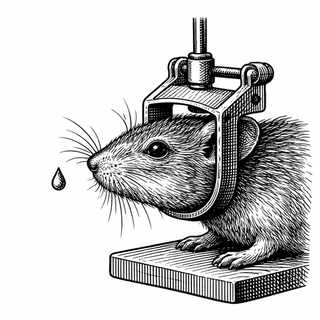
Yes, that means the mice are choosing to snort cocaine. Science is also occasionally a sentence you cannot say at Thanksgiving without needing to explain yourself for twenty minutes.
The key point is not novelty for novelty's sake. Self-administration tasks matter because they model something closer to actual choice and motivation, not just drug exposure delivered by a researcher. The twist here is that this version drops the indwelling catheter and uses a route of administration that is actually common in human cocaine use.
Less Plumbing, More Psychology
The mice in this study increased lever pressing when cocaine became available, showed dose-dependent responding, and produced the classic inverted-U dose-response curve researchers expect from a reinforcing drug. They also kept responding during longer sessions, and the authors measured high plasma cocaine concentrations afterward. The drug got in, and it mattered (Erickson et al., 2025).
Why is that useful? Because intravenous mouse models are powerful but notoriously finicky. If your setup requires surgery, specialized maintenance, and monastery-level patience, fewer labs can use it well. A simpler setup could let more researchers test questions about craving, decision-making, and neural circuitry in mice while pairing the behavior with modern imaging tools. It is not just "mice can do a weird drug thing." It is "we may have a more practical window into the addicted brain while it is making choices in real time."
That matters because cocaine use disorder is still a brutal public health problem, even when it slips out of the daily headline rotation. In the United States, CDC reporting showed cocaine-involved overdose death rates rising from 4.5 to 8.6 per 100,000 people between 2018 and 2023 (CDC MMWR, 2025). Cocaine also remains tangled up with relapse risk and impaired inhibitory control, which makes "just stop" about as useful as telling a migraine to grow up.
Your Brain, the Overcaffeinated Negotiator
Cocaine works largely by blocking dopamine reuptake, which means reward signals hang around longer than they should. Your brain's motivational machinery then starts learning the wrong lesson with the confidence of a guy at the bar explaining cryptocurrency. Over time, cues, habits, stress, and impulsive decision-making can all get recruited into the mess.
Recent research keeps filling in that picture. A 2021 review in Pharmacology & Therapeutics summarized how glutamate systems may help drive cocaine seeking and relapse, which matters because dopamine gets all the press while glutamate often does the backstage logistics (Niedzielska-Andres et al., 2021). An umbrella review in Neuroscience and Biobehavioral Reviews pulled together evidence on risk and protective factors for cocaine and other substance use disorders, underlining how biology and environment like to team up and make life complicated (Solmi et al., 2021). Human imaging studies also show the aftermath is not subtle: altered inhibitory-control networks during abstinence were reported in Molecular Psychiatry (Zilverstand et al., 2023), and a Biological Psychiatry study found that blunted anticipation of loss predicted relapse to stimulant use (Mortazavi et al., 2024).
So this mouse paper is not a cure, and it is not the whole story. The mice were male. They were head-restrained. The model still needs extension to other drugs, other questions, and female animals. It also does not solve the larger treatment problem, which remains painfully unsolved in the clinic.
But it does solve a real bottleneck. Good science often moves forward not just by big theories, but by better handles. This paper may have given addiction neuroscience one: a model that is easier to run, closer to a common human route of cocaine use, and compatible with the fancy neural recording tools that let researchers eavesdrop on the brain's tiny gossip networks while bad decisions are being assembled. If that helps labs ask sharper questions about why cocaine becomes so compelling, that is more than a technical trick. That is a useful new door.
References
Erickson KR, Quan Y, Farahbakhsh ZZ, Branthwaite HE, Song K, Kim JD, Lee JJ, Gibson-Corley KN, Kimchi EY, Siciliano CA. Intranasal cocaine self-administration in male mice. Nature Communications. 2025;16:10916. DOI: https://doi.org/10.1038/s41467-025-65875-w
Niedzielska-Andres E, Pomierny-Chamioło L, Andres M, Walczak M, Knackstedt LA, Filip M, Przegaliński E. Cocaine use disorder: A look at metabotropic glutamate receptors and glutamate transporters. Pharmacology & Therapeutics. 2021;221:107797. DOI: https://doi.org/10.1016/j.pharmthera.2020.107797
Solmi M, Dragioti E, Croatto G, Radua J, Borgwardt S, Carvalho AF, Demurtas J, Mosina A, Kurotschka PK, Shin JI, Fusar-Poli P. Risk and protective factors for cannabis, cocaine, and opioid use disorders: An umbrella review of meta-analyses of observational studies. Neuroscience and Biobehavioral Reviews. 2021;126:243-251. DOI: https://doi.org/10.1016/j.neubiorev.2021.03.014
Zilverstand A, Parvaz MA, Moeller SJ, Kalayci S, Kundu P, Malaker P, Alia-Klein N, Gümüş ZH, Goldstein RZ. Whole-brain resting-state connectivity underlying impaired inhibitory control during early versus longer-term abstinence in cocaine addiction. Molecular Psychiatry. 2023;28(8):3346-3358. DOI: https://doi.org/10.1038/s41380-023-02189-7
Mortazavi L, MacNiven KH, Knutson B. Blunted neurobehavioral loss anticipation predicts relapse to stimulant drug use. Biological Psychiatry. 2024;95(3):256-265. DOI: https://doi.org/10.1016/j.biopsych.2023.07.020. PMCID: https://pmc.ncbi.nlm.nih.gov/articles/PMC10840879/
CDC. Drug Overdose Deaths Involving Stimulants - United States, January 2018-June 2024. MMWR. 2025. https://www.cdc.gov/mmwr/volumes/74/wr/mm7432a1.htm
Disclaimer: The image accompanying this article is for illustrative purposes only and does not depict actual experimental results, data, or biological mechanisms.