
A side quest in a small alcohol trial ended with some participants smoking fewer cigarettes too, which is the kind of buried bonus level that makes addiction researchers stare at the screen and go, hold on, was that in the game the whole time? That strange little twist sits underneath a bigger idea explored in a recent Nature long read: blockbuster obesity drugs such as semaglutide might not just quiet appetite - they might also turn down the brain's craving machinery for alcohol, nicotine, and maybe other drugs too (Dolgin and Thompson, 2025).
The Brain's Reward Tree Has Shared Branches
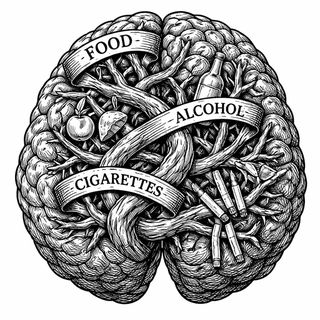
The reason this idea refuses to die is that the brain does not keep food, booze, and cigarettes in neat little folders labeled "totally separate problems." Reward circuits overlap. The mesolimbic dopamine system helps stamp in behaviors that feel rewarding, and GLP-1 receptors show up in some of those same brain regions, including the ventral tegmental area and nucleus accumbens. In plain English: the appetite drug may have wandered into the craving control room and started pressing buttons it was not originally hired to press (Zheng et al., 2025; Shen et al., 2024).
Not a Magic Potion, More Like a Difficulty Slider
The clearest randomized evidence so far comes from a phase 2 trial published in JAMA Psychiatry on February 12, 2025. In 48 adults with alcohol use disorder, once-weekly low-dose semaglutide did not significantly cut overall drinking days or average drinks per calendar day. That is the part hype merchants like to drop behind the couch. But semaglutide did reduce alcohol craving, reduce drinks per drinking day, and predict greater reductions in heavy drinking over time. In a laboratory drinking task, it also lowered post-treatment alcohol intake. A small subgroup analysis also hinted at fewer cigarettes per day among participants who smoked (Hendershot et al., 2025, PMCID: PMC11822619).
So no, this is not a cheat code that makes addiction vanish in a puff of pharmaceutical sparkles. It looks more like the game setting changed from "boss fight with lava" to merely "boss fight." That still matters. Many people are trying to drink less, binge less, and relapse less, not teleport into perfect abstinence.
Why Researchers Are Suddenly Hovering Over the Start Button
Addiction medicine has badly needed new tools. Approved medications for alcohol and nicotine problems help some people, but not nearly enough. If GLP-1 drugs can dampen craving across more than one substance, they might be hitting something general about reward rather than one specific drug alone.
Other recent papers keep that possibility alive without proving it yet. A 2024 scoping review called the human evidence limited but promising (Shen et al., 2024). A 2025 systematic review on alcohol-related behaviors found strong preclinical support and mixed but encouraging early clinical signals (Zheng et al., 2025). And a 2023 randomized study from a smoking-cessation program found dulaglutide reduced alcohol intake during treatment, even though it did not become a glorious anti-smoking finishing move on its own (Probst et al., 2023, PMCID: PMC10721313).
As of May 4, 2026, the plot has thickened further. A large BMJ cohort study in US veterans linked GLP-1 receptor agonist use to lower risks of several substance use disorder outcomes and lower substance-related hospital visits and mortality in people with pre-existing disorders. Important translation: that study was observational, not randomized, so it cannot prove the drugs caused the benefit. Still, it is the sort of signal that makes researchers start booking more trials and fewer naps (Cai et al., 2026, PMCID: PMC12958796).
The Catch, Because the Brain Loves Those
There are obvious caveats. These drugs are expensive. Access is uneven. Side effects are real. Most addiction studies so far are small, short, or both. We also do not know who benefits most or whether the effect lasts after stopping treatment. The brain, in its usual gremlin energy, has not agreed to make this simple.
Still, the question in that Nature piece lands because it feels newly plausible. Maybe obesity drugs will not "revolutionize" addiction treatment in the dramatic movie-trailer sense. But if they reliably lower craving, blunt heavy use, and help people stay in the fight long enough for counseling, support, and other medications to work, that would already be a big deal. Not a miracle. Not a final boss one-shot. Just a surprisingly useful power-up in a field that has been short on new ones for years.
References
Dolgin E, Thompson B. Audio long read: Will blockbuster obesity drugs revolutionize addiction treatment? Nature. Published online December 29, 2025. https://doi.org/10.1038/d41586-025-04147-5
Hendershot CS, Bremmer MP, Paladino MB, et al. Once-Weekly Semaglutide in Adults With Alcohol Use Disorder: A Randomized Clinical Trial. JAMA Psychiatry. 2025;82(4):395-405. https://doi.org/10.1001/jamapsychiatry.2024.4789 PMCID: PMC11822619
Shen MR, O'Brien KS, Hohle LM, Suzuki J. The Efficacy of GLP-1 Agonists in Treating Substance Use Disorder in Patients: A Scoping Review. Journal of Addiction Medicine. 2024. https://doi.org/10.1097/ADM.0000000000001347
Zheng YJ, Soegiharto C, Au H, et al. A systematic review on the role of glucagon-like peptide-1 receptor agonists on alcohol-related behaviors: potential therapeutic strategy for alcohol use disorder. Acta Neuropsychiatrica. 2025. https://doi.org/10.1017/neu.2025.6
Probst L, Monnerat S, Vogt DR, et al. Effects of dulaglutide on alcohol consumption during smoking cessation. JCI Insight. 2023;8(22):e170419. https://doi.org/10.1172/jci.insight.170419 PMCID: PMC10721313
Cai M, Choi T, Xie Y, Al-Aly Z. Glucagon-like peptide-1 receptor agonists and risk of substance use disorders among US veterans with type 2 diabetes: cohort study. BMJ. 2026;392:e086886. https://doi.org/10.1136/bmj-2025-086886 PMCID: PMC12958796
Disclaimer: The image accompanying this article is for illustrative purposes only and does not depict actual experimental results, data, or biological mechanisms.