The shortest version of this story: a new mouse study suggests dopamine axons in the striatum do not just spray out dopamine on command - they also listen to local GABA and acetylcholine signals, and that local eavesdropping changes what gets released. The interesting version takes a bit longer.
For years, the simple cartoon went like this: dopamine neurons fire in the midbrain, the signal races down the axon, dopamine gets released in the striatum, and your brain updates its opinions about movement, reward, effort, and whether that third cookie was "a choice" or "a destiny." Nice diagram. Very tidy. Also, like many tidy neuroscience diagrams, a bit of a liar.
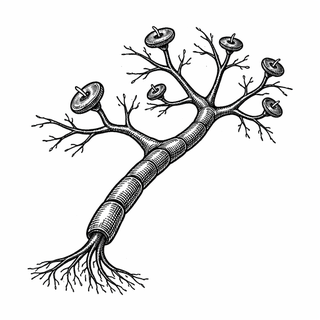
The new paper by Brill-Weil and colleagues says dopamine axons in the striatum are not passive cables at all. They carry GABA_A receptors and nicotinic acetylcholine receptors, which means they can be tuned locally by the chemical chaos around them before dopamine release happens [1]. In plainer English: the axon is not just a delivery tube. It is more like a branch office with opinions.
That matters because the striatum is one of the brain's big decision-and-action hubs. It helps coordinate movement, motivation, habit formation, and reward-related learning. It is also packed with cholinergic interneurons, which release acetylcholine, and with GABA-rich local circuitry, which means dopamine axons are operating in a neighborhood where everybody is yelling advice through the window [2,3].
What The Researchers Actually Found
The team used axonal recordings and calcium imaging in mouse striatal tissue to ask a pretty specific question: what happens when GABA_A receptors and nicotinic acetylcholine receptors interact on dopamine axons themselves [1]?
Their answer was nicely awkward in the way good data often are. Boosting GABA_A receptor activity with benzodiazepine-sensitive signaling suppressed dopamine axon responses to cholinergic input. Blocking GABA_A receptors with gabazine did the opposite - it selectively strengthened the nicotinic component of the axonal signal [1]. So local GABA signaling seems to put a hand on the shoulder of acetylcholine and say, "Let's all calm down."
The twist is that gabazine did not change acetylcholine release itself. That points the finger at GABA_A receptors on the dopamine axon, not on the acetylcholine-releasing interneurons [1]. In other words, the brake seems mounted on the dopamine cable, not on the kid mashing the accelerator.
Then came a useful bit of scientific housekeeping. The authors found that picrotoxin, a drug many labs use as a GABA_A receptor blocker, also inhibits axonal nicotinic receptors in this system [1]. That is the sort of detail that sounds fussy until you realize entire literatures can end up arguing over what is basically a mislabeled remote control.
Why This Is More Than Receptor Trivia
This paper fits into a bigger shift in dopamine research. Earlier work showed that acetylcholine in the striatum can directly trigger spikes in distal dopamine axons, meaning local cholinergic signals can generate dopamine release without waiting for instructions from the cell body like obedient little Victorian telegraph wires [4]. More recent studies pushed that idea further. One 2024 Cell Reports paper found that dopamine axons can co-release GABA, and that this GABA can feed back onto axonal GABA_A receptors to dampen phasic dopamine release [5]. A 2025 Nature Neuroscience study then showed cholinergic interneurons can also create a brief "axonal brake" that limits how quickly dopamine axons reactivate after nicotinic depolarization [6].
Put all that together and the message is hard to miss: dopamine release in the striatum is not just a broadcast from the midbrain. It is a local negotiation. Maybe a committee meeting. Possibly the bad kind where everyone brought slides.
That is interesting for basic neuroscience because it changes how we think about what an axon is doing. But it also matters for disease. Parkinson's disease, addiction, and several psychiatric disorders all involve disrupted striatal dopamine signaling. If local receptors on dopamine axons strongly shape release, then some symptoms or drug effects may depend not only on how much dopamine neurons fire, but on what chemical mood the striatum is in when the signal arrives [3,7].
The Catch, Because There Is Always A Catch
This is still mostly a mouse ex vivo physiology story, not a human treatment story. Nobody should read this and assume we are one clever receptor tweak away from fixing Parkinson's, compulsive behavior, or the human tendency to make terrible choices after midnight. The paper shows mechanism, not therapy [1].
But mechanism is how the whole game starts. If you want better drugs, you first need a less wrong map.
And this study offers exactly that. It suggests dopamine axons compute. They integrate local inhibitory and excitatory signals. They can be fooled by pharmacology. They can probably behave differently depending on circuit context. Neurons, those dramatic little overachievers, apparently gave their axons a side hustle.
References
- Brill-Weil SG, Kramer PF, Yanez A, Lipkin AM, Clever FH, Zhang R, Khaliq ZM. Presynaptic GABA_A receptors control integration of nicotinic input onto dopaminergic axons in the striatum. Cell Reports. 2025;44(12):116555. doi: 10.1016/j.celrep.2025.116555. PubMed: 41313682
- Striatum. Wikipedia. Accessed via search summary: https://en.wikipedia.org/wiki/Striatum
- Holly EN, Galanopoulou J, Fuccillo MV. Local regulation of striatal dopamine: A diversity of circuit mechanisms for a diversity of behavioral functions? Current Opinion in Neurobiology. 2024;85:102839. doi: 10.1016/j.conb.2024.102839
- Liu C, Cai X, Ritzau-Jost A, Kramer PF, Li Y, Khaliq ZM, Hallermann S, Kaeser PS. An action potential initiation mechanism in distal axons for the control of dopamine release. Science. 2022;375(6587):1378-1385. doi: 10.1126/science.abn0532. PMCID: PMC9081985
- Patel J, Sherpa A, Melani R, Witkovsky P, Wiseman M, O'Neill B, Aoki C, Tritsch NX, Rice ME. GABA co-released from striatal dopamine axons dampens phasic dopamine release through autoregulatory GABA_A receptors. Cell Reports. 2024;43(3):113834. doi: 10.1016/j.celrep.2024.113834. PubMed: 38431842
- Zhang YF, Luan P, Qiao Q, He Y, Zatka-Haas P, Zhang G, Lin MZ, Lak A, Jing M, Mann EO, Cragg SJ. An axonal brake on striatal dopamine output by cholinergic interneurons. Nature Neuroscience. 2025;28(4):783-794. doi: 10.1038/s41593-025-01906-5. PubMed: 40082616
- Touponse GC, Pomrenze MB, Yassine T, Mehta V, Denomme N, Zhang Z, Malenka RC, Eshel N. Cholinergic modulation of dopamine release drives effortful behavior. bioRxiv preprint. 2025. doi: 10.1101/2025.06.18.660394. PubMed: 40667072
Disclaimer: The image accompanying this article is for illustrative purposes only and does not depict actual experimental results, data, or biological mechanisms.