
Boomers were told kids with ADHD just needed more discipline, millennials got the "chemical imbalance" era, and Gen Z inherited a social-media feed that treats dopamine like a missing phone charger everybody keeps blaming for everything. Same condition, three different stories, and all of them a little too tidy. That is why this 2026 Nature feature matters: it takes the very popular "ADHD equals low dopamine" slogan and politely asks it to step outside and explain itself. [1]
The Brain Loves a Simple Story. The Brain Is Wrong Again
Dopamine has been the celebrity molecule in ADHD for decades, mostly because the best-known stimulant medications, like methylphenidate and amphetamine, affect dopamine signaling. Fair enough. If the medicine changes dopamine and the symptoms improve, it is tempting to say, "Aha, case closed, the brain was short on dopamine." But that is a bit like saying your kitchen fire alarm proves the only problem in your house is smoke. Useful clue? Yes. Full explanation? Not even close. [1,2]
The newer picture is messier and, frankly, more believable. A 2024 review of the field found real evidence that dopamine is involved in ADHD, but much weaker evidence for the cartoon version where every person with ADHD just has a plain, global dopamine shortage. Researchers see hints of altered dopamine transport, reward processing, timing, motivation, and circuit tuning, but not one neat broken switch. The brain, as usual, refuses to become a three-bullet infographic. [2]
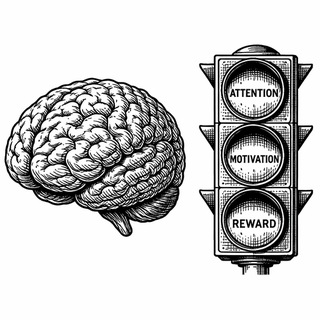
Dopamine Is More Like Traffic Control Than Gasoline
When people talk about dopamine, they often talk as if it is raw fuel. Pour in more, get more focus. Your neurons would like to file a complaint. Dopamine is closer to a traffic cop for salience, motivation, learning, and prediction. It helps the brain decide what deserves attention now, what feels rewarding, and what should get stamped as worth repeating. If that signaling is mistimed, too noisy, or handled differently across circuits, daily life can start feeling like every browser tab is yelling your name at once. [1,2]
That fits with broader ADHD research. A major 2024 primer in Nature Reviews Disease Primers describes ADHD as a highly heterogeneous neurodevelopmental condition, with differences in symptoms, impairment, co-occurring conditions, cognition, and brain measures. Translation: ADHD is less one disorder wearing one hat and more a very unruly family reunion where several cousins keep borrowing the same label. [3]
Genetics tells a similar story. A 2023 genome-wide study identified 27 ADHD risk loci and found that ADHD-associated variants are enriched in genes active during early brain development, including links to midbrain dopaminergic neurons. That supports dopamine involvement, but it also shows the condition is broader than one neurotransmitter fairy tale. Many risk variants overlap with other psychiatric conditions, which is a reminder that brains do not organize themselves according to neat textbook chapter headings. Rude, but true. [4]
Why This Matters Outside the Lab
This is not just a nerdy argument over molecular gossip. If clinicians and the public oversimplify ADHD into "low dopamine," they can miss what treatment is actually trying to do. Stimulants do help many people, often substantially, but that does not mean they work like topping off windshield fluid. They may be helping tune signal-to-noise ratios in attention and reward circuits, and that tuning probably differs across people, ages, and symptom profiles. [1,2,3]
That has real consequences. It affects how researchers hunt for biomarkers, how drug developers design non-stimulant treatments, and how patients understand themselves. It also pushes back on the annoying internet habit of turning every motivation problem into a dopamine deficiency story. Some newer work has even suggested that stimulants can increase willingness to invest effort without necessarily making complex thinking uniformly better in every context, which is a nice reminder that feeling sharper and being sharper are not always identical twins. [5]
The Useful Kind of Humbling
So what challenge is this research really tackling? Precision. ADHD has been clinically obvious for a long time, but biologically slippery. Scientists are trying to move from broad descriptions like "attention problem" or "dopamine problem" toward a more honest map: which circuits, which developmental windows, which subgroups, and which treatments for which people. That is slower than internet mythology and less catchy than "dopamine detox," but it is how you eventually get better care. [1,3,4,6]
If this line of work keeps holding up, the payoff could be big: more personalized medication choices, better non-stimulant options, fewer blunt stereotypes, and maybe a future where people with ADHD are not forced to explain their brains using half a meme and one overworked neurotransmitter. Your neurons, those chaotic little relatives at the family dinner, deserve at least that much.
References
- Madhusoodanan J. Untangling the connection between dopamine and ADHD. Nature. Published January 21, 2026. doi:10.1038/d41586-026-00094-x. PubMed: 41565954
- MacDonald HJ, Kleppe R, Szigetvari PD, Haavik J. The dopamine hypothesis for ADHD: An evaluation of evidence accumulated from human studies and animal models. Front Psychiatry. 2024;15:1492126. doi:10.3389/fpsyt.2024.1492126. PMCID: PMC11604610
- Faraone SV, Bellgrove MA, Brikell I, et al. Attention-deficit/hyperactivity disorder. Nat Rev Dis Primers. 2024;10:11. doi:10.1038/s41572-024-00495-0
- Demontis D, Rajagopal VM, Thorgeirsson TE, et al. Genome-wide analyses of ADHD identify 27 risk loci, refine the genetic architecture and implicate several cognitive domains. Nat Genet. 2023;55:198-208. doi:10.1038/s41588-022-01285-8
- Bowman E, Coghill D, Murawski C, Bossaerts P. Not so smart? "Smart" drugs increase the level but decrease the quality of cognitive effort. Sci Adv. 2023;9(24):eadd4165. doi:10.1126/sciadv.add4165. PMCID: PMC10266726
- Veronesi GF, Curatolo P, Masi G, et al. Connecting the dots and finding the way forward: Pharmacological, neuromodulatory, and psychotherapeutic interventions for the complex treatment of adult ADHD. Neurosci Biobehav Rev. 2026;174:108997. doi:10.1016/j.neubiorev.2026.108997
Disclaimer: The image accompanying this article is for illustrative purposes only and does not depict actual experimental results, data, or biological mechanisms.