
A neurologist walks into a bar and says, "I have got a tumor that used to look like a polite neighbor, and now it is trying to merge with the house next door." That, give or take a whiskey, is the vibe of a new Neuro-Oncology paper on meningiomas, the very common brain tumors that usually grow from the membranes around the brain rather than from brain tissue itself. Most meningiomas are relatively manageable. But some decide the product roadmap should include invading the brain. Classic founder overreach.
The Tumor That Would Not Stay In Its Lane
Meningiomas are often described as "usually benign," which is medically true and emotionally not that comforting when one is pressing on your brain like an uninvited houseguest. What makes brain invasion such a big deal is simple: once tumor cells start pushing into neighboring brain tissue, surgery gets harder, recurrence risk goes up, and the line between "remove the tumor" and "please do not damage the circuitry that runs my life" gets uncomfortably thin. Brain invasion is one reason some meningiomas get classified as WHO grade 2 rather than grade 1, and that changes prognosis and treatment planning (Assadi et al., 2026; Wang et al., 2024).
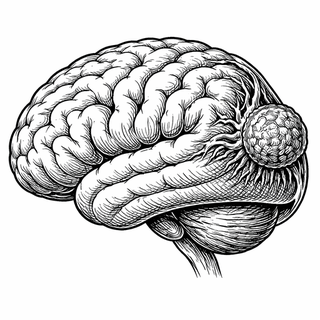
That is the setup for the new study by Aggarwal and colleagues. They asked a sharp question: what actually changes when a meningioma starts invading the brain? Not just under a microscope, but at the level of genes, cell states, neighborhood politics, and live interactions with nearby neurons (Aggarwal et al., 2026).
A Molecular Rebrand at the Brain-Tumor Border
The team did not rely on one shiny method and call it a day. They combined bulk RNA sequencing from 199 meningiomas, single-cell RNA sequencing from matched regions, and spatial transcriptomics focused on the brain-tumor interface, basically the contested border where the tumor meets actual brain. That matters because tumors are not uniform blobs. They are more like badly managed companies with wildly different subcultures by floor.
Across those datasets, four genes kept showing up at that interface: TGM2, S100A11, ZYX, and PDGFRA. In plain English, the tumor cells near the edge seemed to be reprogramming themselves into a more invasive state. Not content with occupying space, they appeared to be changing their operating system for border expansion. The study also found macrophages enriched at that interface, which suggests the local immune microenvironment is not just watching from the sidelines with a clipboard. It is in the scrum.
That idea fits with broader meningioma work showing that the tumor microenvironment matters a lot. Recent studies have tied meningioma behavior to molecular class, spatial heterogeneity, and immune-cell composition, especially macrophages (Nassiri et al., 2021; Lucas et al., 2024; Ke et al., 2024).
Plot Twist: The Neurons Are Not Innocent Bystanders
Here is the part where the paper gets extra interesting and a little rude to our old assumptions. The authors did coculture experiments with meningioma cells and neurons and found signs of neuronal hyperexcitability alongside increased meningioma cell proliferation. Translation: the nearby neurons were not just being bullied by the tumor. They may be participating in a weird two-way feedback loop where neural activity and tumor growth help each other along.
If that sounds familiar, it is because cancer neuroscience has been making this point across brain tumors for a while now: tumors and neurons can talk, and sometimes that conversation is a terrible idea. This paper suggests meningiomas may join that club more than we appreciated. Which is unsettling, but scientifically useful. Your brain, once again, refuses to keep one clean org chart.
Why This Could Matter in the Real World
If these findings hold up, they could change how people think about aggressive meningiomas. Instead of treating brain invasion as just a pathology checkbox after surgery, clinicians could start treating it as a biologically active state with recognizable molecular signals and a distinct microenvironment. That opens the door to better risk prediction, smarter sampling at surgery, and eventually therapies aimed at the invasive edge rather than the whole tumor in one undifferentiated lump (Wang et al., 2024; Assadi et al., 2026).
It also raises a more provocative possibility: maybe part of the danger is not just the tumor cell itself, but the conversation between tumor cells, macrophages, and electrically active brain tissue. Shut down the wrong chat channel, and perhaps you slow invasion or recurrence. That is still speculative. Nobody should run out of the bar yelling "we cured meningioma." But it is a more actionable picture than "some tumors are just mean."
The catch, of course, is that this is still early translational work. The patient-derived sequencing is powerful, but the neuron coculture system is not a whole human brain, much as scientists would probably enjoy billing one to the grant. We need replication, larger cohorts, and proof that these edge-associated signals actually help predict outcomes or therapeutic response in patients.
References
Aggarwal A, Youngblood MW, Picart T, et al. Meningioma cell reprogramming and microenvironment interactions underlie brain invasion. Neuro Oncol. 2026;28(4):926-938. DOI: 10.1093/neuonc/noaf292. PubMed: 41476144.
Assadi M, Juweid ME, Lohmann P, et al. Multidisciplinary management of meningiomas in the era of precision oncology. Nat Rev Clin Oncol. Published online April 13, 2026. DOI: 10.1038/s41571-026-01148-9. PubMed: 41975017.
Ke C, Huang B, Xiang J, et al. Secreted clusterin inhibits tumorigenesis by modulating tumor cells and macrophages in human meningioma. Neuro Oncol. 2024;26(7):1262-1279. DOI: 10.1093/neuonc/noae034. PMCID: PMC11226886.
Lucas CG, Mirchia K, Seo K, et al. Spatial genomic, biochemical and cellular mechanisms underlying meningioma heterogeneity and evolution. Nat Genet. 2024;56(6):1121-1133. DOI: 10.1038/s41588-024-01747-1. PMCID: PMC11239374.
Nassiri F, Liu J, Patil V, et al. A clinically applicable integrative molecular classification of meningiomas. Nature. 2021;597(7874):119-125. DOI: 10.1038/s41586-021-03850-3. PMCID: PMC11604310.
Wang JZ, Patil V, Landry AP, et al. Molecular classification to refine surgical and radiotherapeutic decision-making in meningioma. Nat Med. 2024;30(11):3173-3183. DOI: 10.1038/s41591-024-03167-4. PMCID: PMC11564112.
Disclaimer: The image accompanying this article is for illustrative purposes only and does not depict actual experimental results, data, or biological mechanisms.