
The hiss of a coffee machine, the smell of burnt toast, the sting of cold air on your face - all of that starts as raw sensory gossip. Receptors fire, nerves pass the message along, and cortical circuits decide whether this is breakfast, weather, or a sign you really need to stop cremating bagels. That whole chain depends on brain cells keeping the neighborhood stable. After a stroke, that neighborhood goes from tidy block party to folding-chair chaos.
This new mouse study asks a very specific question with surprisingly big consequences: who tells astrocytes, the brain's cleanup crew and emergency fencing contractors, how reactive to become after an ischemic stroke? The answer points to Chd7, a chromatin remodeler - basically a molecular interior designer for DNA, deciding which genes get the nice open floor plan and which stay shut in the basement. In the study, blocking Chd7 in astrocytes toned down harmful post-stroke reactivity, shrank lesions, reduced inflammation, and improved motor recovery in mice (Nagao et al., 2025).
Astrocytes: Helpful Neighbors, Occasional Drama Magnets
Astrocytes usually do the unglamorous jobs that keep neurons from acting like overcaffeinated cousins at Thanksgiving. They help regulate blood flow, manage ions and neurotransmitters, support synapses, and help maintain the blood-brain barrier. When the brain is injured, they switch into reactive mode - a process called reactive astrogliosis. That can be protective, at least at first. It helps wall off damaged tissue, limit spread of inflammation, and stabilize the local environment.
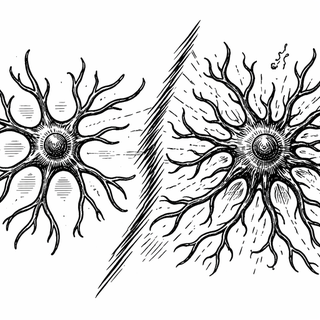
But reactive astrogliosis is a little like calling in a renovation crew that also loves sledgehammers. Too little response and the damage spreads. Too much, or the wrong kind, and you get extra inflammation, scar formation, and recovery that feels like trying to jog through wet cement. Astrocytes are neither saints nor villains. They are context-dependent, which is scientist code for "annoyingly complicated" (Edison, 2024).
Chd7 Shows Up With a Clipboard
Nagao and colleagues found that after stroke, a subset of reactive astrocytes in the tissue around the infarct turned up Chd7, along with the transcription factors Sox2 and Atf4. Chd7 then teamed up with those factors to push on genes linked to astrocyte proliferation and inflammatory signaling. One route involved Trib3, which helped drive astrocyte proliferation. Another involved C3ar1 and Malt1, which fed into interleukin-1beta signaling, one of inflammation's favorite ways to make itself everyone else's problem.
When the researchers deleted Chd7 specifically in astrocytes, the mice had less astrocyte proliferation, smaller lesions, less glial scar formation, less neuroinflammation, and better motor recovery. That does not mean glial scars are always bad. Other work shows reactive astrocytes can be essential for repair, including rebuilding blood vessels after stroke (Williamson et al., 2021, PMCID: PMC8142687).
That is what makes this paper interesting. It is not saying, "Turn astrocytes off." It is saying, "Maybe stop them from becoming the loudest person in the group chat."
Why This Matters Outside a Mouse Cage
Stroke treatment still mostly focuses on restoring blood flow fast with clot-busting drugs or thrombectomy. But even after blood flow returns, the brain keeps arguing with itself through inflammation, vascular damage, and cellular stress. That is where astrocytes become hard to ignore.
Recent work keeps circling the same theme from different angles. One Cell Reports study found that astrocytic Slc4a4 helps protect blood-brain barrier integrity after stroke (Ye et al., 2024). Another showed astrocyte-derived extracellular vesicles can improve spontaneous recovery after stroke in mice, which is a nice reminder that these cells are not just tiny arson inspectors with whistles (Otxoa-de-Amezaga et al., 2022, PMCID: PMC8821969). And outside stroke specifically, a 2024 Nature paper showed astrocytes can develop an epigenetic "memory" of inflammation that later worsens CNS pathology (Sanmarco et al., 2024, PMCID: PMC11016191).
So the big appeal here is precision. If researchers can learn how to nudge astrocytes away from the most damaging reactive states without blocking their repair jobs, that could open a very different kind of stroke therapy. Not a bulldozer. More like a stern project manager.
The Catch, Because There Is Always a Catch
This is still a mouse study, and mouse brains have a long history of making scientists look brilliant right up until human trials show up and ask for receipts. Chd7 also does important jobs in many biological contexts, so any future therapy would need excellent timing and cell specificity. Hit too early, too broadly, or too hard, and you could interfere with useful recovery programs.
Still, this paper sharpens the question in a useful way. Post-stroke astrocytes are not just "on" or "off." They are running gene programs, and some of those programs may be steerable. If that idea holds up, stroke recovery might eventually involve not only reopening blocked vessels but also persuading the brain's most overinvolved support staff to calm down and do the helpful chores first.
References
- Nagao M, Maekawa T, Yamazaki A, Ogata T. Chromatin remodeler Chd7 regulates reactive astrogliosis after ischemic stroke. Cell Reports. 2025;44(12):116590. DOI: https://doi.org/10.1016/j.celrep.2025.116590. PubMed: https://pubmed.ncbi.nlm.nih.gov/41264417/
- Williamson MR, Fuertes CJA, Dunn AK, Drew MR, Jones TA. Reactive astrocytes facilitate vascular repair and remodeling after stroke. Cell Reports. 2021;35(4):109048. DOI: https://doi.org/10.1016/j.celrep.2021.109048. PMCID: https://pmc.ncbi.nlm.nih.gov/articles/PMC8142687/
- Edison P. Astroglial activation: Current concepts and future directions. Alzheimer's & Dementia. 2024;20(4):3034-3053. DOI: https://doi.org/10.1002/alz.13678. PMCID: https://pmc.ncbi.nlm.nih.gov/articles/PMC11032537/
- Ye Q, Jo J, Wang CY, et al. Astrocytic Slc4a4 regulates blood-brain barrier integrity in healthy and stroke brains via a CCL2-CCR2 pathway and NO dysregulation. Cell Reports. 2024;43(5):114193. DOI: https://doi.org/10.1016/j.celrep.2024.114193. PubMed: https://pubmed.ncbi.nlm.nih.gov/38709635/
- Otxoa-de-Amezaga A, Miro-Mur F, Pedragosa J, et al. Improved post-stroke spontaneous recovery by astrocytic extracellular vesicles. Molecular Therapy. 2022;30(2):798-815. DOI: https://doi.org/10.1016/j.ymthe.2021.09.023. PMCID: https://pmc.ncbi.nlm.nih.gov/articles/PMC8821969/
- Sanmarco LM, Wheeler MA, Gutiérrez-Vázquez C, et al. Disease-associated astrocyte epigenetic memory promotes CNS pathology. Nature. 2024;628(8008):196-204. DOI: https://doi.org/10.1038/s41586-024-07187-5. PMCID: https://pmc.ncbi.nlm.nih.gov/articles/PMC11016191/
Disclaimer: The image accompanying this article is for illustrative purposes only and does not depict actual experimental results, data, or biological mechanisms.