
February 24, 2026, Berkeley, California. That is when researchers made an odd little battlefield report official: give a Xenopus tadpole extra genome copies, and its neurons do not just get bigger. They start changing how the whole nervous system develops and behaves. Same basic frog. Same broad brain layout. Different cellular logistics. It is the sort of finding that makes biology look like it misplaced a wrench inside the control panel and decided to keep going anyway (Liu et al., 2026).
Situation Report: What Even Is Ploidy?
Ploidy is the number of chromosome sets a cell carries. Most of the time, the simple version is enough: diploid means two sets, triploid means three. More DNA often pushes cells to become larger, and Xenopus frogs are a handy system for studying that because their ploidy is unusually flexible across species and experiments.
That matters because neurons are not generic office furniture. Size changes what they can do. Bigger cell bodies mean different geometry, different membrane area, and potentially different electrical behavior. A neuron is basically a living cable with opinions. Change the hardware and you may change the message traffic.
Mission Objective: Test Whether Neuron Size Actually Matters
Liu and colleagues used triploid Xenopus tadpoles, which carry about 1.5 times the genome size of diploid animals. The mission was blunt and useful: if you enlarge neurons in a vertebrate nervous system without otherwise blowing the whole animal apart, what happens?
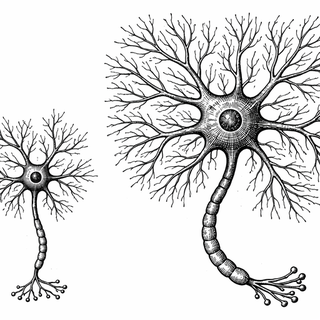
Quite a lot, as it turns out. Triploid neurons got larger overall, and their membrane surface area increased even more than you would expect from a simple scale-up. That matters because membrane is where the action lives - ion channels, synapses, electrical signaling, the whole command post. Meanwhile, the triploid brains looked broadly similar in structure and gene-expression profile to diploid brains, but they were less proliferative and ended up with fewer neurons overall. So the system did not become a supersized brain army. It became a force with fewer units, each carrying bulkier equipment (Liu et al., 2026).
Then came the operational test. The triploid nervous systems showed increased global activity, and that difference was enough to alter tadpole swimming behavior. That is the key point. This was not a decorative change under a microscope. The altered cell and genome scaling pushed all the way up to behavior. Small frog. Real consequences.
Execution: Why This Is More Than Frog Trivia
This paper plugs into a larger campaign in cell biology. Earlier work from the same general research orbit showed that polyploid Xenopus embryos have lower metabolic rates, likely because larger cells reduce total membrane surface area and therefore cut some energy costs (Cadart et al., 2023). Another study using the 12-ploid frog Xenopus longipes mapped how genome-size and cell-size scaling relationships emerge during development, showing these size rules are not fixed from minute one (Miller et al., 2023, PMCID: PMC10115129).
Put those together and the picture gets interesting fast. Cell size is not cosmetic. It affects metabolism, development, and now nervous-system function. Your neurons are not just brain raisins sitting around waiting for thoughts to happen. They are strategic assets with strict physical constraints.
There is also a medical flank here. Abnormal neuronal ploidy, cell-cycle re-entry, and genome instability have been discussed in neurodevelopmental and neurodegenerative contexts for years, although the human story is still messy and incomplete (Nandakumar et al., 2021, PMCID: PMC8264763; Albert et al., 2023). This frog study does not mean "big neurons cause disease." That would be sloppy. What it does say is that changing genome size and neuron size can reshape neural development and circuit output in a living vertebrate. That gives researchers a cleaner framework for asking when size changes are adaptive, harmless, or a full administrative disaster.
Assessment: Why You Should Care
Brains spend a shocking amount of effort balancing growth, wiring, energy use, and signal reliability. It is less like building a perfect supercomputer and more like running a military base inside a swamp while the walls are still being installed. This study shows that one basic variable - how much DNA a neuron has, and therefore how big it becomes - can shift that balance without rewriting the entire blueprint.
That is useful for basic neuroscience, because it links genome size to circuit behavior in a vertebrate. It is useful for developmental biology, because it shows you can keep the overall plan while quietly altering the size and number of the units inside it. And it is useful for disease research, because many brain disorders involve cells that are the wrong size, wrong number, or wrong state. The brain hates paperwork errors. It notices.
The tadpoles, in short, delivered a clean message: bigger neurons are not just larger furniture. They change the mission.
References
Liu X, Wan C, Shah SA, Heald R. Ploidy and neuron size impact nervous system development and function in Xenopus. Cell Reports. 2026;45(2):116969. DOI: 10.1016/j.celrep.2026.116969
Cadart C, et al. Polyploidy in Xenopus lowers metabolic rate by decreasing total cell surface area. Current Biology. 2023;33(9):1744-1752.e3. DOI: 10.1016/j.cub.2023.03.071
Miller KE, et al. Dodecaploid Xenopus longipes provides insight into the emergence of size scaling relationships during development. Current Biology. 2023;33(7):1327-1336.e4. DOI: 10.1016/j.cub.2023.02.021. PMCID: PMC10115129
Nandakumar S, Rozich E, Buttitta L. Cell Cycle Re-entry in the Nervous System: From Polyploidy to Neurodegeneration. Frontiers in Cell and Developmental Biology. 2021;9:698661. DOI: 10.3389/fcell.2021.698661. PMCID: PMC8264763
Albert O, Sun S, Huttner A, Zhang Z, Suh Y, Campisi J, Vijg J, Montagna C. Chromosome instability and aneuploidy in the mammalian brain. Chromosome Research. 2023;31(4):32. DOI: 10.1007/s10577-023-09740-w
Disclaimer: The image accompanying this article is for illustrative purposes only and does not depict actual experimental results, data, or biological mechanisms.