
Some people with triple-negative breast cancer spend their days in a rotten rhythm: appointments, scans, chemo, more waiting, then the recurring reminder that this subtype is fast, stubborn, and short on easy drug targets. TNBC makes up about 15% of breast cancers and is more likely than many other breast cancers to grow quickly and come back, which is a pretty rude personality profile for a disease to have.[6] So when a new paper suggests that nerve fibers may help the tumor lock immune cells out, that gets your attention fast.
The paper highlighted here, by Fan, Zhi, and Liu in Trends in Pharmacological Sciences, discusses new work from Zhang and colleagues showing that sensory neurons are not just innocent bystanders hanging around a breast tumor like confused cable installers.[1,2] In triple-negative breast cancer, they may be helping build the local anti-immune architecture.
The Tumor Is Not Working Alone
Cancer is never just a pile of rogue cells. It is more like a startup with terrible ethics and excellent networking. Around the tumor sits a support crew called the tumor microenvironment: immune cells, blood vessels, extracellular matrix, fibroblasts, and, increasingly, nerves. Cancer-associated fibroblasts, or CAFs, help shape the scaffold around a tumor by making and remodeling extracellular matrix, including collagen.[3,4] That scaffold can become so dense that killer T cells struggle to enter. Immunotherapy cannot do much if the immune system is stuck outside like a delivery driver staring at a locked gate.
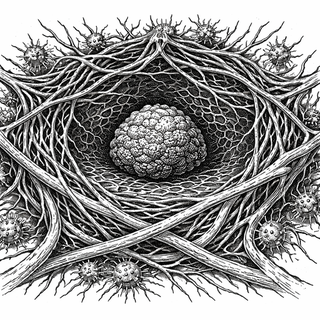
That fits a broader shift in cancer neuroscience. Recent reviews argue that peripheral nerves can actively push tumors toward growth and immune escape, not just react to the chaos after the fact.[3] Nerves are information networks. Tumors love information networks. Of course these two would eventually start texting.
The Nerve-Fibroblast Group Chat
Here is the core mechanism from the Zhang study. In mouse and human TNBC samples, sensory neurons appeared to be the dominant nerve type in the tumor microenvironment.[2] Tumor-derived nerve growth factor seemed to stimulate those neurons to release CGRP, a neuropeptide better known for migraine biology. That signal acted on fibroblasts through RAMP1, pushing them toward a matrix-producing state. Result: more collagen, a denser extracellular matrix, and fewer T cells getting where they need to go.[1,2]
If you want the plain-English version, the tumor basically persuades nearby nerves to hype up the fibroblasts, and the fibroblasts respond by pouring extra concrete around the place. Not subtle. Effective, unfortunately, yes.
This matters because immune exclusion is one reason checkpoint inhibitors can underperform in TNBC. Immunotherapy has a role in this disease, including pembrolizumab-based regimens in early-stage and metastatic settings, but responses remain uneven.[5,6] A tumor that builds itself into a collagen bunker is not exactly inviting the immune system in for tea.
Why a Migraine Drug Crashes the Oncology Party
The especially interesting twist is therapeutic. The neuron-to-fibroblast signal ran through the CGRP-RAMP1 axis, and the authors report that blocking this pathway with rimegepant helped reorganize the matrix and improved the effect of anti-PD-1 therapy in preclinical TNBC models.[1,2] Rimegepant is a migraine drug, which makes this one of those science moments where two fields accidentally realize they have been dating the same molecule.
That does not mean anyone should start freelancing with migraine pills for breast cancer. This is still preclinical work, and tumors are masters of rerouting around obstacles. CAFs are also heterogeneous. Some fibroblast states may support tumor growth, others may restrain it, which means bluntly flattening all fibroblasts could backfire.[4] Still, the logic here is strong: if nerves help fibroblasts build an immune barrier, then interrupting that crosstalk could make existing immunotherapy work better.
Why This Is Worth Watching
The bigger message is not just "neurons matter in cancer," though they do. It is that tumors behave like systems engineering problems. Change the signaling between two non-cancer cell types, and you may change the geometry of the whole battlefield. Cancer treatment usually focuses on the malignant cell as the main villain, which is fair, but this study says some leverage may come from sabotaging the tumor's support staff.
If these findings hold up in larger studies and eventually in people, the payoff could be substantial. Instead of asking only whether a tumor expresses the right checkpoint target, clinicians might also ask whether the tumor is heavily innervated, collagen-dense, and primed for immune exclusion. That could help explain why some patients respond to immunotherapy while others get the molecular equivalent of "message seen, no reply."
For now, the important thing is conceptual. Triple-negative breast cancer may be using a nerve-to-fibroblast relay to wall itself off from immune attack. Stop the relay, and the fortress starts to look less like a fortress and more like drywall with commitment issues.
References
- Fan P, Zhi X, Liu WL. Halting neuron-fibroblast crosstalk disarms tumor and augments immunotherapy. Trends Pharmacol Sci. 2026. DOI: https://doi.org/10.1016/j.tips.2026.03.006
- Zhang et al. Sensory neurons drive immune exclusion by stimulating a dense extracellular matrix in the breast cancer tumor microenvironment. Cell. 2026. DOI: https://doi.org/10.1016/j.cell.2026.01.001
- Yaniv D, Mattson B, Talbot S, Gleber-Netto FO, Amit M. Targeting the peripheral neural-tumour microenvironment for cancer therapy. Nat Rev Drug Discov. 2024;23:780-796. DOI: https://doi.org/10.1038/s41573-024-01017-z. PMCID: https://pmc.ncbi.nlm.nih.gov/articles/PMC12123372/
- Zhang H, Yue X, Chen Z, et al. Define cancer-associated fibroblasts (CAFs) in the tumor microenvironment: new opportunities in cancer immunotherapy and advances in clinical trials. Mol Cancer. 2023;22:159. DOI: https://doi.org/10.1186/s12943-023-01860-5. PMCID: https://pmc.ncbi.nlm.nih.gov/articles/PMC10544417/
- Michaels E, Chen N, Nanda R. The role of immunotherapy in triple-negative breast cancer (TNBC). Clin Breast Cancer. 2024;24:263-270. DOI: https://doi.org/10.1016/j.clbc.2024.03.001
- National Cancer Institute. Triple-Negative Breast Cancer (TNBC). Updated December 2, 2025. https://www.cancer.gov/types/breast/breast-cancer-types/triple-negative
Disclaimer: The image accompanying this article is for illustrative purposes only and does not depict actual experimental results, data, or biological mechanisms.