
Like a storm front rolling over a coastline, Parkinson's disease does not crash into the brain all at once. It builds. Pressure shifts. Tiny disturbances start bouncing around before the big damage shows up on the radar. Alright, let us talk about something wild: researchers may have found one of the little troublemakers helping that storm gather strength right at the synapse, where neurons swap microscopic gossip.
The new study looks at alpha-synuclein, or α-syn, the protein that keeps showing up whenever Parkinson's gets ugly. In healthy neurons, α-syn hangs around synapses and helps with vesicle traffic - basically helping the cell manage its chemical drink orders without spilling everything on the floor. In Parkinson's, though, α-syn can misfold, clump, and eventually pile into Lewy pathology, the cellular junk heap the disease is famous for. This paper argues that chromogranin A, or CgA, helps push α-syn from "useful bar staff" into "guy starting a chair fight" [1].
The Synapse Is Where the Plot Thickens
One of the sharpest points in the paper is timing. The authors report that just one day after adding preformed α-syn fibrils to primary neurons, phosphorylated α-syn showed up prominently in the presynapse [1]. That hints the earliest mess may begin at the synapse, not only later when neurons are already obviously sick.
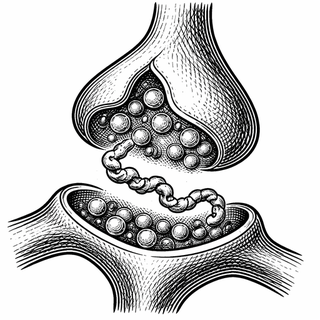
CgA is not a random extra wandering through the scene. It sits in large dense-core vesicles, which are secretory packages neurons use for certain signaling molecules. The authors found that boosting CgA increased α-syn aggregation in cell systems and mouse models of Parkinson's disease [1]. When they mixed CgA with α-syn directly, the resulting fibrils were shorter, harder to digest, and better at triggering more aggregation than standard α-syn fibrils [1]. In plain English: CgA seems to help α-syn form a nastier flavor of clump.
That idea fits a broader shift in the field. Researchers increasingly think α-syn is not one single bad blob, but a family of misfolded shapes, or "strains," with different biological behavior. Human brain studies have already shown that Lewy pathology has a distinct structural fold, not just a generic protein pileup [2]. So when this paper says CgA helps generate a particular, more toxic fibril form, people in the field are not going to shrug and order another pretzel.
Why This Is More Than Mouse-Brain Weirdness
Honestly, the interesting part is not just "protein clumps are bad." The interesting part is where and how the badness may start. If CgA helps seed α-syn pathology inside vesicle-rich synaptic territory, that gives researchers a more specific map of the opening act.
The study also found that knocking out CgA reduced dendritic spine loss, improved synaptic function, and slowed the spread of pathological inclusions in vivo [1]. Synapses are where brain cells negotiate everything. When the synapse goes sideways, the whole cocktail menu starts tasting wrong.
This lines up with recent reviews arguing that α-syn-related synaptic dysfunction may happen early, before full-blown neurodegeneration steals the spotlight [3]. There is also growing interest in phosphorylated α-syn, especially the Ser129 form, as something more nuanced than a mere postmortem calling card. It may play roles in normal synaptic biology while also becoming part of pathology when the system goes off the rails [4]. The brain, as usual, refuses to do anything in a simple and emotionally supportive way.
What Could This Mean in Real Life?
If these results hold up, CgA or the vesicle environment around it could become a target for therapies aimed at the earliest seeding steps of Parkinson's disease. That is attractive because by the time classic motor symptoms show up, α-syn pathology has often been quietly spreading for years. The field is already moving toward biology-first detection, with α-syn seed amplification assays and even skin-biopsy approaches trying to catch synuclein pathology earlier and more objectively [5,6]. A better handle on what starts the seeding process could help those diagnostic tools make more biological sense, not just statistical sense.
But real talk: there are limits here. This is still heavily based on cell and mouse models, including preformed fibril experiments that are useful but not the same thing as a human brain developing Parkinson's over decades. CgA also has normal jobs, so blocking it carelessly could create new problems. And even when scientists identify a tempting mechanism, biology loves to reply, "Cute theory, now watch me be complicated."
Still, this paper gives the field something worth chasing: a plausible accomplice sitting at the synapse, helping α-syn turn from a regular working protein into a more dangerous self-propagating form. That does not solve Parkinson's. It does, however, make the opening scene less foggy. And in a disease this sneaky, seeing the first leak in the roof matters a lot.
References
- Liu Y, Kong W, Zhu F, et al. Chromogranin A promotes the pathological conversion of α-synuclein at the synapse in Parkinson's disease. Cell Reports. 2025;44(11):116562. doi:10.1016/j.celrep.2025.116562
- Yang Y, Shi Y, Schweighauser M, et al. Structures of α-synuclein filaments from human brains with Lewy pathology. Nature. 2022;610(7933):791-795. doi:10.1038/s41586-022-05319-3. PMCID:PMC7613749
- Uytterhoeven V, Verstreken P, Nachman E. Synaptic sabotage: How Tau and α-Synuclein undermine synaptic health. Journal of Cell Biology. 2025;224(2):e202409104. doi:10.1083/jcb.202409104. PMCID:PMC11668179
- Ramalingam N, Haass C, Dettmer U. Physiological roles of α-synuclein serine-129 phosphorylation - not an oxymoron. Trends in Neurosciences. 2024;47(7):480-490. doi:10.1016/j.tins.2024.05.005
- Soto C, Mollenhauer B, Hansson O, et al. Toward a biological definition of neuronal and glial synucleinopathies. Nature Medicine. 2025;31:396-408. doi:10.1038/s41591-024-03469-7
- Gibbons CH, Levine T, Adler C, et al. Skin biopsy detection of phosphorylated α-synuclein in patients with synucleinopathies. JAMA. 2024;331(15):1298-1306. doi:10.1001/jama.2024.0792
- Siderowf A, Concha-Marambio L, Lafontant DE, et al. Assessment of heterogeneity among participants in the Parkinson's Progression Markers Initiative cohort using α-synuclein seed amplification: a cross-sectional study. The Lancet Neurology. 2023;22(5):407-417. doi:10.1016/S1474-4422(23)00109-6
Disclaimer: The image accompanying this article is for illustrative purposes only and does not depict actual experimental results, data, or biological mechanisms.