
As children, many of us spent an unreasonable amount of time sorting things into tidy piles - Lego by color, sweets by flavor, absolutely vital pebbles by pebble vibe. It felt satisfying because categories make the world behave. Psychiatry has done something similar with mental health conditions for decades. This new genetics study suggests the boxes were never quite as watertight as advertised.
Researchers analysed genetic data tied to 14 psychiatric conditions and found that the shared risk did not sort itself into a long list of perfectly separate disorders. Instead, it clustered into five broader groups: compulsive disorders, schizophrenia-bipolar disorder, neurodevelopmental conditions, internalizing conditions such as depression and PTSD, and substance use disorders (Grotzinger et al., 2025). The genome, in other words, seems less impressed by our filing system than we are.
The Brain's Family Resemblance Problem
This matters because psychiatric diagnoses often overlap in real life. People do not arrive with one immaculate, museum-grade disorder and a little plaque underneath. They arrive with symptoms that blur, stack, and refuse to behave. Clinicians have known this for ages. Genetics is now showing why.
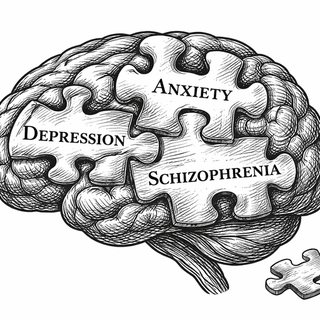
The study used genome-wide association data from more than a million people and modelled how genetic risk is shared across disorders. Some pairings showed especially strong overlap, including bipolar disorder with schizophrenia, and major depression with anxiety and PTSD. The authors also found a broader "p-factor" - a kind of general genetic liability to psychopathology - sitting above those five clusters.
This does not mean all psychiatric conditions are secretly the same. The study also found disorder-specific genetic effects, and some diagnoses, such as Tourette syndrome, retained a lot of unique signal (Grotzinger et al., 2025). So the message is not "one illness to rule them all." It is closer to "several disorders are cousins, some are siblings, and a few are only loosely related."
Why Scientists Care So Much About Shared Risk
This paper builds on a line of work showing that psychiatric genetics is deeply pleiotropic, meaning the same variants can influence more than one condition. A 2021 review in Biological Psychiatry argued that this overlap shows up at multiple levels, from genome-wide correlations to specific pathways and loci (Lee et al., 2021; PMCID: PMC7898275). A 2022 Nature Genetics study likewise found that 11 major psychiatric disorders could be grouped into broader dimensions such as neurodevelopmental, compulsive, psychotic, and internalizing patterns (Grotzinger et al., 2022).
The new study pushes that idea further with bigger datasets and more disorders, including substance use conditions. That matters because the old diagnostic boundaries were built from symptoms first, biology second. Useful in the clinic, yes. Biologically neat, not especially.
So Will This Change Anyone's Life?
If these findings hold up, they could help researchers design studies around shared mechanisms instead of forcing every condition to sit in splendid isolation. That could improve drug discovery, sharpen risk prediction, and support a more biologically grounded way of classifying mental illness. It may also help explain why treatments sometimes work across diagnoses, and why comorbidity is so common it practically deserves its own parking space.
There is also a quieter, human point here. For patients, shared genetic roots can cut against the idea that a diagnosis reflects a personal failing or some bizarre moral defect. The brain is not a Victorian gentleman keeping separate ledgers for every kind of distress.
Still, there are limits. Most of the main cross-disorder analyses relied on people of European-like ancestry, which means the findings may not generalize cleanly across populations. And genes are not destiny. A 2025 clinical review in American Journal of Psychiatry makes the point plainly: psychiatric genetics is useful only when integrated with environment, development, lived experience, and careful clinical judgment (Besterman et al., 2025).
The Slightly Awkward Bottom Line
This study does not blow up psychiatry. It does, however, give the field a firmer biological reason to rethink where one disorder ends and another begins. The old boxes still help people get diagnosed and treated. They just look less like laws of nature and more like rough sketches.
And that may be the most useful part. Not a miracle cure, not a DNA horoscope, just a better map of a very complicated landscape. Which, for brain science, counts as real progress.
References
- Grotzinger AD, et al. Mapping the genetic landscape across 14 psychiatric disorders. Nature. 2025;649:406-415. DOI: https://doi.org/10.1038/s41586-025-09820-3
- Lee PH, Feng YC, Smoller JW. Pleiotropy and Cross-Disorder Genetics Among Psychiatric Disorders. Biol Psychiatry. 2021;89(1):20-31. DOI: https://doi.org/10.1016/j.biopsych.2020.09.026 PMCID: https://pmc.ncbi.nlm.nih.gov/articles/PMC7898275/
- Grotzinger AD, et al. Genetic architecture of 11 major psychiatric disorders at biobehavioral, functional genomic and molecular genetic levels of analysis. Nat Genet. 2022;54:548-559. DOI: https://doi.org/10.1038/s41588-022-01057-4
- Besterman AD, et al. Psychiatric Genetics in Clinical Practice: Essential Knowledge for Mental Health Professionals. Am J Psychiatry. 2025;182(8):728-741. DOI: https://doi.org/10.1176/appi.ajp.20240295
Disclaimer: The image accompanying this article is for illustrative purposes only and does not depict actual experimental results, data, or biological mechanisms.