
As a kid, you probably learned the torture of waiting for something to kick in. Waiting for the popsicle to freeze. Waiting for the scraped-knee cream to stop stinging. Depression treatment has its own version of that wait, except the stakes are much uglier.
A new research highlight in Nature Reviews Drug Discovery points to a clever way around an annoyance: serotonin drugs often change brain chemistry quickly, but mood can take weeks to catch up (Villanueva, 2026). The underlying Cell study asked a question: what if the problem is not just which receptor we hit, but which downstream wiring we hit after that receptor wakes up? (Wang et al., 2025)
One Receptor, Two Personalities
The star of this story is the serotonin 5-HT1A receptor. It has a split life. In some places, especially on serotonin neurons in the dorsal raphe, it acts like a brake pedal. These are autoreceptors. Turn them on, and they tell serotonin neurons to cool it, release less serotonin, and stop acting like caffeinated interns.
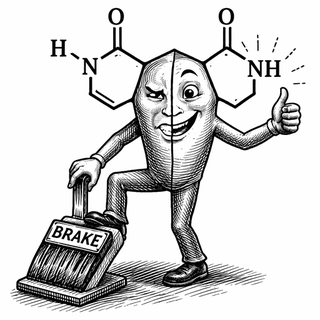
But 5-HT1A receptors also sit on other neurons in places like the prefrontal cortex and hippocampus. Those are heteroreceptors, and they look more useful if your goal is lifting mood rather than suppressing the whole system. Reviews over the past few years have argued that this receptor's location and signaling bias may matter as much as the receptor itself (Newman-Tancredi et al., 2021).
That distinction matters because standard serotonin-boosting drugs can trigger both sides of the setup. So you get the cruel little paradox: the brain chemical you are trying to boost can immediately activate a receptor that says, actually, let's all do less. If your brain were a company, this receptor would be the manager who schedules an emergency meeting that causes productivity to go down.
The Trick: Hit the Helpful Wiring, Dodge the Buzzkill
Wang and colleagues found that these two flavors of 5-HT1A signaling lean on different G proteins. Presynaptic autoreceptors mainly used Gi3, while postsynaptic heteroreceptors mainly used Go. That gave the team an opening. Instead of making a drug that simply grabs the receptor harder, they designed one, called TMU4142, that preferentially pushes the receptor toward the postsynaptic-style pathway while minimizing the autoreceptor-style one (Wang et al., 2025).
In mouse depression models, TMU4142 produced rapid antidepressant-like effects without strongly activating 5-HT1A receptors in the dorsal raphe. In plain English: it seemed to get the useful cortical and hippocampal conversation going without letting the serotonin system slap a giant "do not disturb" sign on itself.
This is part of a broader pharmacology plot twist called biased agonism. Same receptor, different downstream consequences, depending on how the drug nudges it. GPCRs are less like light switches and more like cocktail shakers. Tilt them one way and you get one cellular flavor; tilt them another and suddenly the side effects have arrived with garnish.
Why Neuroscientists Keep Coming Back to This
This idea did not appear out of nowhere. Earlier work showed that selective or biased 5-HT1A agonists can produce unusually fast antidepressant-like effects in rodents, with the medial prefrontal cortex looking especially important (Fukumoto et al., 2020). Other recent studies on compounds like NLX-204 also found rapid antidepressant-like effects and cortical signaling changes (Głuch-Lutwin et al., 2023). A 2024 review put the case neatly: biased 5-HT1A agonists may help because they favor therapeutically relevant brain regions and pathways instead of mashing every serotonin button at once (Depoortère and Newman-Tancredi, 2024).
That matters because fast-acting antidepressants are a small club. Esketamine exists, but it comes with clinic logistics, monitoring, and cost. The FDA's 2023 approval of gepirone ER shows that 5-HT1A-targeted drug development is not just academic wallpaper (FDA).
The Fine Print, Because the Brain Loves Humbling Us
Before anyone starts composing love poems to TMU4142, this is still mouse work. Mouse "antidepressant-like" behavior is useful, but it is not the same thing as a person saying morning no longer feels like wet cement.
There are other open questions too. Will this pathway selectivity hold up in humans? Will repeated dosing keep helping, or will the system adapt and get weird in some new, expensive way? The brain is not a tidy machine. It is a soup of feedback loops wearing a trench coat.
Still, this paper lands with a satisfying snap. It suggests that the long delay of serotonin-based antidepressants may not be unavoidable. It may partly reflect lousy targeting. And if that is true, the future may involve less brute-force flooding and more finesse - not "more serotonin everywhere," but "the right serotonin signal, in the right place, through the right intracellular door."
That idea has notes of precision, a little bitterness from decades of trial and error, and a surprisingly clean finish.
References
- Villanueva MT. Pathway-selective 5-HT1AR agonist speeds up antidepressant effect. Nat Rev Drug Discov. 2026;25:20. DOI: 10.1038/d41573-025-00201-z
- Wang C, Zhang N, Shao Y, et al. Pathway-selective 5-HT1AR agonist as a rapid antidepressant strategy. Cell. 2025;188(25):7222-7237.e24. DOI: 10.1016/j.cell.2025.10.022
- Newman-Tancredi A, Depoortère RY, Kleven MS, Kołaczkowski M, Zimmer L. Translating biased agonists from molecules to medications: Serotonin 5-HT1A receptor functional selectivity for CNS disorders. Pharmacol Ther. 2021;229:107937. DOI: 10.1016/j.pharmthera.2021.107937
- Fukumoto K, Fogaça MV, Liu RJ, et al. Medial PFC AMPA receptor and BDNF signaling are required for the rapid and sustained antidepressant-like effects of 5-HT1A receptor stimulation. Neuropsychopharmacology. 2020;45(10):1725-1734. DOI: 10.1038/s41386-020-0705-0 | PMCID: PMC7485645
- Głuch-Lutwin M, Sałaciak K, Pytka K, et al. The 5-HT1A receptor biased agonist, NLX-204, shows rapid-acting antidepressant-like properties and neurochemical changes in two mouse models of depression. Behav Brain Res. 2023;438:114207. DOI: 10.1016/j.bbr.2022.114207
- Depoortère R, Newman-Tancredi A. Serotonin 5-HT1A receptor biased agonists: The challenge of translating an innovative neuropharmacological concept into therapeutics. Neuropharmacology. 2024;253:110167. Link: ScienceDirect
Disclaimer: The image accompanying this article is for illustrative purposes only and does not depict actual experimental results, data, or biological mechanisms.