
On April 17, 2026, Nature Biotechnology reported that China approved an invasive brain chip to help people with paralysis move their hands. That is neuroscience in its flashy demo-day era. But the quieter startup hiding backstage is just as important: before you can decode thought, you need to know how a brain keeps track of a place it is not even standing in.
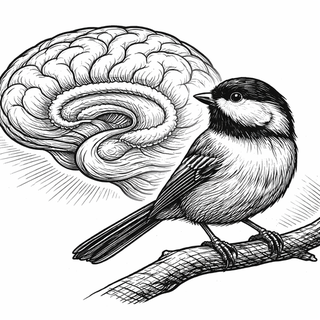
That is why one of the sneakiest cool items in Nature's December 11, 2025 year-end roundup was a bird-brain story, not a gadget story. In black-capped chickadees, researchers found that some hippocampal "place cells" fired not only when the bird reached a location, but also when it merely looked at that location from across the arena. The brain was not just logging where the bird was. It was preloading where the bird cared about next. (Nature roundup; Payne & Aronov, 2025)
The brain's navigation app just shipped a new feature
Classic place cells, first described decades ago, are the celebrity employees of the hippocampus. They tend to fire when an animal occupies a specific location. That helped build the famous idea that the hippocampus works as a cognitive map - a system that links memory to space so you can remember not just what happened, but where.
The chickadee study adds a sharp twist. These birds are spatial-memory monsters because they hide food all over the place and then go find it again later. Payne and Aronov tracked the birds' head direction as a proxy for gaze and recorded hippocampal activity during a visual search task. Some neurons fired when the bird stood at a feeder, which is normal place-cell business. But a subset also fired when the bird looked toward that feeder from the center of the arena. Same location, different use case. (Payne & Aronov, 2025)
Chickadees: tiny birds, absurdly overbuilt memory stack
This did not come out of nowhere. The same Columbia group has spent the past few years showing that food-caching birds run a navigation-and-memory operation that looks eerily familiar to mammals. In 2023, they described an entorhinal-like region in chickadees, including grid-like and border-like coding. (Applegate et al., 2023)
Across the broader field, the idea that hippocampal maps are goal-aware has been getting stronger. In rats, place cells can organize into vector-like patterns aimed toward a goal, not just represent blank coordinates on a floor plan. A 2025 review by John O'Keefe argues that this helps explain flexible navigation. (Ormond & O'Keefe, 2022; O'Keefe, 2025)
And here is the key insight. The hippocampus may not be a static map you consult after the fact. It may be a live planning workspace that flips between present location, remembered location, and likely next move. That fits newer studies showing remote, task-relevant location coding in nearby navigation circuits such as medial entorhinal cortex. (Aery Jones et al., 2026)
Why you should care, even if you are not a bird with a seed budget
If these findings keep holding up, they matter well beyond avian trivia night. Spatial navigation is one of the earliest things to wobble in disorders that hit the hippocampus, including Alzheimer's disease. A better model of how brains represent remote goals could help explain why getting lost can show up before bigger memory failures become obvious. It could also sharpen brain-computer interfaces and AI systems that try to predict intention.
There is also a more philosophical payoff. Memory is not just an archive. It is an action system. When you glance down a street and immediately know which way to turn, your brain is not opening a dusty folder labeled "map." It is running a fast merge of vision, memory, goals, and movement.
Fine print from reality
The caution label matters. This was an animal experiment, not a readout of how human navigation works in a city, hospital, or grocery store parking lot. We still need to know how general this remote coding is across species, how it changes during real-world decision-making, and whether it helps cause the next move rather than simply tagging a relevant memory. Recent work on experience-dependent place-cell referencing in mice suggests the system is highly plastic, which is exciting, but also a reminder that the map is constantly being edited while we are trying to understand it. (Qian et al., 2025)
Still, for a study tucked inside a year-end "look at all the wild science" roundup, this one lands hard. Asteroids are great. Antibiotics are useful. Ants are chaos goblins. But a bird looking across a room and lighting up a memory of somewhere else? That makes the hippocampus look less like a map drawer and more like a full-stack navigation company that has been quietly beating our best prototypes for a few hundred million years.
References
- Nature. Asteroids, antibiotics and ants: a year of remarkable science. 2025;648:539-542. DOI: 10.1038/d41586-025-03807-w
- Payne HL, Aronov D. Remote activation of place codes by gaze in a highly visual animal. Nature. 2025;643(8073):1037-1043. DOI: 10.1038/s41586-025-09101-z. PMCID: PMC12356099
- O'Keefe J. How the Hippocampal Cognitive Map Supports Flexible Navigation. Annual Review of Neuroscience. 2025;48:331-344. DOI: 10.1146/annurev-neuro-112723-023341
- Ormond J, O'Keefe J. Hippocampal place cells have goal-oriented vector fields during navigation. Nature. 2022;607(7920):741-746. DOI: 10.1038/s41586-022-04913-9. PMCID: PMC9329099
- Applegate MC, Gutnichenko KS, Mackevicius EL, Aronov D. An entorhinal-like region in food-caching birds. Current Biology. 2023;33(12):2465-2477.e7. DOI: 10.1016/j.cub.2023.05.031. PMCID: PMC10329498
- Qian FK, Li Y, Magee JC. Mechanisms of experience-dependent place-cell referencing in hippocampal area CA1. Nature Neuroscience. 2025;28:1486-1496. DOI: 10.1038/s41593-025-01930-5
- Aery Jones EA, Low IIC, Cho FS, et al. Entorhinal cortex represents task-relevant remote locations independently of CA1. Nature Neuroscience. Published online April 1, 2026. DOI: 10.1038/s41593-026-02232-0
- Nature Biotechnology. China approves brain chip to overcome paralysis. 2026;44:497. DOI: 10.1038/s41587-026-03101-8
Disclaimer: The image accompanying this article is for illustrative purposes only and does not depict actual experimental results, data, or biological mechanisms.