
The experiment was supposed to help explain how people listen to speech. Instead, it blew a hole in an old assumption. Researchers expected the heavy lifting for word recognition to sit farther up the language chain, but recordings from the superior temporal gyrus, or STG, showed this patch of cortex was not just sorting raw sounds like some bored warehouse clerk with a barcode scanner. It was already doing language-shaped work. Let me break this down.
The Crew in the Wall
Your brain does not hear speech as neat little Lego bricks. Spoken language is more like a wet concrete pour. No clean gaps. No tidy edges. People talk fast, swallow syllables, mumble into scarves, and somehow you still know where one word ends and the next one begins.
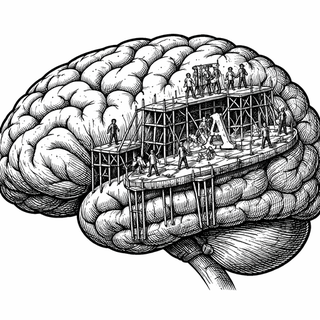
The new study behind this Nature briefing recorded brain activity directly from people who were already undergoing neurosurgical monitoring. Participants listened to English, Spanish, and Mandarin. Some of those languages were familiar to them. Some were not. The key result was wonderfully annoying for anyone who likes clean textbook boxes: the same STG region handled both universal speech features and language-specific ones, but not in the same way (Bhaya-Grossman et al., 2025).
At the basic level, the STG responded to speech sounds across languages. Consonants, vowels, timing cues, acoustic edges - the general building materials of speech - were represented even when the listener did not know the language. So the brain was not standing there like, "Sorry, no English, no service." It still recognized the construction materials.
But when it came to the higher-order stuff that actually helps you carve the sound stream into meaningful units, the response changed. Native-language listening boosted neural encoding of word boundaries, word frequency, and language-specific sound-sequence statistics. In plain English: your brain is better at spotting where the walls and doorways go when it already knows the building code.
Same Lumber, Different Blueprint
A 2022 review described the STG as a critical interface between hearing and language, where sound gets turned into usable phonological structure (Bhaya-Grossman and Chang, 2022; PMCID: PMC9447996). A 2024 review in Nature Reviews Neuroscience made the same broader point: the core language network works closely with lower-level perceptual machinery, but it is not reducible to bare acoustics (Fedorenko et al., 2024).
This paper pushes that argument harder. The STG is not just a microphone feed. It is more like a framing crew that starts shaping the structure early. That fits other recent work showing shared pitch-processing machinery that gets tuned by language experience (Li et al., 2021; PMID: 33608548) and single-neuron evidence that STG cells encode a messy mix of speech cues across cortical depth (Leonard et al., 2024).
Why Foreign Speech Sounds Like a Run-On Sentence From Hell
If you have ever landed in another country and heard the local language as one long audio noodle, this study explains why.
The universal machinery is still there. Your brain can hear the pieces. What it struggles with is segmentation. It does not yet know the local habits: which sound combinations usually travel together, where words tend to begin and end, which patterns are common, which ones are suspicious. UCSF summarized the practical version in a November 25, 2025 news release: familiar-language speech lights up STG populations that help divide continuous speech into words, while unfamiliar language is much harder to parse (UCSF News, 2025).
That has real consequences. Better maps of how the brain segments speech could sharpen aphasia research, improve surgical language mapping, and inform speech neuroprosthetics for people who have lost the ability to speak. It also gives language learning a less romantic frame. Adults are not "bad at languages." They are trying to renovate a building after the concrete has set.
The Messy Part That Still Matters
This is not the final blueprint. The study sampled patients in clinical settings, not random people from a coffee shop. It focused on recordings from the lateral temporal lobe, so it does not settle how the rest of the language network joins the job. And language is bigger than phonology - meaning, syntax, context, memory, and attention all come barging in like subcontractors with no respect for schedule.
Still, the core idea is sturdy: your brain's speech center is not simply universal and not simply language-specific. It is both. It recognizes the common hardware of speech, then uses experience to turn that hardware into something livable. That is why your native language sounds carved and jointed, while an unfamiliar one can sound like someone dumped a truck of syllables down the stairs.
References
- Bhaya-Grossman I, Lu J, Gwilliams L, et al. Shared and language-specific phonological processing in the human temporal lobe. Nature. 2025. https://doi.org/10.1038/s41586-025-09748-8
- Fedorenko E, Ivanova AA, Regev TI. The language network as a natural kind within the broader landscape of the human brain. Nature Reviews Neuroscience. 2024;25:289-312. https://doi.org/10.1038/s41583-024-00802-4
- Bhaya-Grossman I, Chang EF. Speech Computations of the Human Superior Temporal Gyrus. Annual Review of Psychology. 2022;73:79-102. https://doi.org/10.1146/annurev-psych-022321-035256. PMCID: https://pmc.ncbi.nlm.nih.gov/articles/PMC9447996/
- Li Y, Tang C, Lu J, et al. Human cortical encoding of pitch in tonal and non-tonal languages. Nature Communications. 2021;12:1161. https://doi.org/10.1038/s41467-021-21430-x
- Leonard MK, Gwilliams L, Sellers KK, et al. Large-scale single-neuron speech sound encoding across the depth of human cortex. Nature. 2024;626:593-602. https://doi.org/10.1038/s41586-023-06839-2
Disclaimer: The image accompanying this article is for illustrative purposes only and does not depict actual experimental results, data, or biological mechanisms.