
If developing brains do not clear dying neurons on schedule, the wiring job can get messy fast - like renovating a house while leaving demolition rubble in the hallway and still claiming everything is "on track." A new zebrafish study suggests the cleanup system is weirder and more collaborative than scientists thought: one kind of glial cell corrals dead neurons, then another kind barges in to haul the remains away.
Meet the Glia Nobody Should Call "Support Staff"
The paper, Barber et al., 2025, looks at the developing optic tectum in zebrafish. That is a visual processing hub, roughly analogous to the mammalian superior colliculus. During development, lots of neurons are born, some are trimmed away, and the whole place gets remodeled fast.
Usually, microglia get top billing as the brain’s professional garbage collectors. They patrol, spot trouble, and eat cellular debris through phagocytosis. Fair enough. But this study shows radial astroglia are not just standing nearby holding a clipboard. They grow big round projections that the authors call scyllate heads, and these structures wrap around dying neurons soon after those neurons flash the biochemical "eat me" flag phosphatidylserine.
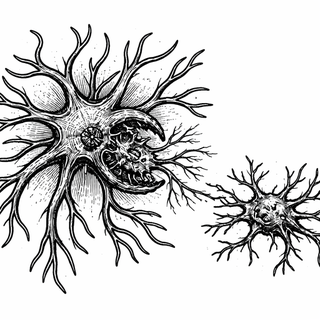
The plot twist is that these scyllate heads do not behave like standard phagosomes, the usual cellular trash bags where breakdown happens. They often linger for hours, are rarely acidified, and usually do not fully internalize the dying neuron. Instead, microglia push into these astroglial compartments and remove the contents for final degradation. It is less "one cell eats another cell" and more "temporary holding pod with specialized pickup service."
A Brain Cleanup Handoff, Not a Solo Act
For years, the default story has been simple: microglia do the engulfing, everybody else mostly stays in their lane. Recent work has been chipping away at that tidy version. Reviews have argued that astrocytes can act as phagocytes too, especially in development and disease (Konishi et al., 2022; PMCID: PMC9305589). Other recent overviews emphasize that microglia do far more than prune synapses - they help shape the whole developing brain ecosystem (Wong and Favuzzi, 2023; Barry-Carroll and Gomez-Nicola, 2024).
This zebrafish paper pushes that idea further. It suggests astroglia and microglia can split the labor. Astroglia may be the fast local first responders that wrap and contain dying neurons. Microglia then act like the specialized disposal crew that finishes the job. If your brain were a city, this is less one department doing everything and more traffic cones first, tow truck second.
That matters because developmental cell death is not a side quest. It is part of how nervous systems get the right number of cells in the right places. Miss the timing, miss the signaling, or miss the cleanup, and nearby tissue can get inflamed or stressed. Nobody wants a developing brain to run its garbage collection algorithm with a memory leak.
Why Zebrafish Are Pulling Their Weight Here
Zebrafish are fantastic for this kind of question because their larvae are transparent, which lets researchers watch cells interact in real time. Instead of inferring what happened from a frozen snapshot, the team could see astroglia form these spherical compartments and then watch microglia enter and extract cargo.
That real-time view also lines up with another recent zebrafish study in the retina, where Müller glia often contacted dying cells first and then transferred cargo to microglia for terminal clearance (Morales et al., 2024; PMCID: PMC10820749). So this may not be a one-off cellular oddity. It may be a broader design pattern: glia cooperating during normal development, with one cell type staging the problem and another cell type closing the ticket.
The Big "So What?"
No, this does not mean a zebrafish paper just cured Alzheimer's by lunchtime. But it does sharpen a big theme in neuroscience: glia are active managers of brain construction, not background wallpaper with good attendance.
That broader shift shows up all over recent literature. Microglia are now understood as major architects of developmental brain dynamics (Green et al., 2022; PMCID: PMC10680068), and astroglia are increasingly seen as hands-on partners in maintenance, signaling, and cleanup. If researchers can map exactly how these handoffs work, it could help explain what goes wrong when developmental pruning or cell clearance misfires in neurodevelopmental disease or after injury.
The immediate challenge is figuring out the rules of the partnership. Why do astroglia make scyllate heads instead of simply digesting the cargo themselves? What signal invites microglia into the compartment? Is this trick unique to zebrafish optic tectum, or does evolution reuse it elsewhere?
The annoying but honest answer is: we do not know yet. The fun answer is: the cells we once treated like the brain's support team keep sneaking into lead roles, and they have earned better billing.
References
Barber HM, Robbins CG, Cutler Z, Brown RI, Jung LE, Werkman I, Kucenas S. Radial astroglia cooperate with microglia to clear neuronal cell bodies during zebrafish optic tectum development. Cell Reports. 2025;44(11):116509. DOI: https://doi.org/10.1016/j.celrep.2025.116509
Barry-Carroll L, Gomez-Nicola D. The molecular determinants of microglial developmental dynamics. Nature Reviews Neuroscience. 2024;25(6):414-427. DOI: https://doi.org/10.1038/s41583-024-00813-1
Green LA, O'Dea MR, Spring CA, DeSantis DF, Smith CJ. The embryonic zebrafish brain is seeded by a lymphatic-dependent population of mrc1+ microglia precursors. Nature Neuroscience. 2022;25(7):849-864. DOI: https://doi.org/10.1038/s41593-022-01091-9
Konishi H, Koizumi S, Kiyama H. Phagocytic astrocytes: Emerging from the shadows of microglia. Glia. 2022;70(6):1009-1026. DOI: https://doi.org/10.1002/glia.24145. PMCID: https://pmc.ncbi.nlm.nih.gov/articles/PMC9305589/
Morales M, Findley AP, Mitchell DM. Intercellular contact and cargo transfer between Müller glia and to microglia precede apoptotic cell clearance in the developing retina. Development. 2024;151(1):dev202407. DOI: https://doi.org/10.1242/dev.202407. PMCID: https://pmc.ncbi.nlm.nih.gov/articles/PMC10820749/
Wong FK, Favuzzi E. The brain's polymath: Emerging roles of microglia throughout brain development. Current Opinion in Neurobiology. 2023;79:102700. DOI: https://doi.org/10.1016/j.conb.2023.102700
Disclaimer: The image accompanying this article is for illustrative purposes only and does not depict actual experimental results, data, or biological mechanisms.