
In five years, this discovery might mean that treating some brain tumors will involve doing something that sounds almost rude: telling nearby neurons to stop hyping the tumor up like an overcaffeinated wingman. That is the basic vibe of a new Neuron paper on pediatric brain tumors, and honestly, it is weird in the best possible way.
The paper looks at pilocytic astrocytoma, the most common brain tumor in children. These tumors are often considered low-grade, which sounds reassuring until you remember they are still inside a child’s brain, where "slow-growing" can still mean real trouble depending on location and recurrence. Recent reviews make it clear that pediatric low-grade gliomas are increasingly being understood as MAPK-pathway diseases, with treatment moving toward targeted therapy rather than bigger medical hammers (Crotty et al., 2025; Ziegler et al., 2024).
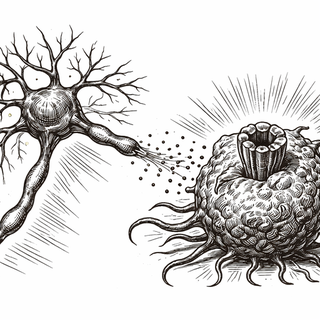
What makes this new study spicy is that it asks a very specific question: neurons release glutamate all the time, so how does that signal get converted into a "grow more tumor" command inside cancer cells?
That may sound niche, but it matters. Cancer neuroscience has been showing that brain tumors do not just passively exist like bad tenants. They plug into neural circuits, exploit neurotransmitters, and sometimes remodel the surrounding network to their own advantage (Taylor and Monje, 2023; Westphal et al., 2025). Real talk: the tumor microenvironment is less "background scenery" and more "messy bar full of people influencing each other’s decisions."
Glutamate walks in, growth signaling orders another round
Here is the central trick. The researchers found that in pilocytic astrocytoma cells, glutamate can drive proliferation not by the usual neuron-style electrical route, but by hijacking growth-factor signaling machinery.
Specifically, the tumor cells showed aberrant expression of the glutamate receptors GRID2 and GRIK3. When those receptors were stimulated, they activated Src, which then switched on PDGFR-alpha, a receptor tyrosine kinase. That kicked off the RAS-ERK pathway, one of cancer biology’s all-time repeat offenders. In plain English: a neurotransmitter signal got rerouted into a tumor-growth pathway like somebody crossed the wires and now the doorbell starts the blender.
That is the clever part. Glutamate usually makes you think of neurons firing and membranes depolarizing. But this study found the growth effect did not depend on membrane depolarization. The tumor cells were not acting like fake neurons having a little voltage party. They were using glutamate as a biochemical shortcut to hit a mitogenic pathway.
Why this matters outside the lab
This finding matters because it suggests several druggable choke points. If tumor growth depends on this weird glutamate-to-Src-to-PDGFR-alpha-to-ERK relay, then blocking pieces of that chain might slow the disease. In the study, genetic or pharmacologic inhibition of the glutamate receptors and PDGFRA reduced ERK activation, tumor-cell proliferation, and xenograft growth.
That does not mean a cure is hiding behind the pharmacy counter next to the cough drops. Mouse and cell-model wins fail all the time. But it does mean the field is getting less vague. Instead of saying "neurons somehow help tumors," researchers can now point to a specific signaling handoff. That is what turns an interesting story into an actual therapeutic strategy.
It also fits a broader pattern in glioma biology. Other recent work has shown that neuronal activity can push gliomas forward through secreted factors and circuit-level interactions, including SEMA4F-driven effects and synaptic plasticity mechanisms that strengthen neuron-glioma communication (Huang-Hobbs et al., 2023; Taylor et al., 2023). So this new paper is not a random plot twist. It is more like the writers finally revealed how one of the side characters has been sabotaging the whole season.
The catch, because there is always a catch
The big unanswered question is whether this mechanism matters across many patients and other tumor types, or whether it is especially important in a subset of pediatric low-grade gliomas. Brain tumors are molecularly diverse, which is a polite scientific way of saying they love making every case annoying in its own custom way.
There is also the practical issue of treatment. Even when a signaling pathway looks targetable, drugs need to reach the tumor, avoid wrecking normal brain function, and make sense for children who may live many years with the consequences of therapy. That is why the current push toward MAPK-targeted treatment in pediatric low-grade glioma is promising but still very much a careful balancing act, not a victory lap (Crotty et al., 2025).
Still, this paper gives the field something valuable: a cleaner explanation for how neural activity can get translated into tumor growth without requiring the tumor cell to behave like a tiny electrical chaos goblin. Sometimes progress is a moonshot. Sometimes it is figuring out exactly which bad cable got plugged into which cursed outlet.
References
- Anastasaki C, Mu R, Kernan CM, et al. Aberrant coupling of glutamate and tyrosine kinase receptors enables neuronal control of brain-tumor growth. Neuron. 2025. DOI: https://doi.org/10.1016/j.neuron.2025.08.005
- Taylor KR, Monje M. Neuron-oligodendroglial interactions in health and malignant disease. Nature Reviews Neuroscience. 2023;24:733-746. DOI: https://doi.org/10.1038/s41583-023-00744-3
- Huang-Hobbs E, Antonios JP, Barker A, et al. Remote neuronal activity drives glioma progression through SEMA4F. Nature. 2023;619:844-850. DOI: https://doi.org/10.1038/s41586-023-06267-2
- Taylor KR, Bagchi A, Fangusaro J, et al. Glioma synapses recruit mechanisms of adaptive plasticity. Nature. 2023;623:398-405. DOI: https://doi.org/10.1038/s41586-023-06635-y
- Crotty EE, Sato AA, Abdelbaki MS. Integrating MAPK pathway inhibition into standard-of-care therapy for pediatric low-grade glioma. Frontiers in Oncology. 2025;15:1520316. DOI: https://doi.org/10.3389/fonc.2025.1520316. PMCID: https://pmc.ncbi.nlm.nih.gov/articles/PMC11850343/
- Ziegler DS, Lehmann R, Eisenstat DD. A paradigm shift in how we treat pediatric low-grade glioma-Targeting the molecular drivers. Neuro-Oncology. 2024;26:593-595. DOI: https://doi.org/10.1093/neuonc/noae008
- Westphal M, Drexler R, Maire C, et al. Cancer neuroscience and glioma: clinical implications. Acta Neurochirurgica. 2025;167:2. DOI: https://doi.org/10.1007/s00701-024-06406-2
Disclaimer: The image accompanying this article is for illustrative purposes only and does not depict actual experimental results, data, or biological mechanisms.