
The brain likes a beat. Neurons fire in rhythms, immune cells jump in on cue, and when that timing goes sour the whole performance can skid from chamber music into free-jazz panic. That is the mood of a new Cell Reports paper on neuromyelitis optica spectrum disorder, or NMOSD, where the immune system attacks aquaporin-4 and the fallout can damage the optic nerves and spinal cord. In this mouse study, female brains seemed to hear the same bad song louder - and a receptor in microglia, Esr1, may be part of the reason (Zhou et al., 2025).
NMOSD is a rare autoimmune disease, but it punches way above its weight. Attacks can cause vision loss, weakness, pain, and spinal cord inflammation. A big part of the story involves AQP4-IgG, antibodies that target aquaporin-4, the water channel that helps astrocytes manage fluid balance and support the blood-brain barrier.
Scientists have known for a while that NMOSD shows a strong female bias, especially in people with AQP4 antibodies. Reviews over the last few years have mapped the broader disease mechanics and treatment landscape, but the reason for that sex difference has stayed annoyingly slippery (Wingerchuk & Lucchinetti, 2022; Pittock et al., 2021; Jarius et al., 2020).
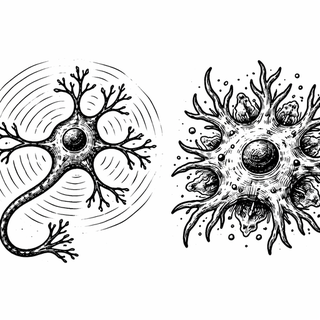
The Plot Twist Is a Tiny Immune Cell With Strong Opinions
This new study used a mouse model triggered by AQP4 antibodies and found that female mice developed more neuroinflammation and demyelination than males. Then the authors started tugging on the hormone wires.
When female mice had their ovarian hormones depleted, the disease eased up. When male mice were castrated and then given estradiol, the damage worsened. That pointed the finger toward estrogen signaling - but not in the simplistic “estrogen is good” or “estrogen is bad” way that magazine headlines tend to prefer after three espressos and no supervision.
The key player was estrogen receptor 1, also called ER alpha or Esr1, in microglia. Microglia are the brain’s resident immune cells, part cleanup crew and part neighborhood watch, except sometimes the neighborhood watch decides every squirrel is a national emergency. In these mice, microglia expressed Esr1, and deleting that receptor specifically in microglia reduced inflammation and demyelination. This receptor looked less like a passive hormone antenna and more like a pro-inflammatory volume knob.
That matters because microglia are increasingly recognized as active participants in NMOSD lesion biology. Earlier work in the Journal of Clinical Investigation showed that astrocyte-microglia crosstalk helps drive evolving NMO-like lesions after AQP4-directed injury (Chen et al., 2020). The new paper adds a sharper detail: in this antibody-driven model, microglial estrogen signaling may help explain why the inflammatory aftermath is harsher in females.
Why This Is More Than a Mouse Soap Opera
One especially interesting detail is that the researchers used fulvestrant, an estrogen receptor antagonist already approved for clinical use in another context, and it reduced disease severity in the mouse model (Zhou et al., 2025). That does not mean people with NMOSD should start asking for oncology drugs by dessert. Mouse success is not human proof, and hormone signaling is tangled up with reproduction, bone health, metabolism, and immune regulation.
Still, the clinical appeal is obvious. NMOSD treatment has improved fast. Targeted drugs aimed at complement, B cells, and IL-6 signaling have changed the field, and the FDA added ravulizumab for AQP4-positive adult NMOSD in 2024 (Pittock et al., 2023; FDA approval letter, 2024). But those treatments mostly target the immune attack from the circulation outward. This paper suggests you might also calm the damage by targeting how the brain’s own immune cells respond once the attack lands.
That is the real intrigue here: not just “women get more NMOSD,” but “there may be a CNS-resident inflammatory mechanism that helps make that bias real.”
The Fine Print, Because Biology Loves Fine Print
There are limits. This is a mouse model, not a human trial. NMOSD in real patients is messy, relapsing, and shaped by age, antibody status, treatment timing, pregnancy, and immune history. Hormones can modulate disease in complicated ways, and sex differences in NMOSD likely involve more than one pathway (Siriratnam et al., 2024).
But the paper does something valuable: it gives the field a concrete mechanistic suspect. If future work in human tissue and clinical studies supports this signal, microglial Esr1 could become part of a more precise way to think about who gets hit hardest by AQP4-antibody disease and how to soften the blow.
Brain immunology, as usual, refuses to be normal. The janitors have hormone receptors, the water channels are somehow central to catastrophe, and the so-called support cells keep stealing the plot. Honestly, neurons should be embarrassed.
References
Zhou Z, Deng Z, Huang Y, Chen J, Yang J, Cao Y. Microglial estrogen receptor 1 signal designates sexual dimorphism of AQP4 antibody-induced neuroinflammation and demyelination. Cell Reports. 2025;44:116636. DOI: https://doi.org/10.1016/j.celrep.2025.116636
Wingerchuk DM, Lucchinetti CF. Neuromyelitis Optica Spectrum Disorder. New England Journal of Medicine. 2022;387(7):631-639. DOI: https://doi.org/10.1056/NEJMra1904655
Pittock SJ, Zekeridou A, Weinshenker BG. Hope for patients with neuromyelitis optica spectrum disorders - from mechanisms to trials. Nature Reviews Neurology. 2021;17:759-773. DOI: https://doi.org/10.1038/s41582-021-00568-8
Jarius S, Paul F, Weinshenker BG, Levy M, Kim HJ, Wildemann B. Neuromyelitis optica. Nature Reviews Disease Primers. 2020;6:85. DOI: https://doi.org/10.1038/s41572-020-0214-9
Chen T, Lennon VA, Liu YU, et al. Astrocyte-microglia interaction drives evolving neuromyelitis optica lesion. Journal of Clinical Investigation. 2020;130(8):4025-4038. DOI: https://doi.org/10.1172/JCI134816
Pittock SJ, Barnett M, Bennett JL, et al. Ravulizumab in Aquaporin-4-Positive Neuromyelitis Optica Spectrum Disorder. Annals of Neurology. 2023;93(6):1053-1068. DOI: https://doi.org/10.1002/ana.26626
Siriratnam P, Huda S, Butzkueven H, van der Walt A, Jokubaitis V, Monif M. Risks and outcomes of pregnancy in neuromyelitis optica spectrum disorder: A comprehensive review. Autoimmunity Reviews. 2024;23:103499. DOI: https://doi.org/10.1016/j.autrev.2023.103499
Disclaimer: The image accompanying this article is for illustrative purposes only and does not depict actual experimental results, data, or biological mechanisms.