
The last time you made a snack and forgot why you walked into the kitchen, your brain was secretly budgeting its supplies like an old gardener eyeing a late frost. That is the gist of this new paper. When amino acids run short, synapses still need to keep the lights on, and a team working in fruit fly larvae found that they do so with a sly bit of stress signaling that seems to whisper backward across the synapse rather than bark forward like the textbooks promised Mori et al., 2025.
Neurons are expensive little aristocrats. They insist on constant fuel and a steady flow of molecular supplies. Amino acids matter because they are the raw ingredients for proteins, and proteins are how synapses build, repair, and signal.
Usually, when cells feel nutritional stress, they activate the integrated stress response, or ISR. One of the main alarm bells is GCN2, a kinase that notices amino acid scarcity and helps phosphorylate eIF2alpha, which then slows most protein production while allowing a select few messages to jump the queue. It is the cellular equivalent of canceling brunch so you can pay rent. That basic ISR logic is well established, but the nervous system keeps insisting on making things stranger than necessary Ryoo, 2024, Wek et al., 2023, Chen et al., 2025.
Plot twist: the muscle starts the conversation
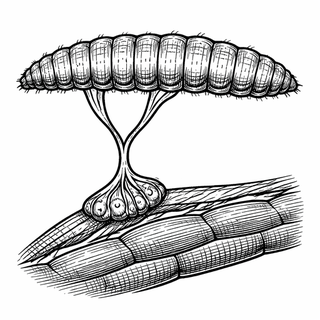
Mori and colleagues studied the Drosophila larval neuromuscular junction, one of neuroscience's favorite neat little garden beds because you can actually see what is growing there. They briefly restricted amino acids for 6 hours and found something unexpected: synaptic strength stayed normal, but only if the postsynaptic muscle could engage this stress pathway properly Mori et al., 2025.
That point matters. The shortage was not handled simply by the neuron tightening its belt. Instead, the muscle sensed the problem, activated GCN2, phosphorylated eIF2alpha, and somehow sent a retrograde signal back to the presynaptic side that preserved neurotransmitter release. If your brain were a company, this is the mailroom quietly saving the quarter while management is still booking a meeting about the crisis.
Even better, the pathway refused to follow the usual script. The canonical ISR often leans on ATF4, the famous stress-response transcription factor. Here, ATF4 was dispensable. The key downstream player was a translational target called Still life, or Sif, the fly ortholog of human TIAM1. So this was not a vague emergency slowdown. It was a more selective workaround that helped maintain synaptic output.
That is the sort of result older neuroscientists recognize with a weary smile. Every decade or so, biology reminds us that the "main pathway" is really just the version polite enough to fit on a slide.
Why this is more than fly trivia
At first glance, this may sound like a niche story about hungry fly larvae. But synapses everywhere face the same basic insult: how do you keep communication reliable when resources dip?
The broader literature is moving in exactly this direction. Recent work in Nature argues that the mammalian ISR is more plastic and context-dependent than the tidy diagrams suggested Chen et al., 2025. A 2025 Cell Metabolism paper tied serine deprivation to ISR-driven changes in stem-cell behavior and tissue repair Novak et al., 2025. And a 2025 Neuron study showed that presynaptic homeostatic plasticity uses shared trans-synaptic logic across peripheral and central synapses Chipman et al., 2025.
That makes this new paper interesting for two reasons. First, it suggests the ISR has synaptic jobs that are partly separable from its famous proteostasis chores. Second, it hints that targeting specific downstream effectors such as TIAM1-like mechanisms might someday be safer than walloping the whole ISR with a pharmacological frying pan. Reviews of ISR biology in metabolism and neurodegeneration keep making the same cautionary point: this pathway can protect cells in one setting and make a mess in another Ryoo, 2024, Bravo-Jimenez et al., 2025.
The weeds still in the bed
A few caveats deserve sunlight. This was an acute amino-acid restriction experiment in flies, not a proof that your lunch is directly negotiating with your synapses in real time. The exact retrograde message from muscle to neuron also remains unresolved.
Still, this is a lovely piece of work because it treats the synapse not as a fragile ornament but as a stubborn living system. When nutrients fall, it does not simply wilt. It trims, reroutes, and calls for help from the other side of the junction. The old lesson returns, as it often does in neuroscience: survival is not just about having enough parts. It is about knowing which branch to prune, which root to spare, and which signal to send before the whole garden sulks.
References
- Mori M, Kauwe G, Aly A, Liao EH, Scott G, Haghighi AP. A retrograde, non-canonical integrated stress response cascade maintains synaptic strength under amino acid deprivation. Cell Reports. 2025;44(11):116522. DOI: https://doi.org/10.1016/j.celrep.2025.116522. PMCID: https://pmc.ncbi.nlm.nih.gov/articles/PMC12710418/
- Ryoo HD. The integrated stress response in metabolic adaptation. Journal of Biological Chemistry. 2024;300(4):107151. DOI: https://doi.org/10.1016/j.jbc.2024.107151. PMCID: https://pmc.ncbi.nlm.nih.gov/articles/PMC10998230/
- Wek RC, Anthony TG, Staschke KA. Surviving and Adapting to Stress: Translational Control and the Integrated Stress Response. Antioxidants & Redox Signaling. 2023;39(4-6):351-373. DOI: https://doi.org/10.1089/ars.2022.0123. PMCID: https://pmc.ncbi.nlm.nih.gov/articles/PMC10443206/
- Chen CW, Papadopoli D, Szkop KJ, et al. Plasticity of the mammalian integrated stress response. Nature. 2025;641(8065):1319-1328. DOI: https://doi.org/10.1038/s41586-025-08794-6
- Novak JSS, Polak L, Baksh SC, et al. The integrated stress response fine-tunes stem cell fate decisions upon serine deprivation and tissue injury. Cell Metabolism. 2025. DOI: https://doi.org/10.1016/j.cmet.2025.05.010. PMCID: https://pmc.ncbi.nlm.nih.gov/articles/PMC12210826/
- Chipman PH, Lee U, Orr BO, Fetter RD, Davis GW. A unifying mechanism for presynaptic homeostatic plasticity at mammalian peripheral and central synapses. Neuron. 2025;113(18):2945-2961.e6. DOI: https://doi.org/10.1016/j.neuron.2025.05.030. PMCID: https://pmc.ncbi.nlm.nih.gov/articles/PMC12370254/
- Bravo-Jimenez MA, Sharma S, Karimi-Abdolrezaee S. The integrated stress response in neurodegenerative diseases. Molecular Neurodegeneration. 2025;20(1):20. DOI: https://doi.org/10.1186/s13024-025-00811-6. PMCID: https://pmc.ncbi.nlm.nih.gov/articles/PMC11837473/
Disclaimer: The image accompanying this article is for illustrative purposes only and does not depict actual experimental results, data, or biological mechanisms.