
If you Google AI tutors, you'll find two kinds of people yelling at each other through the internet. One camp thinks the robot professor is here to replace your favorite teacher with a polite autocomplete in a blazer. The other acts like every chatbot is a vending machine for wrong answers. Both miss the weirder possibility: maybe a short, structured conversation before learning does something important to your brain, whether the guide is human or AI.
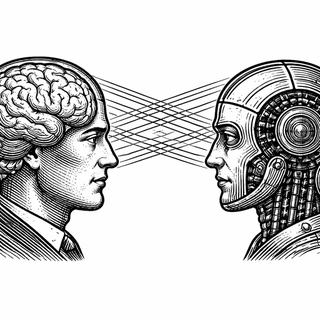
That is basically the premise of a new Neuron paper from Yingying Peng and colleagues, who asked a surprisingly specific question: can a brief one-on-one interaction before an online lecture help students learn better, and does it matter whether that interaction comes from a human instructor or an LLM-powered AI one? [1]
The Tiny Warm-Up That Wasn't Tiny
The setup was straightforward. Fifty-seven students were split into three groups: no pre-lecture interaction, a brief human-led interaction, or a brief AI-led one. Then they watched the same online lecture. Both interaction groups learned more than the no-interaction group. So apparently your brain, much like an old laptop, benefits from a proper startup sequence.
But the interesting part was not just the quiz scores. The researchers found stronger neural alignment during learning in students who had that short pre-lecture exchange. In plain English, their brain activity patterns looked more coordinated with the instructor and with one another. The study also found tighter gaze alignment - students were looking at more of the same things at more of the same moments. [1]
This fits a growing line of research suggesting that teaching is not just information transfer, like dragging a PDF from one skull to another. It is a social coordination problem. A 2024 npj Science of Learning study found that structured teacher-student interaction improved learning and increased interbrain synchrony, and a 2026 classroom study linked changes in student-teacher coupling to later academic improvement. [2,3]
Your Brain Likes a Good Hang Before Class
One reason this paper is interesting is where the alignment showed up. The authors point to regions including the default mode network, or DMN. This network has a misleadingly lazy-sounding name, like it spends all day in sweatpants eating kettle chips. In reality, the DMN helps build meaning, link new information to memory, and model other minds. A 2023 Neuron review described it as part of the machinery that helps create an "internal narrative" by integrating memory, language, and semantic knowledge. [4]
That matters because good teaching is not just pouring facts into a person like soup into a thermos. It is helping the learner build a workable mental model. A short interaction before the lecture may prime that machinery and provide a social frame for what comes next.
The AI Did Pretty Well, Which Is Annoying and Interesting
Here is the plot twist. The AI instructor produced learning gains similar to the human instructor. That is a big deal. One-on-one support is effective, but it is expensive and hard to scale online. If an AI system can supply part of that scaffolding at low cost, that could matter for students who currently get a video, a discussion board, and vibes.
But before anyone builds Robo-Oxford and calls it a day, there was a meaningful difference. Students reported less social closeness with the AI instructor, and their gaze alignment was lower than with the human instructor. So the AI may have matched the human on one outcome while still being worse at the subtle relational stuff.
A 2024 meta-analysis in Nature Human Behaviour reached a similar conclusion: human-AI combinations can beat either side alone, but only when the collaboration is designed well. [5] The best future may not be "humans versus AI." It may be "humans with AI, if we do not lose the social glue."
Why This Could Matter Outside the Scanner
If these findings replicate and generalize, the practical implications are substantial. Online education has always had a scaling problem: personalized interaction helps, but there are only so many hours in a human day. A brief AI-guided pre-lecture exchange could improve attention, comprehension, and retention before the main lesson even starts.
Still, there are obvious caveats. The study is relatively small. Similar learning gains do not mean human and AI teaching are psychologically equivalent. And anytime AI enters education, you inherit the usual concerns: hallucinated explanations, overreliance, privacy issues, and whether the student is learning or merely being supervised by a very articulate toaster.
What this paper adds is a sharper idea of why some support tools might work. Not because AI is magical. Not because humans are obsolete. Because learning is social, attention is fragile, and your brain seems to do better when someone - human or machine - helps line up the mental furniture before class.
References
- Peng Y, Nastase SA, Huang Y, Li Y, Guo Z, Li P. Scaffolding human and AI instruction: Neural alignment and learning gains in online education. Neuron. 2026. DOI: https://doi.org/10.1016/j.neuron.2026.04.005
- Li Q, Wang D, Xiao W, Tang Y, Sun Q, Sun B, Hu Z. Structured interaction between teacher and student in the flipped classroom enhances learning and interbrain synchrony. npj Science of Learning. 2024;9:73. DOI: https://doi.org/10.1038/s41539-024-00286-y
- Xu X, Zhang D, Zhang Y. Student teacher inter brain coupling forecast cross semester academic fluctuation in real world classrooms. npj Science of Learning. 2026. DOI: https://doi.org/10.1038/s41539-026-00421-x
- Menon V. 20 years of the default mode network: A review and synthesis. Neuron. 2023;111(16):2469-2487. DOI: https://doi.org/10.1016/j.neuron.2023.04.023
- Vaccaro M, Almaatouq A, Malone T. When combinations of humans and AI are useful: A systematic review and meta-analysis. Nature Human Behaviour. 2024;8(12):2293-2303. DOI: https://doi.org/10.1038/s41562-024-02024-1. PMCID: https://pmc.ncbi.nlm.nih.gov/articles/PMC11659167/
Disclaimer: The image accompanying this article is for illustrative purposes only and does not depict actual experimental results, data, or biological mechanisms.