
The researchers seem to have had one of those "hold on, run that again" moments. They were testing amyloid-beta peptides in human neurons, expecting the usual Alzheimer-adjacent menace, and instead found that some of these molecules were helping synapses form - right up until aggregation entered the chat and everything went delightfully terrible in the way only brain biology can manage [1].
That twist is the whole plot here. Amyloid-beta, or Aβ, is usually cast as the bad guy in Alzheimer's disease because aggregated forms of it show up in plaques and have long been tied to neuronal damage. But this new study argues that Aβ is less like a comic-book villain and more like a molecule with terrible crowd control. Relatively free Aβ may help neurons build synapses. Aggregated Aβ can damage them. Mathematics loves a phase transition, and apparently so does the brain.
A Molecule With Two Personalities
In the new paper, Alberto Siddu and colleagues chronically exposed human neurons to carefully defined synthetic Aβ40, Aβ42, and Arctic-mutant Aβ42 peptides, each with different tendencies to aggregate [1]. What they found was surprisingly crisp. Free Aβ40 at higher concentrations, and free Aβ42 at lower concentrations, promoted synapse formation. Aggregated Aβ42 and aggregated Arctic Aβ42, by contrast, damaged neurons and synapses.
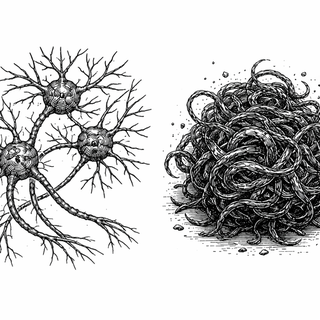
That matters because it helps explain why the Aβ story has felt so inconsistent for years. Researchers have argued over whether Aβ is inherently toxic, whether small soluble species are the real problem, or whether plaques are the issue. This study says the answer may be annoyingly elegant: aggregation state changes function.
The first visible sign of trouble was not instant neuronal doom. It was a contraction of the presynaptic vesicle cluster, followed later by synapse loss [1]. In plain English, the machinery neurons use to send messages got squeezed before the whole connection fell apart. Your neurons were not exploding. They were losing the ability to text each other normally.
Why This Is More Interesting Than "Amyloid Bad"
One big reason this paper is interesting is that it rescues a possibility the field has been circling: Aβ may do something useful in a healthy brain. Review articles over the past few years have argued that amyloid biology is more nuanced than the old all-bad cartoon. Aβ sits inside a broader pathway involving production, clearance, and multiple physical forms, and those forms may have very different effects on synaptic plasticity and disease progression [2-4].
That helps this paper land with more force. If free Aβ can support synapse organization under some conditions, then therapies that simply bulldoze every trace of Aβ might be a bit like fixing a noisy apartment by removing the plumbing. Sure, the banging stops. Other problems arrive immediately.
The authors make that provocative move: instead of trying to suppress all Aβ peptides, maybe therapies should shift the balance away from aggregated forms and toward free ones [1]. That idea also fits with the treatment landscape, where anti-amyloid therapies can matter clinically but come with modest effects, safety concerns, and lingering uncertainty about which Aβ forms are the best targets [4,5].
The Bigger Alzheimer Puzzle
This paper does not solve Alzheimer's disease. Nothing this side of a deity with a pipette does. But it sharpens one piece of the puzzle: synapse failure may start as a state problem before it becomes obvious cell death.
That has real-world implications. Synapse loss tracks cognitive decline in Alzheimer's better than plaques alone, and interventions that preserve synaptic function might matter even before widespread neuronal loss shows up [3]. If aggregation is the switch that flips Aβ from synapse-friendly to synapse-hostile, then the practical target is not just "less amyloid." It is "less of the wrong kind, in the wrong configuration, at the wrong time." Biology, as usual, refuses to use a simple checkbox when a multidimensional topology problem will do.
There is also a broader lesson here. The same peptide can sit on a narrow boundary between normal physiology and pathology. Alzheimer's research may need fewer hero-versus-villain arguments, and more thinking about thresholds and unstable equilibria. Very on-brand for a disease that has spent decades making smart people sound like they are trying to debug fog.
If these findings hold up and extend into animal models and human disease, they could push drug development toward stabilization strategies, anti-aggregation approaches, or treatments tuned to specific Aβ species instead of indiscriminate suppression. That is the difference between treating every node in a network as broken and noticing that the network may just be tipping past a bad critical point.
For a peptide with such a grim reputation, Aβ may turn out to be less a villain than a molecule with catastrophic taste in group projects.
References
- Siddu A, Natale S, Wong CH, Shaye H, Südhof TC. Aggregation shifts amyloid-β peptides from synaptogenic to synaptotoxic. J Clin Invest. 2025;135(24):e193407. DOI: https://doi.org/10.1172/JCI193407
- Hampel H, Hardy J, Blennow K, et al. The Amyloid-β Pathway in Alzheimer's Disease. Nat Rev Neurol. 2021;17(11):699-722. DOI: https://doi.org/10.1038/s41582-021-00533-z
- Kepp KP, Robakis NK, Høilund-Carlsen PF, Sensi SL, Vissel B. The amyloid cascade hypothesis: an updated critical review. Brain. 2023;146(10):3969-3990. DOI: https://doi.org/10.1093/brain/awad159
- Zhang Y, Chen H, Li R, Sterling K, Song W. Amyloid β-based therapy for Alzheimer's disease: challenges, successes and future. Transl Neurodegener. 2023;12(1):36. DOI: https://doi.org/10.1186/s40035-023-00366-z
- Rafii MS, Aisen PS. Amyloid-lowering immunotherapies for Alzheimer disease: current status and future directions. Nat Rev Neurol. 2025;21(9):490-498. DOI: https://doi.org/10.1038/s41582-025-01123-5
Disclaimer: The image accompanying this article is for illustrative purposes only and does not depict actual experimental results, data, or biological mechanisms.