
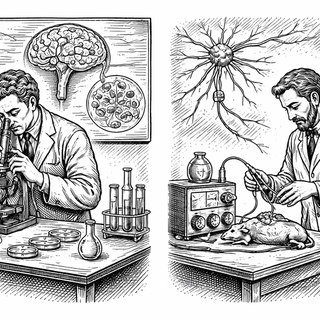
One scientist is peering at brain-tumor cells on a dish while another is zapping nearby neurons, which is a fairly bold way to spend a workday unless your job description includes "prove cancer has been eavesdropping on the nervous system." That slightly absurd lab scene captures the point of Michelle Monje and Frank Winkler's 2025 Nature Cancer comment: cancer neuroscience has moved from intriguing side corridor to a real wing of the building [1].
The Floor Plan Got Weird
For a long time, cancer biology was drawn like a sealed room. You had tumor cells, mutations, immune cells, blood vessels, maybe a bit of biochemical chaos in the drywall. The nervous system was often treated like building services in the basement - present, important, but not really part of the drama upstairs.
Cancer neuroscience blows a hole in that wall.
The field asks a deceptively simple question: what if nerves are not passive bystanders, but active tenants, contractors, and occasionally terrible landlords? Across brain tumors and peripheral cancers, researchers now have evidence that neurons and cancer cells can exchange signals that help tumors grow, adapt to stress, spread, and reshape the surrounding tissue [2-5]. This is less "a lump of bad cells doing bad things" and more "an ugly renovation project with terrible oversight."
That shift is what Monje and Winkler are marking in their paper. It is not a single experiment. It is a status report from the front lines saying, basically, the weirdos were right.
Tumors Are Not Just Growing - They Are Plugging In
One of the biggest ideas in this field is that some cancers do not merely sit next to nerves. They interact with them. In gliomas, for example, work over the last several years has shown that neuronal activity can drive tumor growth, and tumor cells can form synapse-like connections with neurons [2,3]. Which is rude, frankly. Your neurons are supposed to handle thought, memory, and the occasional regrettable text message, not moonlight as growth support for cancer.
Outside the brain, the story also gets busy. Peripheral nerves can infiltrate tumors, release neurotransmitters, and alter the tumor microenvironment in ways that support proliferation, invasion, immune escape, or treatment resistance [4,5]. In other words, the wiring is not just near the room. It is part of the room.
That matters because once you accept that tumors may be electrically and chemically networked into their environment, you stop asking only, "Which mutations are present?" and start asking, "Who is talking to whom, and how do we cut the line without taking down the whole building?"
Why This Is Such a Big Deal
The exciting part is not just that the biology is elegant. It is that it creates new therapeutic angles.
If neural activity helps feed certain cancers, maybe you can block the receptors, neurotransmitters, synapses, or circuit-level signals involved [3-5]. If nerves shape immune behavior inside tumors, maybe cancer therapy starts borrowing more shamelessly from neurobiology and immunology at the same time [5]. If symptoms like pain, seizures, wasting, or cognitive changes are part of tumor-brain-body communication rather than background noise, then those symptoms might also become clues and treatment targets.
This is where the architecture metaphor earns its keep. Classical oncology often focuses on the defective bricks. Cancer neuroscience says the electrical system, ventilation, traffic flow, and emergency alarms may also be helping the fire spread. You can see why people in the field are suddenly talking faster.
The Catch, Because Biology Never Misses a Chance to Be Complicated
Before anyone starts imagining a tidy anti-cancer dimmer switch, there are real problems.
First, these interactions vary by tumor type, location, disease stage, and nerve subtype. "Nerves affect cancer" is true in the same annoying way that "weather affects buildings" is true. Yes, but which weather, which building, and are we discussing a light drizzle or a full structural tantrum? Second, the nervous system is not optional equipment. Therapies that disrupt neural signaling need to avoid wrecking normal sensation, cognition, gut function, or autonomic control [4,5]. Third, many of the cleanest findings still come from preclinical models, so the translational bridge remains under active construction [2,4].
Monje and Winkler's point is that 2025 looks like a milestone because the field now has enough conceptual weight, mechanistic depth, and clinical ambition to count as established rather than merely fashionable [1]. That sounds bureaucratic, but it is actually important. Once a field feels real, it gets better tools, better trial design, better collaboration, and fewer raised eyebrows from people who previously acted as if tumor-neuron crosstalk was a niche hobby.
The Real-World Version
If this line of research keeps holding up, the practical payoff could be substantial: smarter brain-tumor therapies, better ways to limit metastasis or treatment resistance, and more precise management of neurologic symptoms that make cancer feel like an assault on the whole person rather than one organ system [2-5].
That is the deeper intrigue here. Cancer neuroscience is not just adding one more pathway to an already chaotic map. It is changing the map's legend. The nervous system is no longer scenery. It is infrastructure. And once you realize the tumor has been leaning on the wiring all along, the whole building starts to look different.
References
- Monje M, Winkler F. Key developments in the cancer neuroscience field. Nature Cancer. 2025;6:1928-1929. doi:10.1038/s43018-025-01082-2
- Winkler F, Venkatesh HS, Amit M, et al. Cancer neuroscience: state of the field, emerging directions. Cell. 2023;186(8):1689-1707. doi:10.1016/j.cell.2023.02.002. PMCID:PMC10107403
- Monje M, Borniger JC, D'Silva NJ, et al. The neuroscience of cancer. Nature. 2023;618:467-479. doi:10.1038/s41586-023-05968-y
- Yaniv D, Mattson B, Talbot S, et al. Targeting the peripheral neural-tumour microenvironment for cancer therapy. Nature Reviews Drug Discovery. 2024;23:780-796. doi:10.1038/s41573-024-01017-z. PMCID:PMC12123372
- Amit M, Eichwald T, Roger A, et al. Neuro-immune cross-talk in cancer. Nature Reviews Cancer. 2025;25:573-589. doi:10.1038/s41568-025-00831-w
- Shi DD, Guo JA, Hoffman HI, et al. Therapeutic avenues for cancer neuroscience: translational frontiers and clinical opportunities. Lancet Oncology. 2022;23(2):e62-e74. doi:10.1016/S1470-2045(21)00596-9
Disclaimer: The image accompanying this article is for illustrative purposes only and does not depict actual experimental results, data, or biological mechanisms.