
In five years, this discovery might mean we stop treating some neurodevelopmental disorders like vague cosmic bad luck and start tracing them to a very specific piece of cellular plumbing. That sounds reassuring until you remember the plumbing in question sits inside mitochondria, which are already the most overworked organelles in biology.
The new paper by Berezhnaya and colleagues zeroes in on MICU2, a regulator of the mitochondrial calcium uniporter - basically part of the gate that decides when calcium gets waved into the mitochondria and when it gets told to take a hike.[1] Calcium is not just bone dust and milk propaganda. In neurons, it helps run signaling, energy use, growth, and timing. Too little in the wrong place is a problem. Too much in the wrong place is also a problem. Biology loves that kind of management style.
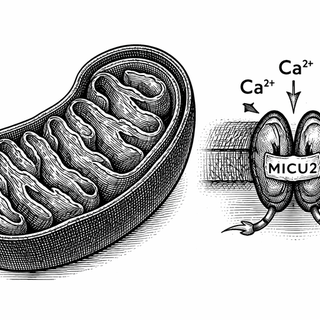
The Mitochondria Are Not Just Batteries
You have probably heard mitochondria called the "powerhouse of the cell." Fine. True. Also incomplete. They are more like power plants with a control board and at least one pipe that can flood the basement if nobody watches the valve. Recent reviews show that mitochondria do not just react to calcium - they shape calcium signals across the cell.[2,3]
That matters in the developing brain, where neurons are still figuring out where to go and when to mature. Neuronal migration is the process where immature neurons travel to their assigned spots in the cortex. It is less "graceful ballet" and more "construction crew trying to move ladders through a hallway during a fire drill." If timing or positioning goes wrong, brain circuits can come out weirdly wired.
So What Did This Study Find?
The short version: MICU2 seems to matter a lot in the developing brain, and then mostly clock out in adulthood.[1]
The authors found that MICU2 is present in the developing mouse cortex but fades as the brain matures. Meanwhile, another regulator, MICU3, rises later on. That suggests the mitochondrial calcium gatekeeping system gets rebuilt during development - same building, different foreman.
Then they removed MICU2. Oddly, the neurons did not show a big change in ordinary cytoplasmic calcium signals. The weirdness stayed more confined to the mitochondria, where calcium in the matrix rose more than it should. That pushed developing cortical neurons into overmigration - they traveled too far. Young adult mice also showed anxiety-like effects at 2 months that were no longer obvious by 12 months.[1]
That is the part I like. Not because anxious mice are funny. They are not. But because the paper avoids fake simplicity. It does not claim one protein "causes behavior" like a clickbait headline wearing safety goggles. It shows a tighter chain: change mitochondrial calcium handling during development, alter migration, then see behavioral consequences later.
Why This Is Bigger Than One Protein
This paper plugs into a broader shift in neuroscience. Mitochondria are increasingly looking like timing devices for brain development, not just fuel tanks parked in the background. A 2024 review argued that mitochondrial metabolism helps set the pace of cortical neuron maturation across species.[4] A 2026 review in Nature Reviews Neuroscience tied mitochondrial dynamics to neurodevelopmental disorders more broadly.[5]
There is also a growing map of the mitochondrial calcium uniporter network itself. A 2024 EMBO Journal paper charted interaction networks around the MCU complex, which matters because these systems are not one-gene fairy tales.[6] They are protein committees. And, as with all committees, the trouble usually starts when one member leaves and everyone else keeps pretending the meeting is still under control.
The human angle matters too. MICU2 loss was already linked to a severe neurodevelopmental disorder in patients years ago, but this new work gives that observation a much sharper developmental explanation.[7]
The Useful Kind of Bad News
No, this does not mean there is a MICU2 pill around the corner. We are nowhere near that. The current conversation around mitochondrial calcium points to a broader therapeutic idea: if scientists can modulate how mitochondria handle calcium, they may be able to protect neurons or improve their energy balance in disorders ranging from developmental disease to neurodegeneration.[2,8] That is promising, but promising is science for "please do not make me predict a launch date."
Still, this study solves an annoying mystery. If MICU2 is barely around in the adult brain, why do patients missing it have brain problems? Answer: because adulthood may be the wrong place to look. The real damage may happen during development, when the mitochondrial gatekeeping system is built differently and neurons are still on the move.
That is not a glamorous finding. It is better. It is specific. And in neuroscience, specific beats grandiose every time.
References
- Berezhnaya E, Cartes-Saavedra B, Singh R, Rodríguez-Prados M, Reiner O, Alkuraya FS, Hajnóczky G. MICU2 controls mitochondrial calcium signaling and migration in neurons during development. Cell Reports. 2025;44(12):116583. DOI: https://doi.org/10.1016/j.celrep.2025.116583. PubMed: https://pubmed.ncbi.nlm.nih.gov/41273721/
- Cartes-Saavedra B, Ghosh A, Hajnóczky G. The roles of mitochondria in global and local intracellular calcium signalling. Nature Reviews Molecular Cell Biology. 2025;26:456-475. DOI: https://doi.org/10.1038/s41580-024-00820-1
- Garbincius JF, Elrod JW. Mitochondrial calcium exchange in physiology and disease. Physiological Reviews. 2022;102(2):893-992. DOI: https://doi.org/10.1152/physrev.00041.2020. PMCID: https://pmc.ncbi.nlm.nih.gov/articles/PMC8816638/
- Casimir P, Iwata R, Vanderhaeghen P. Linking mitochondria metabolism, developmental timing, and human brain evolution. Current Opinion in Genetics & Development. 2024;86:102182. DOI: https://doi.org/10.1016/j.gde.2024.102182. PMCID: https://pmc.ncbi.nlm.nih.gov/articles/PMC11190843/
- Sirois CL, Lee J, Chambers AL, et al. Mitochondrial dynamics in neurodevelopment and neurodevelopmental disorders. Nature Reviews Neuroscience. 2026;27:307-326. DOI: https://doi.org/10.1038/s41583-026-01031-7
- Delgado de la Herran H, Vecellio Reane D, Cheng Y, et al. Systematic mapping of mitochondrial calcium uniporter channel (MCUC)-mediated calcium signaling networks. The EMBO Journal. 2024;43:5288-5326. DOI: https://doi.org/10.1038/s44318-024-00219-w. PMCID: https://pmc.ncbi.nlm.nih.gov/articles/PMC11535509/
- Shamseldin HE, Alasmari A, Salih MA, et al. A null mutation in MICU2 causes abnormal mitochondrial calcium homeostasis and a severe neurodevelopmental disorder. Brain. 2017;140(11):2806-2813. DOI: https://doi.org/10.1093/brain/awx237. PubMed: https://pubmed.ncbi.nlm.nih.gov/29053821/
- Marti Pastor A, Tai Y-H, Misgeld T. Fuelling the brain with calcium. Nature Metabolism. 2026;8:293-294. DOI: https://doi.org/10.1038/s42255-025-01448-x
Disclaimer: The image accompanying this article is for illustrative purposes only and does not depict actual experimental results, data, or biological mechanisms.