
Late spring evenings do something funny to your sense of time. Dinner stretches, the light hangs around like it forgot to leave, and your brain quietly retunes itself to the longer day. That is a handy way into this paper, because it is about keeping messy signals organized when the world refuses to behave. I am writing this while eating buttered toast, which feels right because the study is about reducing chaos into something usable.
The Problem: Wearables Are Messy Little Gremlins
Wearable sensors sound clean in theory. Strap on a watch, collect motion or pulse data, let the algorithm do its thing, and enjoy the future. In real life, wearable data are more like a kitchen after brunch service. There is noise, uneven timing, weird angles, and people moving in ways no benchmark dataset saw coming.
Hong and colleagues tackle that mess with two ideas that normally live in different neighborhoods. First, topological data analysis, or TDA, looks at the shape of data rather than every jittery point. Second, knowledge distillation shrinks a big model into a smaller one that can run on modest hardware.
Topology: Stop Counting Crumbs, Taste the Broth
TDA is useful here because it tries to capture stable structure in noisy signals. Instead of getting distracted by every tiny wiggle in a time series, it asks what patterns persist across scales. In this paper, those patterns become persistence images, compact summaries that tend to survive noise better than raw measurements do. Think of it as skimming the foam off a stock and keeping the deep flavor underneath.
That matters because wearable data are notoriously finicky. Recent work keeps making the same point: wearables can support remote monitoring and large-scale health studies, but the models behind them still struggle with variability across people, noisy signals, and limited labeled data [2,4,5]. If you want a model that works outside a lab, robustness is the rent.
The Brain-Inspired Twist
Here is the part that earns this post its neuroscience badge. The authors borrow from global workspace theory, a cognitive neuroscience idea that the brain integrates information from different systems through a shared workspace, with attention and working memory deciding what gets broadcast. If your cortex were a restaurant, this workspace would be the expediter at the pass.
Why borrow that idea for machine learning? Because standard multi-teacher knowledge distillation has a very human problem: too many experts talking at once. One teacher may encode one kind of signal well, another may specialize in a different representation, and their internal features do not line up neatly.
Hong and colleagues propose a multimodal global latent workspace-based knowledge distillation framework, or mGLW-KD. It uses a working-memory-like module to pull information from multiple teacher models into a shared latent space before handing it to the smaller student model. The goal is to help the student learn what matters, in a common language, without forcing it to run expensive topological computations during inference [1].
Why This Is Interesting Beyond the Acronym Jungle
The immediate payoff is practical. If this approach holds up across broader datasets and real deployments, it could help small wearable devices get some of the robustness benefits of TDA without paying the full computational bill every time they make a prediction. That means less battery drain, less latency, more privacy, and fewer trips to the cloud.
Wearables live inside a stubborn tradeoff: people want useful health insight, but they do not love shipping a firehose of intimate body data somewhere mysterious for algorithmic soup-making [4,5]. On-device or near-device intelligence is also a trust issue.
This paper also fits a broader trend in AI for wearables. The field is moving toward models that are both smarter and smaller, often by letting larger systems teach leaner ones [3,6]. This study adds a sharper trick by asking: what if the student learns not just from raw modalities, but from the durable shape information hidden inside them?
The Catch, Because There Is Always a Catch
No, this does not mean your smartwatch has become a tiny philosopher of geometry. The paper is still about model performance under experimental conditions, not a magic warranty for all real-world wearables. The topological features still need to be computed for teacher training, and the approach still needs testing across devices, populations, and uglier real-world tasks.
Still, the core idea is good: let heavyweight models do the expensive thinking up front, fuse what they know in a shared workspace, and hand a slimmer model the concentrated reduction instead of the whole pantry. In cooking terms, that is less raw prep and more finished sauce. In brain terms, sometimes the clever move is not collecting more chatter. It is building a better room for the chatter to become meaning.
References
- Hong J, Jeon ES, Buman MP, Turaga P, Pavlic TP. Improved Knowledge Distillation Based on Global Latent Workspace With Multimodal Knowledge Fusion for Understanding Topological Guidance on Wearable Sensor Data. IEEE Transactions on Neural Networks and Learning Systems. 2025. DOI: https://doi.org/10.1109/TNNLS.2025.3640274
- Su Z, Liu X, Bou Hamdan L, Maroulas V, Wu J, Wei GW. Topological data analysis and topological deep learning beyond persistent homology: a review. Artificial Intelligence Review. 2026. DOI: https://doi.org/10.1007/s10462-025-11462-w PMCID: https://pmc.ncbi.nlm.nih.gov/articles/PMC12931839/
- Xiao Z, Xing H, Qu R, Li H, Cheng X, Xu L, et al. Heterogeneous Mutual Knowledge Distillation for Wearable Human Activity Recognition. IEEE Transactions on Neural Networks and Learning Systems. 2025;36(9):16589-16603. DOI: https://doi.org/10.1109/TNNLS.2025.3556317
- Cherian J, Mascia G, Kairamkonda D, Fisher A, McGinnis RS, Ray TR. Wearable Sensing for Clinical Physiology Monitoring: Emerging Paradigms. Physiology (Bethesda). 2026;41(4). DOI: https://doi.org/10.1152/physiol.00039.2024
- Zhao M, Liu R, Jin S, Ren B, Zhang Q. From data to diagnosis: A comprehensive review of machine learning-driven wearable sensors in healthcare. Bioelectrochemistry. 2026;170:109228. DOI: https://doi.org/10.1016/j.bioelechem.2026.109228
- Kasnesis P, Toumanidis L, Pagliari DJ, Burrello A. Replacing Attention With Modality-Wise Convolution for Energy-Efficient PPG-Based Heart Rate Estimation Using Knowledge Distillation. IEEE Journal of Biomedical and Health Informatics. 2026;30(1):339-352. DOI: https://doi.org/10.1109/JBHI.2025.3580474
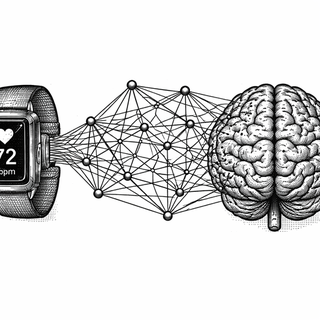
Disclaimer: The image accompanying this article is for illustrative purposes only and does not depict actual experimental results, data, or biological mechanisms.