
Sorry to be the one to tell you this, but your brain has been checking the seasonal menu this whole time. It is not just a gray blob doing spreadsheets in your skull. It is more like a moody kitchen that changes the recipe when the days get short. Terrible joke, I know. But that is basically what a new paper on meadow voles found: winter-style light schedules seem to change how dopamine gets released in the brain, which may help explain why these little rodents become more social when daylight shrinks.[^1]
Tiny Rodents, Big Seasonal Drama
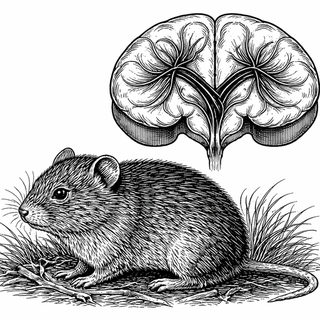
Meadow voles are not random furry extras. They are a useful species because their social behavior shifts with photoperiod, which is the length of day versus night. In longer, summer-like days they tend to be less cuddly and more territorial. In shorter, winter-like days they become more tolerant and social. If your friend group also reorganizes itself when it gets cold and everyone suddenly wants soup and blankets, congratulations, you have something in common with a vole.
That seasonal switch makes meadow voles handy for studying a question neuroscientists love to overcomplicate: how does the environment tune social behavior through brain chemistry?
Dopamine, But Not the Cartoon Version
Dopamine gets treated online like the brain's "yay button," which is a bit like calling a stove "the hot square." Technically true, wildly incomplete. Dopamine helps shape motivation, learning, effort, reward, and how animals respond to things that matter.[^2][^3] It is less a single feeling and more a fast-moving ingredient that changes how the whole dish comes together.
The clever part of this new study is the tool. The researchers used near-infrared catecholamine nanosensors, or nIRCats, which are tiny synthetic sensors that light up when they detect dopamine-like signals.[^1][^4] That matters because meadow voles are not standard lab mice with every genetic trick in the catalog. So instead of saying, "Sorry, no fancy tools, science cancelled," the team brought in a sensor that works in a non-genetic system. Plot twist: the weird nanotube gadget is the hero.
What the Researchers Actually Found
The headline result is simple. Voles housed in short photoperiods, the winter-ish setup, showed stronger dopamine release and more dopamine release sites than voles in long photoperiods.[^1] In other words, the socially friendlier voles also seemed to have a more responsive dopamine setup.
The team then pushed the system a little. When they used manipulations that usually boost dopamine, short-photoperiod voles showed bigger responses. When they used conditions that should suppress dopamine signaling, those same voles were more resilient.[^1] So this was not just a tiny blip on a graph. It suggests the whole dopamine "simmer setting" had shifted.
That is interesting because it connects a plain old environmental cue, day length, to a chemical system deeply involved in social reward and motivated behavior. Other recent work in voles has shown that social bonds and peer relationships rely on overlapping reward circuits, including the nucleus accumbens and dopamine-linked pathways.[^5][^6] A 2024 study in mice also found that photoperiod can alter nucleus accumbens dopamine dynamics, which makes the new vole paper feel less like an isolated oddball and more like part of a pattern.[^7]
Why This Is More Than "Cute Animal, Weird Season"
This paper matters for two reasons.
First, it expands neuroscience beyond the usual suspects. Lab mice and rats are useful, but they do not cover the full buffet of social behavior found in nature. Meadow voles do something seasonally dramatic, and that gives researchers a natural experiment for asking how brains adapt to changing worlds.
Second, it shows that social behavior is not just "in the genes" or "in the moment." It can be tuned by the environment in a slow-cooker kind of way. Light schedules reshape physiology, and physiology reshapes what social life feels like to the animal. Your brain is not a static machine. It is more like leftovers that somehow taste different the next day, and neuroscience is still arguing over the seasoning.
So, Does This Help Humans?
Not directly, not yet, and this is where the paper stays honest. These were meadow voles, not humans, and the study does not prove that seasonal changes in human sociability run on the same mechanism. It also does not show that "more dopamine" automatically causes better social behavior in some universal sense, because dopamine is a control freak and context matters.
But if these findings hold up and get extended, they point toward a useful idea: brains may adapt to seasonal conditions partly by retuning neuromodulators like dopamine. That could help researchers think more clearly about seasonal shifts in motivation, social behavior, and maybe even why light-related biology has such broad effects on mood and cognition. Current human-facing work in circadian and light biology is already asking how light timing shapes cognition and mental health, so this vole work slots neatly into a bigger conversation, even if it is still several steps away from the clinic.[^8]
So yes, scientists spent time watching dopamine in vole brains under different day lengths. As one does. And they found that winter-social voles seem to run a richer batch of dopamine soup. Bad cooking metaphor? Absolutely. Useful science? Also yes.
References
[^1]: Mun J, Power KC, Komatsu N, Tomatz SA, Beery AK, Landry MP. Neurochemical imaging reveals changes in dopamine dynamics with photoperiod in a seasonally social vole species. Proc Natl Acad Sci U S A. 2026;123(4):e2509561123. DOI: https://doi.org/10.1073/pnas.2509561123. PMID: https://pubmed.ncbi.nlm.nih.gov/41576082/
[^2]: Salamone JD, Correa M. The neurobiology of activational aspects of motivation: exertion of effort, effort-based decision making, and the role of dopamine. Annu Rev Psychol. 2024;75:1-32. DOI: https://doi.org/10.1146/annurev-psych-020223-012208. PMID: https://pubmed.ncbi.nlm.nih.gov/37788571/
[^3]: Holly EN, Galanaugh J, Fuccillo MV. Local regulation of striatal dopamine: a diversity of circuit mechanisms for a diversity of behavioral functions? Curr Opin Neurobiol. 2024;85:102839. DOI: https://doi.org/10.1016/j.conb.2024.102839. PMCID: https://pmc.ncbi.nlm.nih.gov/articles/PMC11066854/
[^4]: Yang SJ, Del Bonis-O'Donnell JT, Vanepps JS, et al. Near-infrared catecholamine nanosensors for high spatiotemporal dopamine imaging. Nat Protoc. 2021;16(6):3026-3048. DOI: https://doi.org/10.1038/s41596-021-00530-4. PMCID: https://pmc.ncbi.nlm.nih.gov/articles/PMC10505477/
[^5]: Gustison ML, Munoz-Castaneda R, Osten P, Phelps SM. Sexual coordination in a whole-brain map of prairie vole pair bonding. eLife. 2024;12:RP87029. DOI: https://doi.org/10.7554/eLife.87029. PMID: https://pubmed.ncbi.nlm.nih.gov/37546974/
[^6]: Black AM, Komatsu N, Zhao J, et al. Oxytocin receptors mediate social selectivity in prairie vole peer relationships. Curr Biol. 2025;35(17):4178-4187.e5. DOI: https://doi.org/10.1016/j.cub.2025.07.042. PMCID: https://pmc.ncbi.nlm.nih.gov/articles/PMC12707787/
[^7]: Kassaye BB, Jameson AN, Moore K, McMahon DG, Grueter BA. Identification of photoperiod as a regulator of dopamine-mediated behavior in female mice. Neurobiology of Sleep and Circadian Rhythms. 2025;100135. DOI: https://doi.org/10.1016/j.nbscr.2025.100135. PMID: https://pubmed.ncbi.nlm.nih.gov/41362598/
[^8]: Walch O, Tavella F, Zeitzer JM, Lok R. Beyond phase shifting: targeting circadian amplitude for light interventions in humans. Sleep. 2025;48(1):zsae247. DOI: https://doi.org/10.1093/sleep/zsae247. PMID: https://pubmed.ncbi.nlm.nih.gov/39435852/
Disclaimer: The image accompanying this article is for illustrative purposes only and does not depict actual experimental results, data, or biological mechanisms.