
You used to think memory worked like a decent filing cabinet - label the folder, shove in the facts, move on with your life. But then the hippocampus shows up like that one coworker who insists the meeting notes are useless unless you also remember who rolled their eyes, where everyone was sitting, and whether snacks were involved.
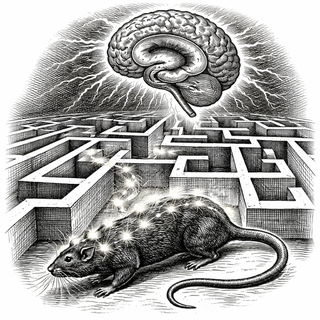
That is basically the setup of a 2025 Cell Reports paper from Gergely Tarcsay and colleagues. They looked at how rats' hippocampal neurons behaved during a memory task where context was either essential or basically decorative wallpaper. The punchline: when context mattered for solving the task, the hippocampus leaned in harder and remapped more strongly - especially in place cells near reward spots (Tarcsay et al., 2025).
Not All Memories Need the Full Director's Cut
The hippocampus helps you keep similar experiences from smearing into one giant mental smoothie. Sometimes your brain needs to say, "This is a different situation, pay attention." Other times it needs to say, "Relax, this is close enough."
Place cells are the famous little mapmakers of the hippocampus. They fire when an animal is in a particular location, then sometimes "remap," meaning the same route can get a different neural signature when the context changes. Recent reviews argue that remapping is one of the brain's main tricks for representing different situations, not just different coordinates on a floor plan (Fenton, 2024).
The Brain's Bouncer Checks the Dress Code
In this new study, the researchers recorded calcium activity from CA1 neurons while rats performed a discrimination/generalization task. The clever bit was that they changed whether paying attention to context was necessary. When the rats had to care about context to get the answer right, the neural code for context got sharper. Decoding context from the population worked better. Place cells remapped more. Reward-adjacent place fields showed the biggest shifts. In other words, the hippocampus did not just passively notice context - it cranked up the signal when context was behaviorally relevant (Tarcsay et al., 2025).
That matters because it suggests the hippocampus is not a bored court stenographer transcribing everything equally. It is more like a bouncer deciding who gets into the velvet-rope version of memory. If context is mission-critical, in you go. If not, the brain may keep things more generalized so you do not waste bandwidth distinguishing every mildly different hallway or awkward family dinner.
There was also a nice nuance here. Not every neuron type cared about context relevance in the same way. Non-place cells and directionally tuned cells still carried contextual information, but they did not ramp it up just because the task demanded it. The big adjustment seemed to come mainly through place-cell-based spatial coding. The hippocampus is not one guy with one clipboard. It is a whole committee, and some members are clearly bigger control freaks than others.
Why This Is More Than Rodents Running Around for Science
This kind of work plugs into a much larger question: how does the brain decide when to separate memories and when to blend them? In PTSD, people can overgeneralize fear to safe contexts. In aging and dementia, memory discrimination can get sloppy. In everyday life, you need enough specificity to remember where you parked today, but enough generalization to recognize that every grocery store is not a brand-new psychological thriller.
Recent work supports that bigger picture. A 2023 review on hippocampal "splitter" signals frames these context-sensitive codes as part of how the brain infers latent states over time, not just location in space (Sanders et al., 2023). Another 2023 study found that remapping grows when an aversive experience is actually remembered, not merely experienced, tying map changes to memory storage itself (Blair et al., 2023). A 2023 PNAS paper also showed that CA1 cells have stable tendencies in how active they are across time and context, suggesting the hippocampal cast has recurring roles even when the script shifts (Hayashi et al., 2023).
So the real excitement here is not "rats had place cells," because yes, thank you, we have been on that ride. The exciting part is that the hippocampus seems to tune the strength of context coding based on what the moment demands. Your brain is not just building a map. It is deciding how picky that map needs to be.
That is a big deal if we want to understand memory failures that involve too much blending, too much separation, or both. It also nudges us toward a less cartoonish view of memory. Memories are not frozen screenshots. They are more like theme park rides your brain keeps redesigning while insisting this is all perfectly organized.
References
- Tarcsay G, Masala N, Yi JD, Igarashi MK, Redic UJ, Ewell LA. The relevance of context in memory tasks influences the magnitude of hippocampal remapping. Cell Reports. 2025;44(12):116682. DOI: https://doi.org/10.1016/j.celrep.2025.116682
- Fenton AA. Remapping revisited: how the hippocampus represents different spaces. Nature Reviews Neuroscience. 2024;25:428-448. DOI: https://doi.org/10.1038/s41583-024-00817-x
- Sanders H, Low IIC, Williams AH. Temporal context and latent state inference in the hippocampal splitter signal. eLife. 2023;12:e82357. DOI: https://doi.org/10.7554/eLife.82357
- Blair GJ, Guo C, Wang S, Fanselow MS, Golshani P, Aharoni D, Blair HT. Hippocampal place cell remapping occurs with memory storage of aversive experiences. eLife. 2023;12:e80661. DOI: https://doi.org/10.7554/eLife.80661 PMCID: https://pmc.ncbi.nlm.nih.gov/articles/PMC10368421/
- Hayashi Y, Kobayakawa K, Kobayakawa R. The temporal and contextual stability of activity levels in hippocampal CA1 cells. Proceedings of the National Academy of Sciences of the United States of America. 2023;120(17):e2221141120. DOI: https://doi.org/10.1073/pnas.2221141120 PMCID: https://pmc.ncbi.nlm.nih.gov/articles/PMC10151562/
Disclaimer: The image accompanying this article is for illustrative purposes only and does not depict actual experimental results, data, or biological mechanisms.