
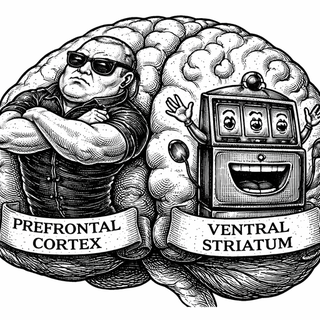
Head to the very front of the brain, right behind the forehead, and you land in the prefrontal cortex - the neighborhood that handles planning, braking, filtering, and the deeply unglamorous job of telling you not to do the dumb thing again. Now swing down into the reward circuitry, where the ventral striatum perks up for novelty, feedback, and shiny little payoffs. Put those systems in a still-developing teenage brain, add ADHD, then toss in an app designed to hand out surprise rewards like a casino run by Pixar interns, and you can see why this gets messy fast.
That is the basic story behind a recent Nature feature on why teens with ADHD can be especially vulnerable to social media's downsides.[1] The piece is not a single lab study with one dramatic brain scan and triumphant movie trailer music. It is more of a guided tour through a growing pile of evidence: ADHD often involves weaker executive control, adolescence is a period of extra-intense social sensitivity, and social platforms are built around exactly the kinds of rapid cues, emotional feedback, and endless novelty that make self-regulation harder.
The Brain's Bouncer Is Still on Break
One reason this matters is developmental timing. Adolescence is not just childhood with acne and stronger opinions about hoodies. It is a period when the brain becomes especially tuned to peers, status, feedback, and belonging.[2] That is useful for normal social development. It is less useful when the social environment also includes autoplay, push alerts, likes, streaks, and an algorithm that seems to know when you are trying to do homework.
For teens with ADHD, the problem is not simply "too much screen time." That phrase is so blunt it might as well be a frying pan. ADHD is strongly tied to difficulties with executive function - things like inhibition, working memory, attention control, and sticking with goals when distractions keep tap-dancing nearby.[3] So the issue is not that phones are uniquely cursed objects. It is that many platforms are exquisitely engineered to exploit the exact mental processes ADHD already makes expensive.
Tiny Dopamine Slot Machines
Social media hands out rewards in a weird, unpredictable pattern: maybe your post gets ignored, maybe it blows up, maybe somebody leaves a kind comment, maybe somebody replies with the emotional energy of a raccoon in a garbage can. That uncertainty keeps people checking. For a teen with ADHD, whose attention can be pulled hard by novelty and immediate feedback, the whole setup can feel less like "I'll just check one thing" and more like "I briefly opened the app and somehow it is tomorrow now."
Recent research backs up the idea that mental health matters when we talk about social media effects. A 2025 Nature Human Behaviour study found that adolescents with mental health conditions differed from peers without such conditions on several dimensions of social media use, including time spent online, social comparison, difficulty controlling use, and how much feedback affected their mood.[4] That does not prove social media causes ADHD or that every teen with ADHD is doomed to become one with the algorithm. It does show that vulnerability is not spread evenly.
There is also a useful reality check here. Researchers have been warning for years that the evidence is more nuanced than "phones bad, childhood ruined, everyone go outside immediately."[5] Some teens find support, friendship, identity exploration, and community online - especially those who feel isolated offline. The problem is not the existence of digital social life. The problem is when a brain already prone to impulsivity, distraction, or emotional whiplash gets plugged into a machine that runs on frictionless temptation.
Why This Matters Off the Screen
If these findings hold up and get refined, the real-world implications are pretty practical. Clinicians could screen more specifically for problematic social media habits in teens with ADHD instead of asking vague questions about screen time. Parents could focus less on dramatic phone confiscations worthy of a hostage exchange and more on predictable routines, sleep protection, notification settings, and app designs that reduce compulsive checking. Schools could stop pretending a blanket "be responsible online" speech solves anything.
It also raises an uncomfortable design question. If platforms amplify the traits that make ADHD hard - impulsivity, reward chasing, emotional reactivity, difficulty disengaging - then at some point this stops being just an individual self-control story. It becomes a design and public health story too.
That is probably the most interesting part of all this. ADHD is often discussed as if the problem lives entirely inside one teenager's skull. But brains do not operate in a vacuum. They operate in environments. And modern social media is not a neutral backdrop - it is more like a carnival that follows you into your pocket and keeps shouting your name.
So no, the internet has not "caused" ADHD. But for many teens who already have ADHD, it may be acting like gasoline near a stove. Not every spark becomes a fire. Still not a setup you would choose on purpose.
References
- Dolgin E. Why teens with ADHD are so vulnerable to the perils of social media. Nature. 2026; doi:10.1038/d41586-026-00096-9. PubMed: https://pubmed.ncbi.nlm.nih.gov/41565957/
- Cheng T, Mills KL, Pfeifer JH. Revisiting adolescence as a sensitive period for sociocultural processing. Neurosci Biobehav Rev. 2024;164:105820. doi:10.1016/j.neubiorev.2024.105820
- Sadozai AK, Sun C, Demetriou EA, et al. Executive function in children with neurodevelopmental conditions: a systematic review and meta-analysis. Nat Hum Behav. 2024;8:2357-2366. doi:10.1038/s41562-024-02000-9
- Fassi L, Ferguson AM, Przybylski AK, Ford TJ, Orben A. Social media use in adolescents with and without mental health conditions. Nat Hum Behav. 2025;9:1283-1299. doi:10.1038/s41562-025-02134-4
- Odgers CL, Schueller SM, Ito M. Screen time, social media use, and adolescent development. Annu Rev Dev Psychol. 2020;2:485-502. doi:10.1146/annurev-devpsych-121318-084815
Disclaimer: The image accompanying this article is for illustrative purposes only and does not depict actual experimental results, data, or biological mechanisms.