
Forget everything you know about brain wiring - or at least the tidy little idea that the adult brain is just a neutral map of cables laid down with perfect fairness. It is not fair. It is family politics. According to a new Nature Communications paper, some brain regions got to the party early in embryonic development and never really gave up the good seats. Like cousins who arrived first for Thanksgiving and somehow claimed the soft chair, the brain's earliest-built circuits seem to become the big structural hubs of the adult connectome.[1]
That is the basic plot of the study by Ibai Diez and colleagues: the timing of when a brain circuit is first born may help predict how centrally connected it becomes later on.[1] The authors sorted adult human brain circuits by their "first neurogenic time" and asked whether birth order relates to adult brain connectivity. Short answer: yes.
The Early Birds Get the Hub
The researchers found what they call an "older gets richer" rule.[1] Earlier-born regions, especially ancient subcortical systems, tended to be more central in the brain's structural network. In plain English, the old neighborhoods have the best roads.
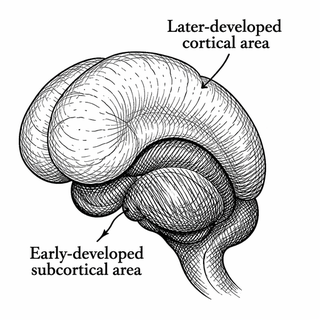
That makes intuitive sense once you stop expecting the brain to behave like a democratic city planner. Early circuits handle basic survival jobs - arousal, movement, internal regulation. If those systems come online first, later-developing regions may have to build around them, like new subdivisions connecting to the old highway.
The twist is that functional connectivity showed the opposite pattern.[1] Structurally older regions were not automatically the loudest at the level of synchronized activity. Later-developing cortical areas can look more functionally central, which fits the idea that higher-order cortex acts less like old plumbing and more like a group chat that never stops buzzing.
Brain Regions Like Age-Matched Friend Groups
The paper also found a "preferential age attachment" rule: regions were more likely to connect with other regions born around a similar developmental time.[1] Apparently the embryonic brain has social sorting.
This matters because it suggests brain wiring is not random spaghetti with a PhD. Development leaves a lasting fingerprint on the adult connectome. Researchers increasingly want connectome maps annotated with biology - gene expression, cell types, developmental history - and this paper leans right into that shift.[2]
The Genes Join the Conversation
Here is where things get extra interesting in a very "your brain keeps receipts" sort of way. The authors linked embryonic timing and connectivity patterns to adult brain gene-expression maps from the Allen Human Brain Atlas.[1] Genes associated with nervous system development, synapse regulation, and neurological disease showed strong spatial relationships with these birth-order patterns.
That does not mean scientists found a single "bossy hub gene" wearing a tiny headset. It means the adult brain still carries molecular echoes of how it was assembled. That broader idea matches work in imaging transcriptomics, where researchers combine brain maps with region-by-region gene-expression data to ask why some circuits look and behave the way they do.[3]
Other recent work points the same way. Studies of structure-function coupling during development show that anatomical wiring and brain activity do not mature in lockstep, and those changing relationships connect to transcriptomic patterns.[4] Comparative transcriptomics has also shown that human cortex has species-specific cellular and molecular features.[5]
Why You Should Care, Even If You Did Not Major in Connectome Drama
If these results hold up and expand, they could help explain why some brain regions become bottlenecks in disease and why certain disorders hit specific networks so hard. A developmental blueprint that shapes adult hubs could matter for conditions involving connectivity breakdown, from neurodevelopmental disorders to neurodegeneration. The paper does not hand us a miracle treatment in a gift bag. What it offers is a better map of why the traffic is the way it is.
That is useful because one of neuroscience's recurring headaches is linking three things that refuse to sit still: development, adult brain networks, and genes. This study takes a respectable swing at all three.
So the next time someone describes the brain as a wiring diagram, picture less a neat circuit board and more an old city that grew in phases. The oldest districts still anchor the infrastructure. The newer neighborhoods do plenty of flashy cultural work. And underneath it all, the construction timeline is still written into the streets.
References
- Diez I, García-Moreno F, Carral-Sainz N, et al. Connectivity of the adult human brain with sequential neurogenesis of circuits and transcriptomics signatures. Nature Communications. 2025. DOI: https://doi.org/10.1038/s41467-025-67785-3
- Bazinet V, Hansen JY, Misic B. Towards a biologically annotated brain connectome. Nature Reviews Neuroscience. 2023;24(12):747-760. DOI: https://doi.org/10.1038/s41583-023-00752-3
- Mandal AS, Gandal MJ, Seidlitz J, Alexander-Bloch A. A Critical Appraisal of Imaging Transcriptomics. Biological Psychiatry: Global Open Science. 2022;2(4):311-313. DOI: https://doi.org/10.1016/j.bpsgos.2022.08.001 PMCID: https://pmc.ncbi.nlm.nih.gov/articles/PMC9616265/
- Feng G, Wang Y, Huang W, et al. Spatial and temporal pattern of structure-function coupling of human brain connectome with development. eLife. 2024;13:RP93325. DOI: https://doi.org/10.7554/eLife.93325 PMCID: https://pmc.ncbi.nlm.nih.gov/articles/PMC11189631/
- Jorstad NL, Bakken TE, Hu Q, et al. Comparative transcriptomics reveals human-specific cortical features. Science. 2023;382(6667):eade9516. DOI: https://doi.org/10.1126/science.ade9516
Disclaimer: The image accompanying this article is for illustrative purposes only and does not depict actual experimental results, data, or biological mechanisms.