
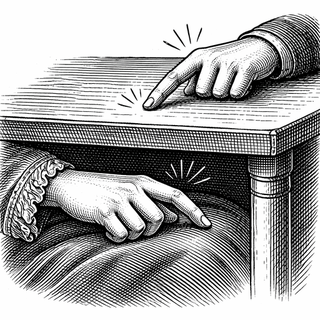
On a rainy Tuesday, a woman rests her hand under a table while a fake hand sits above it like a smug prop from a low-budget magic act. A pair of taps lands on the hidden real finger and the visible rubber one, almost together, and for a brief, deeply unsettling moment, the brain shrugs and says: sure, that one is mine.
That is the premise behind a new paper from Mariano D'Angelo, Renzo Lanfranco, Marie Chancel, and H. Henrik Ehrsson, published in Nature Communications, asking a deceptively simple question: does the speed of your parietal alpha rhythm help determine how tightly your brain binds bodily signals together into a sense of ownership? Their answer is yes. Faster alpha frequencies predicted a narrower temporal binding window, meaning participants were pickier about what counts as simultaneous touch and sight. Slower alpha frequencies predicted a wider window, meaning the brain was more willing to mash nearby events into one bodily story. Then the researchers nudged alpha frequency with transcranial alternating current stimulation and changed that window experimentally, which is the scientific version of saying the timing knob was not just decorative (D'Angelo et al., 2026).
The Bouncer Outside Club Body
To follow this paper, you need one big idea: your brain does not simply collect sensory facts like a bored accountant. It has to decide which signals belong together and which do not. If the sight of a touch and the feeling of a touch arrive close enough in time, the brain often treats them as coming from the same event. That interval is called the temporal binding window.
Alpha rhythms, usually around 8 to 13 hertz, have long been suspected of acting like the brain's internal sampling rate. Hans Berger first described alpha activity nearly a century ago, and we still have not finished arguing about what this rhythm is up to, which feels very on-brand for neuroscience (Jensen and Bonnefond, 2026; Wikipedia: Alpha wave). A 2022 review in Nature Human Behaviour argued that alpha frequency may help determine whether sensory events get integrated or kept apart across time (Buergers and Noppeney, 2022, PMCID: PMC7612782). The new study extends that idea to the feeling that your body is, in fact, your body.
When the Parietal Lobe Starts Keeping Time
The relevant brain real estate here is the parietal cortex, a region heavily involved in combining sensory information and helping construct body and space awareness (Wikipedia: Parietal lobe). D'Angelo and colleagues measured each participant's individual alpha frequency from parietal regions and then tested how sensitive they were to visuotactile simultaneity and how much timing mismatch they tolerated before a rubber hand stopped feeling like their own.
The pattern was strikingly consistent. Faster parietal alpha went with sharper temporal resolution. Participants with faster rhythms had narrower binding windows and better sensitivity in both body ownership and simultaneity judgments. Slower rhythms went with broader windows. The team then used stimulation at relatively low or high alpha frequencies, plus sham stimulation, and shifted those judgments in the predicted direction.
The authors also used computational modeling and found that alpha frequency seemed linked to uncertainty about asynchrony information during causal inference. In plain English, your brain is constantly asking: did these signals come from one thing or two? Alpha timing appears to influence how fuzzy that verdict gets. So the sense of owning a hand depends on a live negotiation among vision, touch, timing, and uncertainty.
Why This Is More Than a Rubber-Hand Party Trick
Body ownership research matters because the machinery behind it shows up all over medicine and technology. Reviews and recent studies connect bodily self-perception to prosthetics, immersive virtual reality, stroke-related disturbances of ownership, and broader models of bodily self-consciousness (Crucianelli et al., 2024; Brunello et al., 2025; Weijs et al., 2024). If reproducible and extended, findings like these could help explain why some people more readily embody prosthetic or virtual limbs than others, or why carefully tuned stimulation might someday improve rehabilitation.
There is also a more basic payoff. Neuroscience has spent years debating whether alpha rhythms truly set the tempo of perception or merely tag along while more important processes do the actual work. This paper does not end every argument forever, but it does move the debate out of the abstract and into the bodily self. It suggests that the beat of parietal alpha is not just background elevator music for the cortex. It may help decide where you end and the world begins.
Which is a slightly unnerving thought. Most of us prefer to imagine that ownership of our own limbs comes standard, factory-installed, and not contingent on millisecond bookkeeping in a cortical region quietly integrating everything. But the brain has always been less like a fortress and more like a committee: efficient, mostly reliable, and occasionally prepared to adopt a rubber hand if the timing is good enough.
References
D'Angelo M, Lanfranco RC, Chancel M, Ehrsson HH. Parietal alpha frequency shapes own-body perception by modulating the temporal integration of bodily signals. Nature Communications. 2026;17:53. https://doi.org/10.1038/s41467-025-67657-w
Buergers S, Noppeney U. The role of alpha oscillations in temporal binding within and across the senses. Nature Human Behaviour. 2022;6(5):732-742. https://doi.org/10.1038/s41562-022-01294-x PMCID: PMC7612782
Jensen O, Bonnefond M. The alpha rhythm: from physiology to behavior. Physiological Reviews. 2026;106(3):1123-1159. https://doi.org/10.1152/physrev.00001.2025 PMCID: PMC7618721
Crucianelli L, Reader AT, Ehrsson HH. Subcortical contributions to the sense of body ownership. Brain. 2024;147(2):390-405. https://doi.org/10.1093/brain/awad359
Brunello N, Diana L, Sritharan J, Glisic M, Nef T, Verma RK, Zito GA. A systematic review and meta-analysis on the neural correlates of bodily self-consciousness. Neuroscience and Biobehavioral Reviews. 2025;179:106420. https://doi.org/10.1016/j.neubiorev.2025.106420
Weijs ML, Lesur MR, Daum MM, Lenggenhager B. Keeping up with ourselves: Multimodal processes underlying body ownership across the lifespan. Cortex. 2024;177:209-223. https://doi.org/10.1016/j.cortex.2024.05.013
Disclaimer: The image accompanying this article is for illustrative purposes only and does not depict actual experimental results, data, or biological mechanisms.