
The year is 2025. A gut neuroscientist in New York just noticed something strange. The "second brain" in your intestines was not acting like one big noodle of nerve soup. It looked more like a messy group chat full of specialists: one neuron pushing food along, another nudging secretions, another weighing in on appetite.
That is the basic thrill of a new Cell paper from Claire J. Millett and colleagues, who answered "so what exactly are these gut neurons doing?" with single-nucleus sequencing, circuit tracing, and targeted manipulation [1]. They did not just make a parts list. They tried to figure out who in the gut is actually running the place.
The Gut Is Not Just a Dumb Tube
The enteric nervous system, or ENS, is the dense network of neurons embedded in the wall of the gastrointestinal tract. It helps control motility, secretion, blood flow, barrier function, and local reflexes without waiting for your brain to supervise every bowel decision [2].
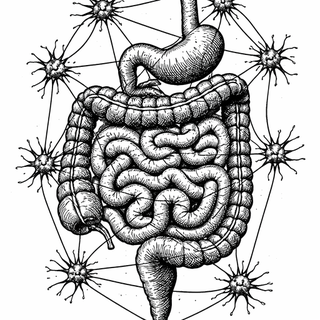
That matters because gut disorders are often not just "stomach problems." Constipation, visceral pain, inflammatory bowel disease, and appetite changes can all involve misfiring communication among neurons, immune cells, epithelial cells, and microbes. The gut-brain axis is real, but it is not magic. It is plumbing, chemistry, electricity, hormones, and a lot of very opinionated cells trying to share one tiny apartment [2,3].
So What Did This Study Actually Find?
The headline is that enteric neurons are not interchangeable background extras. Millett and colleagues built a detailed molecular map of gut neuron subtypes, then linked some of those subtypes to distinct jobs in living animals [1]. Certain populations influenced gastrointestinal motility. Others shaped secretion. Others affected food intake and inflammatory responses.
That regional piece matters. Your small intestine and colon are not doing the same job, and apparently their neurons did not get that memo confused either. The paper also asked how much of the mouse neuron taxonomy shows up in humans. The answer was neither "perfect match" nor "total disaster." Some subsets were conserved. Some were not [1].
Why Scientists Keep Staring at Gut Neurons
Because gut neurons keep turning out to have side hustles. Recent work has tied the ENS to intestinal inflammation during psychological stress, suggesting that stress is not just "in your head" - your gut can absolutely receive that memo [4]. Other papers show enteric neurons responding to nutrients, mechanical force, microbiota, and type 2 inflammation, which makes the ENS look less like a passive wire bundle and more like an active decision-making network [6-8].
Clinically, that opens a tempting possibility. If you can identify the neuron populations that control transit, secretion, satiety, or inflammatory tone, you might someday target them more precisely in disorders like chronic constipation, irritable bowel syndrome, inflammatory bowel disease, or motility syndromes. The current reality is more "we found the right apartment building, now we still need the correct buzzer code."
The Translation Hangover
This paper is strongest where many flashy neuroscience stories get weak: it takes translation seriously [1]. Mouse data are useful, but nobody wants a medicine that works beautifully in a rodent and then folds like a lawn chair in humans. By comparing mouse and human enteric neuron subsets, the authors give the field a better sense of which targets might be real therapeutic candidates.
That said, challenges remain. Human gut tissue is harder to collect, the ENS varies by region and disease state, and neuron identity does not automatically tell you function. Reviews in Physiological Reviews and Nature Reviews make the same point from different angles: the gut's neural circuits sit inside a moving, inflamed, microbe-soaked environment that refuses to behave like a clean lab diagram [2,3,5].
The Big Takeaway, Minus the Lab Coat Voice
Your gut is not just digesting lunch. It is sensing, calculating, negotiating, and occasionally overreacting like an ex who saw a harmless text and decided it was a federal case. This study gives researchers a better map of who those gut neurons are and what some of them do.
No, this does not mean your colon has a tiny philosopher-king inside it. But it does mean future gut medicines may get smarter. Instead of broadly pushing the whole digestive system harder or quieter, researchers may eventually target the exact neuron populations that control the problem at hand.
References
- Millett CJ, Shaver JJ, Bracken B, Jones SJ, Lovelett RJ, Rubinow DA, Singhal R, Charlton C, Piazza N, Hauck Q, Sharma N, Muller PA. In vivo transcriptomic, functional, circuit-based, and translational analyses of enteric neurons. Cell. 2025;188(26):7547-7570.e45. DOI: https://doi.org/10.1016/j.cell.2025.11.024
- Sharkey KA, Mawe GM. The enteric nervous system. Physiol Rev. 2023;103(2):1487-1564. DOI: https://doi.org/10.1152/physrev.00018.2022 PMCID: https://pmc.ncbi.nlm.nih.gov/articles/PMC9970663/
- Ohara TE, Hsiao EY. Microbiota-neuroepithelial signalling across the gut-brain axis. Nat Rev Microbiol. 2025;23:371-384. DOI: https://doi.org/10.1038/s41579-024-01136-9
- Schneider KM, Blank N, Alvarez Y, Thum K, Lundgren P, Litichevskiy L, et al. The enteric nervous system relays psychological stress to intestinal inflammation. Cell. 2023;186(13):2823-2838.e20. DOI: https://doi.org/10.1016/j.cell.2023.05.001 PMCID: https://pmc.ncbi.nlm.nih.gov/articles/PMC10330875/
- Castro MM, Chiu IM. The gut-brain axis and pain signalling mechanisms in the gastrointestinal tract. Nat Rev Gastroenterol Hepatol. 2025;22:206-221. DOI: https://doi.org/10.1038/s41575-024-01017-9
- Tan P, Jaiswal A, Murphy SP, Brown EM, Wheeler H, Su CW, et al. Regional encoding of enteric nervous system responses to microbiota and type 2 inflammation. Science. 2025. DOI: https://doi.org/10.1126/science.adr3545
- Xie Z, Le R, Roche K, Rao Q, O'Leary CE, Jackson R, et al. Enteric neuronal Piezo1 maintains mechanical and immunological homeostasis by sensing force. Cell. 2025;188(9):2417-2432.e19. DOI: https://doi.org/10.1016/j.cell.2025.02.031
- Fung C, Venneman T, Holland AM, Martens T, Alata MI, Hao MM, et al. Nutrients activate distinct patterns of small-intestinal enteric neurons. Nature. 2025;644(8078):1069-1077. DOI: https://doi.org/10.1038/s41586-025-09228-z
Disclaimer: The image accompanying this article is for illustrative purposes only and does not depict actual experimental results, data, or biological mechanisms.