
Last winter, a middle-aged patient came into clinic with a strange bundle of problems that did not look like they belonged in the same sentence: dizzy spells on standing, constipation that would not quit, a bladder acting like it had ghosted its owner, and meals that seemed to sit in the stomach like an unwanted houseguest. No dramatic brain lesion. No neat one-nerve explanation. Just a body whose internal autopilot had started missing cues. Cases like that are a reminder that the peripheral nervous system is not just some extension cord hanging off the brain. It is more like a city after midnight - lights on, messages flying, crews coordinating, everybody pretending they are not the reason the whole place works.
That is exactly the assumption a new rat study decided to pick a fight with. In PNAS, Larry Swanson, Joel Hahn, and Olaf Sporns mapped reported axonal connections between peripheral ganglia and asked a deceptively simple question: what if the peripheral nervous system has its own internal network logic, instead of acting like a bunch of separate phone lines to and from the brain? (Swanson et al., 2025)
Not Just Cables in a Trench Coat
You probably learned the peripheral nervous system as the part outside the brain and spinal cord. Fair enough. That is true in the same way saying a symphony is "some people with instruments" is technically true and spiritually useless.
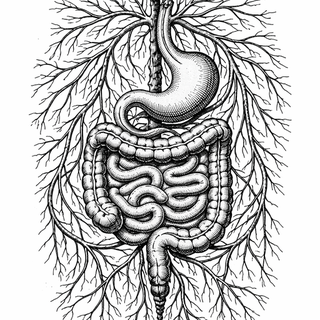
The old default picture has been tidy: brain sends orders, body reports back, peripheral ganglia serve as relay stops. Swanson and colleagues argue the real setup looks messier and more interesting. After collating anatomical evidence in rats, they found more than 100 putative directed, weighted connections among 52 of 84 identified sensory and autonomic ganglia. In other words, the peripheral nervous system may not be a row of disconnected customer-service kiosks. It may be running its own internal group chats.
The Gut Shows Up as the Main Character
One of the punchlines is almost rude in its predictability: the gut network matters a lot. The study found two major hubs in the bilateral myenteric plexus ganglia, a key part of the enteric nervous system that helps control digestion. Which makes sense. If your body were a company, digestion would be the department that files 900 expense reports a day and somehow still claims it is underappreciated.
That enteric angle fits a lot of recent work. A major 2023 Physiological Reviews article describes the enteric nervous system as an intrinsic control network for digestion that also interacts with immune cells, the microbiota, and the epithelial barrier (Sharkey and Mawe, 2023). Another 2023 paper in Cell showed that the enteric nervous system can relay psychological stress into intestinal inflammation, which is the sort of sentence that makes the phrase "gut feeling" look less poetic and more like a systems-biology spoiler (Schneider et al., 2023).
So when this new paper says the peripheral nervous system has small-world properties and organized modules, that is not just graph-theory confetti. It hints that peripheral circuits may coordinate body functions in ways we have underestimated.
Why This Matters Outside a Neuroscience Seminar
A lot of real illnesses look less like a broken wire and more like a broken network. Autonomic disorders can scramble heart rate, blood pressure, sweating, bladder function, sexual function, and digestion all at once. Diabetic autonomic neuropathy and autoimmune autonomic ganglionopathy do not politely fail one symptom at a time. They freestyle.
If the peripheral nervous system is organized as a structured network, that could change how researchers think about those diseases. Instead of asking only which nerve is damaged, they can ask which hub is overloaded, which module is disrupted, and how local ganglia might amplify or buffer trouble. That shift matters for bioelectronic medicine too. If future therapies stimulate peripheral circuits, the target may not be a single wire but a neighborhood of interacting nodes.
This also helps explain why modern connectomics keeps getting bigger ambitions. In October 2024, researchers publishing the complete adult fruit fly brain connectome in Nature showed how full-network maps can reveal organizing principles that are invisible when you inspect cells one by one (Lin et al., 2024). Swanson and colleagues are bringing a version of that network mindset to the mammalian periphery, which has often lived in the shadow of the brain.
The Catch, Because Science Always Has One
This is not a direct movie of ganglia texting each other in real time. It is a synthesized anatomical network built from existing neuroanatomical data in rats. The authors are careful about that. These are putative connections, and the full functional significance still needs testing with modern structure-function tools.
That means the paper is best read as a map sketch, not the final GPS voice.
And that is the fun part here. The peripheral nervous system, long treated like the brain's road crew, may have its own internal architecture, its own hubs, its own modular organization. Not background wiring. Not silent support staff. More like a distributed ensemble keeping the beat while the brain grabs the album cover.
References
- Swanson LW, Hahn JD, Sporns O. Intrinsic neuronal network organization of a mammalian peripheral nervous system. Proc Natl Acad Sci U S A. 2025;122(51):e2528657122. doi:10.1073/pnas.2528657122. PubMed: PMID 41410770.
- Sharkey KA, Mawe GM. The enteric nervous system. Physiol Rev. 2023;103(2):1487-1564. doi:10.1152/physrev.00018.2022. PMCID: PMC9970663.
- Schneider KM, Blank N, Alvarez Y, et al. The enteric nervous system relays psychological stress to intestinal inflammation. Cell. 2023;186(13):2823-2838.e20. doi:10.1016/j.cell.2023.05.001. PMCID: PMC10330875.
- Lin A, Yang R, Dorkenwald S, et al. Network statistics of the whole-brain connectome of Drosophila. Nature. 2024;634(8032):153-165. doi:10.1038/s41586-024-07968-y. PubMed: PMID 39358527.
Disclaimer: The image accompanying this article is for illustrative purposes only and does not depict actual experimental results, data, or biological mechanisms.