
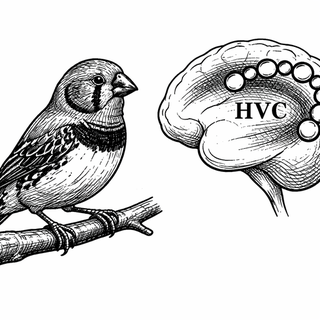
Scientists love naming things, and this one's called HVC, which is great because the letters officially stand for absolutely nothing anymore. Real talk: it used to mean "high vocal center," then the anatomists got into one of their periodic naming brawls, and now HVC is just HVC, a three-letter shrug that everyone agreed to keep. It's the neuroscience equivalent of a bar that's been "Joe's" for forty years even though no Joe has owned it since the Carter administration. Anyway, this little nub of brain tissue in a songbird is where one of the coolest tricks in neuroscience happens, and a new model in eLife just laid out exactly how the bar staff pulls it off.
The Bird That Sings the Same Song Every Single Time
Here's the wild part. A zebra finch learns its song as a juvenile by copying its dad, and once it locks that song in as an adult, it sings the thing the same way every time. Same notes, same order, same timing, down to the millisecond. We're talking a precision that would make a session drummer weep.
That kind of "do the exact same complicated sequence, perfectly, on demand" is called a stereotyped neural sequence, and your brain pulls the same trick constantly. Tying your shoes, the muscle choreography of saying "espresso," that one piano riff you can still play from middle school. The brain is honestly just a very fancy machine for firing things off in the right order. The mystery has always been: how do the neurons know whose turn it is next?
Pour One Out for the Conga Line
Inside HVC there are three kinds of neurons, and think of them as different regulars at the bar. One type (the HVCx crowd) reports gossip down to the basal ganglia. Another type (HVCra) shouts the actual marching orders to the muscles that move air through the bird's vocal organ. And a third bunch, the interneurons, are basically the bouncers, going around shushing everyone so the room stays orderly.
The leading idea is that these neurons form a chain, a sort of neuronal conga line where each tiny group fires a quick burst, taps the next group on the shoulder, and goes quiet. Burst, tap, quiet. Burst, tap, quiet. String enough of those together and you get a song. The long-running argument has been whether this chain runs entirely on its own internal wiring or needs a nudge from outside brain regions to keep advancing.
What the New Model Actually Did
Bou Diab, Chammas, and Daou built a biophysically realistic network, which is the neuroscience way of saying they didn't fake the neurons with cartoon math. They modeled the real ion channels and synaptic currents that earlier lab experiments had actually measured by poking these cells with drugs. Then they wired the three cell types into a feedforward chain of little microcircuits, each one encoding a "sub-syllabic segment" (a bite-sized chunk of a single syllable), and glued the chunks together with structured feedback inhibition. Translation: the bouncers don't just shush randomly, they shush in a deliberate pattern that hands the spotlight cleanly from one group to the next.
And it worked. The model spat out the same firing patterns these neurons actually show in living, singing birds. The HVCra neurons fired their single crisp bursts, the HVCx neurons did their one-to-four-burst routine, and the interneurons rattled away throughout, exactly like the real thing.
The standout character turned out to be a humble little gizmo called the T-type calcium channel. This channel has a quirky habit of staying quiet, then firing back hard right after it's been inhibited, a "rebound" kick. In the model, that rebound is part of what gives each link in the chain its snappy, well-timed burst once the bouncer briefly lets up. The conga line, it turns out, dances because it keeps getting shushed.
Why You Should Care About a Finch's Karaoke Night
Beyond being a delightful party trick, this matters because the brain reuses the same playbook everywhere. Speech, typing, playing an instrument, the smooth chain of movements in a golf swing, these all lean on stereotyped sequences, and when that machinery breaks you get disorders of speech and movement. A model this detailed, built from real ion channels rather than hand-waving, is something researchers can actually prod: knock out a channel in the simulation, see what falls apart, then go check the bird. That's the kind of testable map that turns "neurons fire in order, somehow" into "here's the mechanism, here's the knob, let's turn it."
Not bad for a brain region named after nothing at all.
Disclaimer: The image accompanying this article is for illustrative purposes only and does not depict actual experimental results, data, or biological mechanisms.
References
Bou Diab, Z., Chammas, M., & Daou, A. (2025). Biophysical network modeling of temporal and stereotyped sequence propagation of neural activity in the premotor nucleus HVC. eLife, 14, e105526. https://doi.org/10.7554/eLife.105526 — PMID: 41342437, PMC12677902
Hahnloser, R. H. R., Kozhevnikov, A. A., & Fee, M. S. (2002). An ultra-sparse code underlies the generation of neural sequences in a songbird. Nature, 419, 65-70. https://doi.org/10.1038/nature00974
Long, M. A., Jin, D. Z., & Fee, M. S. (2010). Support for a synaptic chain model of neuronal sequence generation. Nature, 468, 394-399. https://doi.org/10.1038/nature09514
Egger, R., Tupikov, Y., Elmaleh, M., et al. (2020). Local axonal conduction shapes the spatiotemporal properties of neural sequences. Cell, 183(2), 537-548. https://doi.org/10.1016/j.cell.2020.09.019
Cannon, J., Kopell, N., Gardner, T., & Markowitz, J. (2015). Neural sequence generation using spatiotemporal patterns of inhibition. PLOS Computational Biology, 11(11), e1004581. https://doi.org/10.1371/journal.pcbi.1004581