
Forget everything you know about microglia as tiny brain janitors. Yes, they clean up cellular trash and sniff out trouble. But this new eLife study suggests that under chronic neurodegeneration, some microglia stop acting like stationary security cameras and start moving like NPCs with a fresh quest marker over their heads.
The Old Strategy: Sit Still, Wave Arms
In a healthy brain, microglia are restless in a particular way. Their cell bodies mostly stay put, while long branching processes sweep the neighborhood like drones checking every chest, hallway, and ominous glowing door.
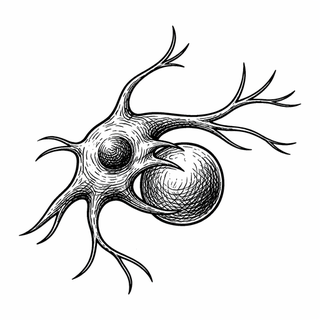
Those branches contact neurons through specialized communication spots called somatic purinergic junctions. "Purinergic" sounds like a spell from a biochemistry scroll, but it means cells use molecules like ATP, ADP, UTP, or UDP as signals. Earlier work showed that microglia monitor and protect neuronal function through these junctions, using receptors such as P2Y12 to sense stressed neurons (Cserép et al., 2020).
That setup works beautifully for acute injury. A neuron has a problem, sends chemical smoke signals, and nearby microglial processes rush over. But chronic neurodegeneration is not a dropped controller. It is a long boss fight where the arena keeps changing.
The New Study: Microglia Go Door to Door
Subhramanian and colleagues studied prion-infected mice, a model of chronic neurodegeneration. Prion diseases involve misfolded proteins that spread damage through the brain, which is about as cheerful as a save file corrupting itself.
The team used time-lapse imaging of acute brain slices to watch reactive microglia in action. These cells had fewer delicate branches, but their cell bodies moved much more. Instead of monitoring many neurons from a fixed base, they migrated through tissue and paused to press against individual neuronal cell bodies (Subhramanian et al., 2026).
Some contacts lasted minutes. Others lasted hours. Sometimes the microglia partially wrapped around a neuron. Sometimes they fully enveloped it. Then they backed off. It was reversible, dynamic, and weirdly intimate, like a bouncer checking IDs by hugging each guest.
The authors describe a shift from broad, multi-neuron monitoring to mobile, neuron-by-neuron engagement. In gaming terms, the microglia switched from area-of-effect scanning to single-target inspection.
Calcium Bursts: The Movement Buff
The researchers also saw sustained calcium bursts inside reactive microglia, and those bursts tracked with increased mobility. Calcium signaling is one of biology's favorite notification systems. Cells use it for everything from movement to secretion to "something is happening, please stop pretending this is fine."
One receptor drew attention: P2Y6. When the team inhibited it, microglial migration dropped partly, though the cells could still contact neurons. That matters because P2Y6 is a possible therapeutic target. A 2024 review argues that UDP-driven P2Y6 activation can promote microglial phagocytosis of synapses or neurons, which may help or hurt depending on context (Dundee and Brown, 2024).
Translation: P2Y6 is not simply a villain button. Biology gives us tangled control panels with labels written by a committee.
Why This Is More Than Cellular Choreography
Microglia are now central characters in neurodegeneration research, not background scenery. Reviews across Alzheimer's, Parkinson's, ALS, Huntington's disease, and related disorders describe them as double agents: they can clear debris and protein aggregates, but they can also drive inflammation, synapse loss, and disease progression when their state goes sideways (Gao et al., 2023).
That is why this paper lands. It does not just ask whether microglia are "activated." That word is the neuroscience equivalent of saying a game has "combat." Fine, but what kind? Stealth? Turn-based? Button-mashing panic?
This study asks what reactive microglia physically do when the brain is under long-term stress. Do they keep using the old branch-based surveillance system, only worse? Or do they unlock a different movement pattern entirely?
The answer seems to be the second option.
Even more surprising, reactive microglia kept their high-mobility behavior after researchers isolated them away from the brain environment. Mobility may become built into the reactive state itself, not merely triggered by nearby distress signals. The cells may be carrying the "patrol mode" setting with them.
The Catch, Because Science Has Terms and Conditions
This was a mouse prion-disease study using brain slices and isolated cells. It does not prove the same exact behavior happens in human Alzheimer's, Parkinson's, ALS, or every chronic brain disorder. It also does not tell us whether neuron-by-neuron contact is mostly protective, harmful, or both. Microglia contain multitudes, which is rude of them but scientifically inconvenient.
Still, if this behavior generalizes, it could reshape microglia-targeted therapies. Drugs may need to consider physical behavior too: where microglia move, how long they contact neurons, and when close surveillance becomes unwanted overmanagement.
Basically, the brain's immune cells may not just change their stats during chronic disease. They may change their playstyle.
References
Subhramanian S, Bocharova O, Makarava N, Safadi T, Baskakov IV. Dissecting surveying behavior of reactive microglia under chronic neurodegeneration. eLife. 2026;14:RP107650. DOI: 10.7554/eLife.107650. PMCID: PMC12782555.
Cserép C, Pósfai B, Lénárt N, et al. Microglia monitor and protect neuronal function through specialized somatic purinergic junctions. Science. 2020;367(6477):528-537. DOI: 10.1126/science.aax6752.
Gao C, Jiang J, Tan Y, Chen S. Microglia in neurodegenerative diseases: mechanism and potential therapeutic targets. Signal Transduction and Targeted Therapy. 2023;8:359. DOI: 10.1038/s41392-023-01588-0. PMCID: PMC10514343.
Dundee JM, Brown GC. The microglial P2Y6 receptor as a therapeutic target for neurodegenerative diseases. Translational Neurodegeneration. 2024;13:47. DOI: 10.1186/s40035-024-00438-5. PMCID: PMC11380353.
Cserép C, Schwarcz AD, Pósfai B, et al. Microglial control of neuronal development via somatic purinergic junctions. Cell Reports. 2022;40(12):111369. DOI: 10.1016/j.celrep.2022.111369. PMCID: PMC9513806.
Disclaimer: The image accompanying this article is for illustrative purposes only and does not depict actual experimental results, data, or biological mechanisms.