
Quick gut check: when was the last time you flinched at a sound in an empty house, then spent the next hour convinced something was definitely about to get you? Hold that feeling. That right there is the difference between two kinds of fear, and a new study out of UNC says your brain might be mixing those two tracks differently depending on your sex.
Here is the setup. Fear is not one note. It is two. There is phasic fear, the sharp jolt when a clear threat drops in your lap. A snake on the trail. A car horn. Boom, react, done. Then there is sustained fear, the slow burn that lingers when the threat is fuzzy, uncertain, maybe-coming-maybe-not. That is the dread that overstays its welcome. Same emotion, different tempo, and the brain runs them through different equipment.
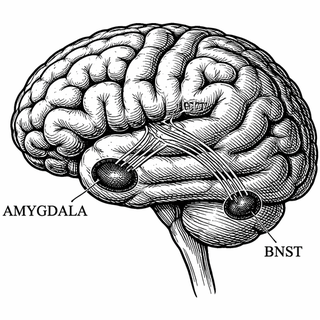
Meet the BNST, the Brain's Anxiety Engineer
Tucked deep in your brain sits a region with a name only a neuroscientist could love: the bed nucleus of the stria terminalis, or BNST. Think of it less as the lead vocalist and more as the producer in the back of the studio, the one who decides how long a feeling gets to ride. The amygdala handles the quick snare hit of acute fear. The BNST handles the bassline that just will not quit, the sustained ambient threat that keeps your nervous system on edge.
And the BNST has a favorite ingredient: a molecule called corticotropin-releasing factor, CRF for short. CRF is the brain's stress signal, the sample that gets looped when things feel uncertain. Past work showed that dropping CRF into the BNST cranks sustained fear up, while blocking it turns the volume down. So far, so tidy.
Then the researchers did something a lot of older studies skipped. They pressed play for both males and females.
Plot Twist: The Track Sounds Different by Sex
Olivia Hon and the Kash lab at UNC put male and female mice through partial fear conditioning, a clever way to keep threats ambiguous so the animals never quite knew when the bad thing was coming. Pure uncertainty. Pure sustained-fear territory.
The males leaned in hard. More arousal. Bigger acoustic startle. Heightened BNST activity that climbed as the threat cues got murkier. Picture the guy who hears one creak and starts patrolling the whole house with a flashlight. Hypervigilance, fully engaged.
The females? They dialed the BNST down. Less engagement, not more, when the cues turned ambiguous. Same studio, same gear, completely different mix.
But the real headline drops when the team knocked down CRF in those BNST neurons. In males, silencing CRF did nothing to their fear behavior. Crickets. In females, knocking down the exact same molecule cranked fear learning and recall way up. Take away the CRF and the females got more afraid, not less.
Flip that logic and it lands hard: in female brains, CRF is not the gas pedal on fear. It is the brake. It is the producer telling the track to chill before it spirals. Remove the brake, and fear runs the whole show.
Why This Beat Matters Beyond the Lab
Here is where it stops being a mouse story. Anxiety disorders and PTSD hit women at roughly twice the rate they hit men, and for decades the foundational fear research ran mostly on male animals. We built the textbook off half the catalog and called it the greatest hits.
This study says the same molecule can play opposite roles in male and female brains. Not louder or softer. Opposite. That is the kind of detail that wrecks a one-size-fits-all drug. A CRF-targeting treatment designed off male data could, in theory, do the reverse of what you want in a female patient. Knowing the mix before you remaster it is the entire point.
None of this is a finished song. It is mice, not people, and human brains remix these signals with far more layers. But it is a sharp reminder that sex is not a footnote in neuroscience. It is part of the arrangement. Study one version of the track and call it universal, and you miss half of what the brain is actually saying.
Your fear has rhythm. Turns out the rhythm section was never playing the same chart for everyone.
Disclaimer: The image accompanying this article is for illustrative purposes only and does not depict actual experimental results, data, or biological mechanisms.
References
Hon, O. J., Neira, S., Flanigan, M. E., Roland, A. V., Caira, C. M., Sides, T., D'Ambrosio, S. L., Lee, S. I., Simpson, Y., Buccini, M. C., Machinski, S., Yu, W., Boyt, K. M., & Kash, T. L. (2025). Sex differences in BNST signaling and BNST CRF in fear processing. eLife. https://doi.org/10.7554/eLife.89189 (PMID: 41348565; PMCID: PMC12680374)
Walker, D. L., & Davis, M. (2009). Selective participation of the bed nucleus of the stria terminalis and CRF in sustained anxiety-like versus phasic fear-like responses. Progress in Neuro-Psychopharmacology & Biological Psychiatry. https://pubmed.ncbi.nlm.nih.gov/19595731/ (PMID: 19595731)
Hofmann, D., & Straube, T. (2022). Resting-state fMRI effective connectivity between the bed nucleus of the stria terminalis and amygdala nuclei. Frontiers in Behavioral Neuroscience, 16, 903782. https://doi.org/10.3389/fnbeh.2022.903782