
Scientists love naming things, and this one's called calcitonin-type and pigment-dispersing factor-type receptors, which sounds less like a discovery in sea cucumber biology and more like two prog-rock bands arguing backstage. But behind that gloriously clunky name is a genuinely juicy idea: some ancient neuropeptides may be able to talk to two different receptor systems at once. In other words, the molecular key might open more than one lock. Biology loves a plot twist, and frankly it has never met a simple family tree it could not turn into a soap opera.
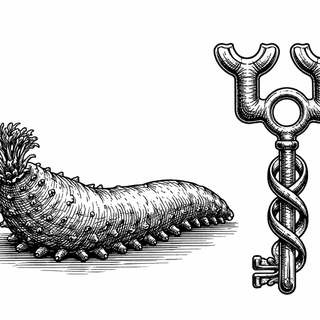
This new study in eLife looked at neuropeptides in a sea cucumber - yes, the soft, squishy ocean tube that looks like it lost a fight with a throw pillow - and found evidence that certain peptides can activate both calcitonin-type and pigment-dispersing factor-type receptors in a deuterostome animal. That matters because it helps explain how signaling systems in nervous systems evolved, split apart, and occasionally kept each other’s phone numbers.
The tiny chemical gossip network
Neuropeptides are short chains of amino acids that neurons use to influence other cells. Think of them as slower, moodier cousins of classic neurotransmitters. If glutamate is a quick text saying "go now," a neuropeptide is more like a long voice memo with emotional context, several side quests, and maybe a passive-aggressive sign-off.
The calcitonin family in vertebrates includes hormones and neuropeptides involved in things like calcium balance, pain, metabolism, and feeding. Pigment-dispersing factor, or PDF, is better known from invertebrates, especially for roles in circadian rhythms - basically helping keep the organism’s internal clock from behaving like a college student on spring break.
For a while, researchers have suspected these signaling systems share an ancient evolutionary relationship. This paper digs into that question by studying the sea cucumber Apostichopus japonicus, a deuterostome relative of vertebrates. So while it is not exactly your cousin, evolutionarily speaking it is on a more relevant branch of the tree than, say, a fruit fly wearing a tiny lab coat.
One peptide, two doors
The key finding is that the researchers functionally characterized neuropeptides that can act as ligands for both calcitonin-type receptors and PDF-type receptors. That is the fun part. Usually we like our receptor-ligand relationships neat and orderly, like labeled spice jars. Biology, meanwhile, stores cumin in an old jam jar and calls it "close enough."
Why is this exciting? Because it suggests that these signaling systems may not have started out as fully separate pathways. Instead, there may have been an ancestral setup where peptide-receptor interactions were more flexible, and only later became more specialized. Evolution often works like a family business that gets weird over generations - one branch keeps the bakery, one opens a nightclub, and somehow they still share the same cash register.
The authors also tie these systems to feeding and growth-related effects in sea cucumber biology, which hints that these peptides are not just interesting museum pieces from deep evolutionary time. They may still be doing active physiological work in living animals.
Why anybody outside a tide pool should care
At first glance, this may seem like one of those papers that is deeply important to five evolutionary neurobiologists and one very enthusiastic marine invertebrate. But it reaches further than that.
A lot of modern biomedical science depends on understanding how signaling systems evolved. G-protein-coupled receptors, or GPCRs, are a huge drug target class in humans. If you want to understand why certain receptors respond the way they do, where their selectivity came from, or how signaling flexibility emerged, evolutionary biology is not a side dish - it is the recipe card.
This study adds a piece to that bigger puzzle. It suggests receptor systems we now treat as distinct may have ancient overlap. That could help researchers think more clearly about receptor promiscuity, ligand evolution, and how complex signaling networks emerge from older, messier systems. The brain, like many families, did not become organized by starting organized.
The hard part: evolution is rude to tidy stories
There is a challenge here, of course. When scientists reconstruct ancient signaling systems, they are doing a bit of molecular detective work with most of the original witnesses dead for half a billion years. You can compare genes, test receptors, map relationships, and build a compelling case - but evolution rarely hands over a clean confession.
That is why functional studies like this matter. Phylogenetic trees can suggest who is related to whom, but receptor activation experiments show who is actually talking to whom right now in the cell. It is the difference between seeing two people in the same family photo and finding out they still borrow each other’s Tupperware.
The bigger picture
If these findings hold up and similar dual-acting peptide systems are found in other animals, we get a richer picture of how nervous systems evolved. Not as a straight march toward perfect specialization, but as a series of tinkering moves - duplication, divergence, overlap, and occasional molecular chaos that somehow works out.
And honestly, that feels very on brand for the nervous system. We like to imagine biology as elegant engineering. Sometimes it is. Other times it is a sea cucumber peptide somehow chatting with two receptor types and making evolutionary history look like it was planned by a committee with snacks but no agenda.
References
Cong X, Liu H, Liu L, Escudero Castelán N, Jones KGE, Egertová M, Elphick MR, Chen M. Functional characterization of neuropeptides that act as ligands for both calcitonin-type and pigment-dispersing factor-type receptors in a deuterostome. eLife. 2024;13:RP101799. doi:10.7554/eLife.101799
Cardoso JC, Félix RC, Power DM. Evolution of secretin family GPCR members in the metazoa. BMC Evol Biol. 2014;14:108. doi:10.1186/1471-2148-14-108 PMCID: PMC4029457
Jékely G. Global view of the evolution and diversity of metazoan neuropeptide signaling. Proc Natl Acad Sci U S A. 2013;110(21):8702-8707. doi:10.1073/pnas.1221833110 PMCID: PMC3666714
Elphick MR, Mirabeau O. The evolution and variety of RFamide-type neuropeptides: insights from deuterostomian invertebrates. Front Endocrinol (Lausanne). 2014;5:93. doi:10.3389/fendo.2014.00093 PMCID: PMC4063932
Mirabeau O, Joly JS. Molecular evolution of peptidergic signaling systems in bilaterians. Proc Natl Acad Sci U S A. 2013;110(22):E2028-E2037. doi:10.1073/pnas.1219956110 PMCID: PMC3670387
Disclaimer: The image accompanying this article is for illustrative purposes only and does not depict actual experimental results, data, or biological mechanisms.