
The operation began with the usual glamour of neuroscience: humans and macaques staring at overlapping fields of moving dots while researchers asked, "How many speeds do you see?" Then came macaque recordings, where electrodes listened to area MT as dots slid in combinations that would make a traffic engineer quietly leave.
This was an ambush on a basic question: when two things move through the same patch of visual space, does the brain keep both speeds on the map, or average them into one memo?
Situation Report: The Visual System Has Incoming
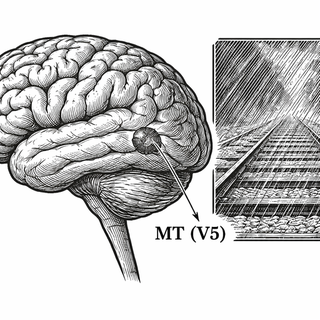
Area MT, also called V5 in humans, is one of the brain's motion specialists. If visual cortex were a command structure, MT would be the officer yelling, "Contact moving left, speed increasing," while everyone else admires the wallpaper.
Motion perception sounds simple because you do it constantly. Cars pass. Dogs sprint. Your coffee mug stays put unless Monday has gone badly. But light hits the retina as changing patterns, not labeled objects. The brain must infer speed, direction, foreground, background, and whether that blur is a cyclist.
Huang and colleagues asked how MT handles multiple speeds in the same location, a situation called transparent motion. Think rain on a train window while scenery moves behind it. Two motion layers occupy the same territory. One synapse may be a strategic asset, but even it deserves clear orders.
Mission Objective: Find the Faster Target
The study found a strong bias in MT responses toward the faster of two speeds, especially when both speeds were relatively slow, at or below 20 degrees per second. As speeds increased, that bias weakened. The neurons did not simply shrug and report the average. At low speeds, the faster component got priority, like the loudest person in a meeting who may or may not have read the agenda.
Faster motion often marks the figure rather than the background. A bird crosses the sky. A person steps off the curb while the street behind them stays put. Faster motion helps separate "track this" from "scenery doing scenery things."
The team also tested perception. Humans and macaques could tell when overlapping stimuli contained two speeds, but spacing mattered. A 4x speed difference was much easier to segment than a 2x difference. That is visual triage under limited bandwidth.
Execution: Normalization Enters the Briefing
The authors used a modified divisive normalization model to explain the responses. Divisive normalization scales one neuron's output by activity in a broader pool. One neuron does not file its report without the unit weighing in.
That sounds annoying, but it is useful. Normalization helps the brain manage contrast, competition, attention, and sensory chaos. It also fits efficient coding: represent the world without wasting spikes like a poorly managed ammunition budget.
Here, the model worked when speed components received weights from a broad population of speed-tuned neurons. The faster speed generated stronger representation, especially at slower ranges, so it pulled the combined MT response toward itself. The fast target got the radio channel.
Assessment: The Code Was Not Lost
The key twist: individual MT neurons showed a faster-speed bias, but population activity still carried enough information to decode two speeds under some conditions. A classifier distinguished two-speed responses from responses to a single log-mean speed. The researchers could also decode both speeds, especially when the speeds were far apart.
The caveat is tactical and serious: decoding did not fully explain perception when speeds were close together. At 2x separation, the neural signal and behavior did not line up as neatly. The system may need downstream areas, attention, decision rules, or extra context. Translation: MT sends a useful field report, but headquarters still has paperwork.
This fits a larger trend in neuroscience. Perception is a population-coding problem, not a single-neuron talent show. Information lives in patterns across many neurons. The brain is a committee, which explains both its power and its occasional interest in making you see a stationary ceiling fan move after you stare too long.
Why This Operation Matters
If these findings hold up and expand, they help explain how the brain separates moving objects in crowded scenes. That matters for driving, sports, navigation, robotics, computer vision, and clinical problems where motion perception goes wrong. Akinetopsia, or motion blindness, can make reality appear in jumps, like continuity got court-martialed.
This study does not cure that. It does something more basic. It clarifies one rule MT may use when the visual world sends overlapping motion signals: at low speeds, favor the faster component, but keep enough population-level information to recover more than one speed when the evidence is strong.
The brain wins many battles this way.
Disclaimer: The image accompanying this article is for illustrative purposes only and does not depict actual experimental results, data, or biological mechanisms.
References
Huang X, Ghimire B, Chakrala AS, Wiesner S. Neural coding of multiple motion speeds in visual cortical area MT. eLife. 2026;13:RP94835. https://doi.org/10.7554/eLife.94835. PMCID: PMC12774417.
Panzeri S, Moroni M, Safaai H, Harvey CD. The structures and functions of correlations in neural population codes. Nature Reviews Neuroscience. 2022. https://doi.org/10.1038/s41583-022-00606-4.
Azeredo da Silveira R, Rieke F. The geometry of information coding in correlated neural populations. Annual Review of Neuroscience. 2021;44:403-424. https://doi.org/10.1146/annurev-neuro-120320-082744.
Kafashan M, Jaffe AW, Chettih SN, Nogueira R, Arandia-Romero I, Harvey CD, Moreno-Bote R. Scaling of sensory information in large neural populations shows signatures of information-limiting correlations. Nature Communications. 2021;12:473. https://doi.org/10.1038/s41467-020-20722-y.
Bucher SF, Brandenburger AM. Divisive normalization is an efficient code for multivariate Pareto-distributed environments. Proceedings of the National Academy of Sciences. 2022;119:e2120581119. https://doi.org/10.1073/pnas.2120581119. PMCID: PMC9546555.