
We still don't know how your brain recognizes an object when the visual signal is lousy. But this paper gets us closer. Let me show you something: your visual system is not a straight assembly line. It is a workshop where the apprentice sends up a rough sketch, the foreman sends back corrections, and somehow the final product is "coffee mug."
The new eLife study by Hou, He, and Zhang asks a clean question with messy wiring behind it: when higher visual areas send feedback down to early visual cortex, what exactly are they sending? Basic measurements, or the whole blueprint?
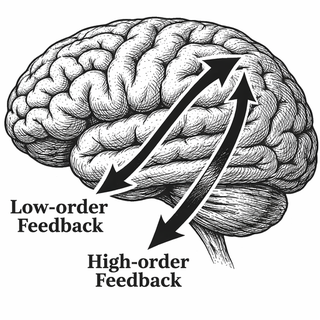
Their answer: both. The two feedback streams take different routes, arrive with different timing, and do different jobs.
The Visual System Has a Return Policy
Most people learn vision as bottom-up. Light hits the retina. Signals go to the thalamus. Then V1, the primary visual cortex, starts detecting edges, contrast, and orientation. From there, information climbs the hierarchy until higher areas decide whether that thing in the corner is a backpack, a cat, or a backpack that has somehow learned malice.
That story is useful, but incomplete. The brain also sends information backward. Predictive coding theories say the brain makes educated guesses about sensory data, then compares the guess with the actual signal. When the guess is wrong, the system updates. Very respectable. Also basically your brain saying, "I meant to do that," several hundred times per second.
The hard part is measuring feedback in humans. fMRI gives you location, but it is slow because blood flow is not exactly a stopwatch. MEG gives you timing in milliseconds, but it is spatially blurrier. Hou and colleagues used both: 7T fMRI for fine layer detail, plus MEG for timing.
Two Kinds of Messages Coming Back Down
The researchers used a peripheral object discrimination task designed to separate feedforward signals from feedback signals in early visual cortex. Peripheral vision is a good place to make the visual system sweat. Objects get fuzzy, crowded, and weird, like trying to identify a tool on the far end of the bench while someone waves a flashlight.
They focused on two kinds of information. Low-order features are the nuts-and-bolts properties V1 already likes: orientation, spatial frequency, local texture. High-order features are more object-level: category, identity, the "what am I looking at?" part.
Feedback carried both low-order and high-order information back into V1. But low-order feedback reached only the deep layers. High-order feedback reached both superficial and deep layers. Same destination city, different loading docks.
That matters because cortical layers are not decorative stripes. They are wiring lanes. Different layers receive and send different kinds of traffic. Laminar fMRI, especially at 7T, lets researchers peek at these depth-specific patterns in living humans.
The 200 Millisecond Callback
The MEG results added the clock. Feedback from occipitotemporal regions to early visual cortex showed up around 200 milliseconds after the stimulus appeared. That is the brain checking the first draft, grabbing a red pencil, and writing "maybe chair?" in the margin.
Even better, only the strength of high-order feedback correlated significantly with behavior. In plain English: the more strongly the brain sent back object-level information, the better people performed.
This does not mean low-order feedback is useless. Nobody should insult the edge detectors. They have unions. Low-order feedback may help tune prediction errors and local sensory details. But in this task, the fancy blueprint looked more tied to getting the answer right.
Why This Is a Big Deal Without Needing Confetti
This paper helps explain object recognition under crummy viewing conditions. Real life is not a lab slide. Objects show up in clutter, shadow, motion, peripheral vision, and restaurant lighting that turns menus into endurance tests.
If these findings hold up and expand, they could sharpen models of visual perception, improve brain-inspired AI, and help explain why some recognition problems happen even when the eyes work fine. They also give researchers a better way to test predictive processing theories with layer and timing data, instead of waving generally toward "top-down effects" like a person trying to find the stud in a wall by vibes.
There are still limits. fMRI layer signals are indirect blood-flow measures. MEG source estimates require modeling. The task was specific, and the brain changes tactics when the job changes. Measure twice, cut once, then discover the cortex brought its own tape measure.
Still, the study gives us a sharper picture: early visual cortex is not a passive screen. It is a workbench receiving return instructions from higher areas. Some messages say, "tighten the local edges." Others say, "this is probably a face, a tool, or a cup." When the scene gets hard, the blueprint may keep the project from turning into scrap wood.
References
Hou W, He S, Zhang J. Differential destinations, dynamics, and functions of high- and low-order features in the feedback signal during object processing. eLife. DOI: 10.7554/eLife.103788. PMCID: PMC12758844.
Kar K, DiCarlo JJ. Fast recurrent processing via ventrolateral prefrontal cortex is needed by the primate ventral stream for robust core visual object recognition. Neuron. 2021;109(1):164-176.e5. DOI: 10.1016/j.neuron.2020.09.035.
Wischnewski M, Peelen MV. Causal neural mechanisms of context-based object recognition. eLife. 2021;10:e69736. DOI: 10.7554/eLife.69736. PMCID: PMC8354632.
Yang J, Huber L, Yu Y, Bandettini PA. Linking cortical circuit models to human cognition with laminar fMRI. Neuroscience & Biobehavioral Reviews. 2021;128:467-478. DOI: 10.1016/j.neubiorev.2021.07.005. PMCID: PMC12906289.
de Lange FP, Schmitt LM, Heilbron M. Reconstructing the predictive architecture of the mind and brain. Trends in Cognitive Sciences. 2022;26(12):1018-1019. DOI: 10.1016/j.tics.2022.08.007.
Singer W. Recurrent dynamics in the cerebral cortex: Integration of sensory evidence with stored knowledge. Proceedings of the National Academy of Sciences. 2021;118(33):e2101043118. DOI: 10.1073/pnas.2101043118. PMCID: PMC8379985.
Disclaimer: The image accompanying this article is for illustrative purposes only and does not depict actual experimental results, data, or biological mechanisms.