
When your phone runs slow, you don't crack open the logic board with a soldering iron. You open Settings, slide a few toggles, and watch what changes. Neuroscientists modeling single brain cells have never had that luxury. For decades, building a realistic neuron in software meant hand-coding hundreds of parameters, running it blind, and praying the output looked vaguely like a real cell. A new tool called DendroTweaks finally hands researchers the settings menu - sliders, live previews, and all.
Consider This: The Cell Is Running a Distributed Economy
Here's the setup. A neuron isn't a simple wire that carries a signal from point A to point B. Its dendrites - the branching, tree-like extensions that collect incoming messages - are studded with ion channels, the tiny gated pores that let charged particles flow in and out. Those channels are active. They amplify, suppress, and reshape signals before the cell ever decides to fire. Think of dendrites less as passive mailboxes and more as regional trading floors, each running its own local market in electrical current, all reporting up to the soma, the cell body that acts as headquarters.
The problem is that this economy has an absurd number of variables. How much sodium channel here, how much potassium there, how the branches taper, how fast each channel opens and closes. A single biophysically detailed neuron model can carry hundreds of parameters, and they all interact. Change one and three others misbehave. Poirazi and Papoutsi, in their widely cited review of dendritic modeling, laid out exactly why these models are both indispensable and maddening: they capture real biology, but the parameter jungle makes them nearly impossible to interpret (Poirazi & Papoutsi, 2020).
The Case Against the Old Way
The prosecution's argument is short. Detailed neuron models were powerful but opaque. You'd inherit a model from a published paper, full of values someone tuned years ago, and you had roughly no way to know which knob did what. Validating it meant trusting numbers you couldn't see. That's a lousy way to do science, and everyone knew it.
DendroTweaks, built by Roman Makarov, Spyridon Chavlis, and Panayiota Poirazi, makes the counterargument by attacking the interface itself. It's a Python toolbox with a web-based graphical front end that lets you load a neuron's morphology, place ion channels across its branches, and then watch the consequences in real time (Makarov et al., 2025). Move a slider for channel density, and the simulated voltage trace updates in front of you. The heavy numerical lifting gets handed off to established simulators like NEURON or the newer GPU-friendly Jaxley, so the tool isn't reinventing the physics - it's making the physics legible.
Why a Better Dashboard Counts as Real Progress
Skeptics might shrug: it's just a nicer wrapper on math that already existed. But interfaces shape what questions you can even ask. When poking a parameter costs an afternoon of coding, you poke conservatively. When it costs a mouse drag, you explore. That difference is the whole game in understanding active dendrites, where the interesting behavior - dendritic spikes, nonlinear input summation, the way a branch can act like its own little computer - emerges only from the interplay of many variables at once (Active dendrites review, 2020). You don't find that by changing one number. You find it by playing.
There's also a standardization payoff. DendroTweaks includes tooling to convert and validate ion channel descriptions, which is the kind of unglamorous plumbing that lets one lab actually reproduce another lab's model instead of squinting at a methods section and guessing. Reproducibility in computational neuroscience has been about as reliable as a weather forecast, and shared, inspectable models are a genuine fix.
The Verdict
The realistic near-term payoff isn't curing anything next Tuesday. It's that more people - students, experimentalists who don't code for a living, modelers checking each other's work - can build, break, and understand single-neuron models without a PhD in software archaeology. Understanding how dendrites compute is a load-bearing step toward understanding how brains compute at all, and you can't reverse-engineer a system whose models nobody can read. DendroTweaks doesn't solve the brain. It just unlocks the settings menu, hands you the toggles, and lets you see what happens. For a field that's been flying blind, that's not a small thing.
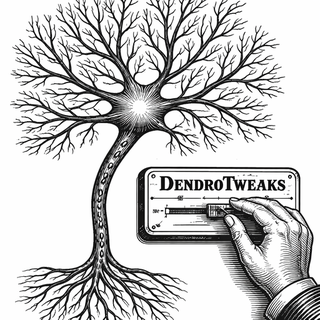
Disclaimer: The image accompanying this article is for illustrative purposes only and does not depict actual experimental results, data, or biological mechanisms.
References
-
Makarov, R., Chavlis, S., & Poirazi, P. (2025). DendroTweaks, an interactive approach for unraveling dendritic dynamics. eLife, 13:RP103324. DOI: 10.7554/eLife.103324 | PMCID: PMC12726829
-
Poirazi, P., & Papoutsi, A. (2020). Illuminating dendritic function with computational models. Nature Reviews Neuroscience, 21(6), 303-321. DOI: 10.1038/s41583-020-0301-7
-
Active Dendrites and Local Field Potentials: Biophysical Mechanisms and Computational Explorations. Neuroscience (2020). PMCID: PMC7612676