
Try this before you read another sentence: raise your hand a little too far, then correct it. That tiny course correction feels boring because your nervous system is showing off. Under the hood, a swarm of neurons just held a quick meeting about reward, error, timing, and whether your arm deserves a gold star for not smacking you in the face.
That is the territory of a new computational paper on the basal ganglia, one of the brain's deep motor hubs that behaves like a suspiciously powerful middle manager. The puzzle is elegant: the basal ganglia help you learn and adapt movements, but many well-learned movements can still run without much basal ganglia output. So what are these structures doing while your arm casually nails the job? Leblois, Boraud, and Hansel argue that the answer lives in the loop itself - a recurrent conversation among cortex, basal ganglia, and thalamus, not a one-way command chain [1].
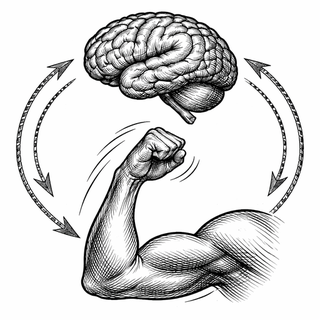
Not a Puppet Master - More Like a Training Partner
The central idea is that movement learning is not just the cortex improvising while dopamine sprays confetti from the balcony. In the model, the basal ganglia sit in a closed loop with cortex and thalamus. That loop can shape ongoing motor output while also nudging the system toward better future movements.
The authors combine three ingredients. First, the loop has its own internal dynamics, so activity can echo and settle into useful patterns instead of vanishing instantly. Second, recurrent cortical connections create attractor dynamics - stable states the network can fall into, like your brain finding the least embarrassing way to reach for a coffee mug. Third, dopamine-dependent plasticity at cortico-striatal synapses lets reward history tune the system over time [1].
Put less formally: the cortex is not practicing alone in a garage. It has a feedback-hungry bandmate downstairs.
Why This Matters for Real Movement
One big contribution of the paper is that it helps explain reward-based adaptation. If a movement works, the loop reinforces the neural patterns that got you there. If it fails, the system explores other options. That matters for tasks like reaching in a shifting environment, where the body has to keep recalibrating. The model also offers a possible mechanism for early "motor babbling" - those messy first attempts where the nervous system samples actions before it gets smooth.
This fits a broader shift in the field. Recent work has emphasized that motor learning depends on distributed circuits rather than a single heroic brain region in a lab coat. A 2024 Neuron review describes cortico-basal ganglia plasticity as a core feature of motor skill acquisition [2]. A 2024 Journal of Neuroscience review makes a similar point from the cortical side, arguing that motor learning reflects remodeling across multiple scales, from dendritic spines up to population dynamics [3].
In other words, the old cartoon where one area "does movement" and another area "does reward" is starting to look like it was drawn during a power outage.
Dopamine, the Tiny Editor with Strong Opinions
If reward is the headline, dopamine is the red pen.
A 2025 Nature Communications study showed that dopaminergic projections from the ventral tegmental area to primary motor cortex were necessary for the reorganization of cortical networks during motor learning. Block that dopamine input, and mice stopped improving on a reaching task even though previously learned movements stayed intact [4]. That is strikingly close to the logic of the new PNAS model: dopamine is not just a pleasure sticker slapped on success. It helps rewire the circuit so successful movement patterns become easier to find again.
Human studies are also creeping toward this circuitry with actual interventions instead of admiring it from afar. In 2023, researchers reported that noninvasive theta-burst temporal interference stimulation aimed at the striatum increased striatal activity and improved motor skill learning, especially in older adults [5]. That does not mean we are one gadget away from downloading tennis skills like Neo. Sadly, your jump shot still requires you to be involved.
Where This Could Go
If the model holds up, it could sharpen how people think about stroke rehab, Parkinson's disease, and neuroprosthetics. Reward-guided training might work better when it is designed around the actual loop structure that shapes adaptation, not just around repetition and grit. Reward is not a cheesy add-on. It may be part of the machinery that lets the motor system update itself.
There is still a catch, because of course there is. This paper is a theoretical model, not a clinical trial, and brains have a long tradition of humiliating anyone who confuses "plausible" with "settled." Still, it offers a strong answer to a nagging question in motor neuroscience: how can the basal ganglia help teach movements that cortex later performs almost on autopilot? By staying in the loop while the lesson is being written.
Your next corrected reach, tap, or half-decent catch may feel effortless. But somewhere inside your skull, a recurrent circuit has been rehearsing, voting, and editing like a very caffeinated wildlife colony.
References
- Leblois A, Boraud T, Hansel D. Reward-driven adaptation of movements requires strong recurrent basal ganglia-cortical loops. Proc Natl Acad Sci U S A. 2025;122(50):e2515994122. DOI: 10.1073/pnas.2515994122
- Roth RH, Ding JB. Cortico-basal ganglia plasticity in motor learning. Neuron. 2024;112(15):2486-2502. DOI: 10.1016/j.neuron.2024.06.014. PMCID: PMC11309896
- Economo MN, Komiyama T, Kubota Y, Schiller J. Learning and control in motor cortex across cell types and scales. J Neurosci. 2024;44(40):e1233242024. DOI: 10.1523/JNEUROSCI.1233-24.2024. PMCID: PMC11459264
- Ghanayim A, Benisty H, Cohen Rimon A, et al. VTA projections to M1 are essential for reorganization of layer 2-3 network dynamics underlying motor learning. Nat Commun. 2025;16:200. DOI: 10.1038/s41467-024-55317-4. PMCID: PMC11696230
- Wessel MJ, Beanato E, Popa T, et al. Noninvasive theta-burst stimulation of the human striatum enhances striatal activity and motor skill learning. Nat Neurosci. 2023;26(11):2005-2016. DOI: 10.1038/s41593-023-01457-7. PMCID: PMC10620076
Disclaimer: The image accompanying this article is for illustrative purposes only and does not depict actual experimental results, data, or biological mechanisms.