
Timing.
Not the kind that ruins a joke or saves a soufflé, but the microscopic, sub-millisecond kind your brain uses to figure out where a sound is coming from. Tilt your head toward a voice across a noisy room and you are, without trying, comparing the arrival times of sound at your two ears. The difference is staggeringly small - often well under a millisecond - and your brain measures it anyway. The flavor of this problem is mostly tension: a faint note of physics, a long finish of "how on earth does wet tissue pull this off."
A new study in eLife on the chicken brainstem offers an answer with an unexpected garnish. The hero of the story is not the neuron. It is the oligodendrocyte, the cell that wraps neurons in insulation - and apparently does so with the discerning fussiness of a tailor who refuses to use the same stitch twice.
A delay line walks into a bar
To localize a sound, birds (and you) use circuits that work like coincidence detectors. Signals from each ear race down long axons toward neurons that fire hardest when the two inputs arrive at exactly the same instant. To make that work, the brain has to fine-tune how fast each signal travels - speeding some paths up, slowing others down - so that the timing lands just right. These tunable cables are charmingly called "delay lines," and their conduction speed has to be precise to the point of obsession (Seidl et al., 2010).
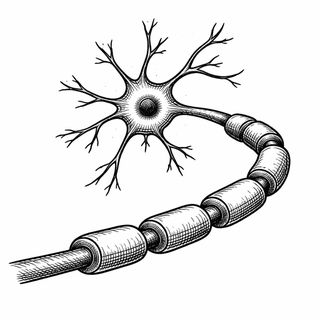
Here is the lever the brain pulls. Axons are wrapped in myelin, a fatty insulation broken up by tiny bare gaps called nodes of Ranvier. The electrical signal leaps from node to node, so the spacing between nodes - the internode length - sets the speed. Wide spacing, fast signal. Tight spacing, slower. In this auditory circuit, the spacing is deliberately biased: it changes along the length of a single axon, region by region, like a road that switches speed limits depending on the neighborhood.
The question the researchers chased: who decides where those speed-limit signs go?
The usual suspect has an alibi
The obvious guess is that the axon itself dictates the pattern - thicker here, thinner there, and the myelin just follows orders. Using painstaking 3D morphometry, the team reconstructed these axons and their wrapping cells in fine detail. The verdict had a bracing, slightly bitter note: axon structure did not explain internode length. The cable wasn't writing its own rules.
What did explain it were the oligodendrocytes. Across different regions of the circuit, these cells showed up wearing distinctly different outfits - varied shapes and varied population densities - and that regional personality tracked the biased node spacing (Egawa et al., 2026). The insulation crew, it turns out, has strong regional opinions about how to do the job. This echoes earlier work showing oligodendrocytes carry an intrinsic, built-in sense of how long to make their sheaths, even when you grow them in a dish away from any axon (Bechler et al., 2015).
Electrical activity: the supporting cast, not the lead
Naturally, you'd expect neural activity to be calling the shots - the brain loves to wire itself by experience. So the researchers silenced vesicular release from the axons, muting their chemical chatter. The result was a two-part tasting note. The biased spacing pattern and the oligodendrocyte shapes held steady - activity wasn't writing the script. But silenced axons developed bare, unmyelinated patches near their synaptic terminals, because the quiet suppressed the birth of new oligodendrocytes right where they were needed.
So activity isn't the architect. It's the staffing manager, making sure enough insulation cells show up for the shift. The blueprint comes from the oligodendrocytes' own intrinsic heterogeneity.
Why this lingers on the palate
For decades, myelin got cast as passive bubble wrap - structurally important, narratively dull. This work pours it a proper glass: oligodendrocytes are active sculptors of how fast a circuit thinks, with regional flavor profiles that fine-tune timing down to fractions of a millisecond.
The implications reach well past birdsong. Myelin precision underlies speech processing, motor coordination, and the timing-dependent computations scattered all over your nervous system. In diseases where myelin frays - multiple sclerosis being the headline example - it's usually treated as a matter of how much insulation is lost. This study hints that where and how it's patterned may matter just as much. Assuming the finding holds and extends to mammals, repairing myelin might one day require restoring not just coverage, but the regional artistry of the cells that lay it down.
Your sense of where a sound comes from rests on cells most people have never heard of, making decisions you'll never notice. The finish on that thought is humbling, with a lingering note of awe.
Disclaimer: The image accompanying this article is for illustrative purposes only and does not depict actual experimental results, data, or biological mechanisms.
References
- Egawa, R., Hiraga, K., Matsui, R., Watanabe, D., & Kuba, H. (2026). Regional heterogeneities of oligodendrocytes underlie biased Ranvier node spacing along single axons in sound localization circuit. eLife. https://doi.org/10.7554/eLife.106415 (PMID: 41432370)
- Bechler, M. E., Byrne, L., & ffrench-Constant, C. (2015). CNS Myelin Sheath Lengths Are an Intrinsic Property of Oligodendrocytes. Current Biology, 25(18), 2411-2416. https://doi.org/10.1016/j.cub.2015.07.056 (PMID: 26320951)
- Seidl, A. H., Rubel, E. W., & Harris, D. M. (2010). Mechanisms for Adjusting Interaural Time Differences to Achieve Binaural Coincidence Detection. Journal of Neuroscience, 30(1), 70-80. https://doi.org/10.1523/JNEUROSCI.3464-09.2010 (PMCID: PMC2823357)