
There are two types of people: the ones who think hearing is basically the ear acting like a tiny microphone, and the ones who suspect biology is never that tidy. The second group keeps winning. A new Cell Reports paper argues that normal hearing depends not just on the usual ion-channel suspects, but on a force-sensing GPCR called LPHN2 that helps cochlear hair cells feel mechanical force and pass the message along [1].
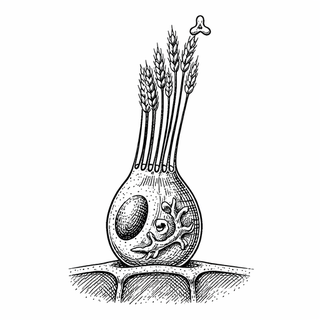
Hearing starts in cochlear hair cells, which wear bundles of stereocilia on top like absurdly delicate wheat stalks. Sound-driven motion bends those bundles, and that bend opens mechano-electrical transduction, or MET, channels. Mechanical force becomes electrical signal.
For years, the leading stars in this story have been proteins such as TMC1 and its partners, which sit near the tips of stereocilia and help form the MET machinery [2,3]. The broader picture has been that hair cells are exquisitely tuned mechanical devices, pruned by evolution with almost irritating precision [2].
This new study adds a twist. The authors found that LPHN2, also called ADGRL2, sits at stereocilia tips in cochlear hair cells and associates with known MET-channel components [1]. That is eyebrow-raising because LPHN2 belongs to the adhesion GPCR family, better known for signaling and cell-surface communication than for moonlighting as a molecular force detector in the ear [4,5].
A Molecule With Its Hand on the Gate
The core result is blunt: when the researchers removed LPHN2 specifically from hair cells in mice, hearing suffered and MET responses dropped [1]. When they used an LPHN2 inhibitor, MET responses were reversibly blocked [1]. That is the sort of result that makes the field put down its coffee for a minute.
Mechanistically, the paper proposes that force applied to LPHN2 activates TMC1 through physical interaction and changes TMC1 conformation [1]. The authors also report that LPHN2 force sensing boosts calcium responses and neurotransmitter release in hair cells [1]. So LPHN2 is not merely standing near the machinery. It appears to be participating in the first conversion step and helping drive the downstream signal.
If that holds up, it matters because the MET apparatus has long been treated as a very select club. This work suggests the guest list was incomplete. The door person, it turns out, may have been a GPCR all along, quietly checking wrists while the rest of us argued about the hinges.
Why This Is More Than a Niche Ear Fact
A related 2025 study found LPHN2 is also required in vestibular hair cells for normal balance, where it supports a tip-link-independent form of mechano-electrical transduction [5]. That makes the auditory paper feel less like an oddball and more like a pattern.
That idea lands in a field already rethinking how hair-cell mechanotransduction really works. Recent reviews note that the broad framework is known, but many details remain unsettled, especially around channel composition, force transmission, adaptation, and differences between auditory and vestibular systems [2,3].
There is also a bigger GPCR angle. Adhesion GPCRs are increasingly viewed as versatile receptors with unusual activation mechanisms and real therapeutic potential [4,5]. So the notion that one of them helps the ear detect force is not absurd.
What Could This Change Someday?
If LPHN2 really modulates TMC1-driven mechanotransduction in vivo, that opens a few practical doors. One is drug development. GPCRs are famously druggable compared with many mysterious membrane proteins, which means a receptor like LPHN2 could become a handle for tuning hair-cell sensitivity or protecting vulnerable cells.
Another is diagnosis and therapy design. Many forms of hearing loss trace back to broken hair-cell machinery. If LPHN2 is part of that machinery, then defects in force sensing may be more diverse than a simple "channel broken, hearing gone" story. The study even showed that expressing an LPHN2-GAIN construct in deficient cochlear hair cells prevented hearing loss in mice [1]. Early-stage mouse rescue is not a clinic, obviously, but it is a seedling.
The challenge, as ever, is translation. Mouse hair cells are not human ears. Molecular partnerships that look clean in controlled experiments can become less polite in living patients. And hearing depends on a whole cultivated landscape - hair bundles, synapses, ionic gradients, supporting cells, timing.
Even so, this paper gives the field a sharp new question: when your ear turns motion into meaning, is the first handshake with force partly brokered by a GPCR? That would have sounded eccentric not long ago. Now it sounds like the sort of idea we may wish we had taken seriously sooner.
References
- Zhou SH, Wang MW, Song ZC, et al. The force-sensing GPCR LPHN2 is indispensable for normal auditory function. Cell Reports. 2025;44(11):116519. DOI: https://doi.org/10.1016/j.celrep.2025.116519
- Zheng J, Holt JR, Peng AW. Mechanotransduction in mammalian sensory hair cells. Molecular and Cellular Neurosciences. 2022;118:103706. DOI: https://doi.org/10.1016/j.mcn.2022.103706. PubMed: https://pubmed.ncbi.nlm.nih.gov/35218890/
- Rutherford MA, von Gersdorff H, Goutman JD. Encoding sound in the cochlea: from receptor potential to afferent discharge. The Journal of Physiology. 2021;599(10):2527-2557. DOI: https://doi.org/10.1113/JP279189. PubMed: https://pubmed.ncbi.nlm.nih.gov/33644871/
- Sun JP, Xiao P, Liebscher I. The therapeutic potential of orphan adhesion G-protein-coupled receptors. Nature Reviews Drug Discovery. 2026. DOI: https://doi.org/10.1038/s41573-025-01371-6. PubMed: https://pubmed.ncbi.nlm.nih.gov/41748743/
- Yang Z, Song ZC, Wang MW, et al. A force-sensitive adhesion GPCR is required for equilibrioception. Cell Research. 2025;35:243-264. DOI: https://doi.org/10.1038/s41422-025-01075-x. PubMed: https://pubmed.ncbi.nlm.nih.gov/39966628/
Disclaimer: The image accompanying this article is for illustrative purposes only and does not depict actual experimental results, data, or biological mechanisms.