Good news: male fruit flies have a surprisingly elegant neural control system for reproduction, like a spring creek where every ripple arrives at the right stone. Bad news: it is attached to ejaculation, so we all have to be grown-ups for the next five minutes. A new eLife study mapped the motor neurons that innervate the internal male reproductive organs of Drosophila melanogaster, and the result is less "simple plumbing" and more "miniature orchestra."
The Body Has Choreography, Not Plumbing
When scientists talk about mating, it is easy to imagine the brain issuing one grand command: go forth and reproduce. Biology, naturally, saw that tidy idea and threw it into a compost heap.
Ejaculation requires timed contractions, sperm release, seminal fluid secretion, and coordination across organs. In flies, accessory glands make influential seminal fluid proteins, seminal vesicles store sperm, and the ejaculatory duct is the exit route, the biological equivalent of "please proceed to gate B12."
Chaverra and colleagues wanted to know what motor neurons talk to these organs, and what chemical language they use. Behavior is not just a brain event. It is a whole-body weather pattern. A decision made in the nervous system has to become muscle movement, gland secretion, and timing precise enough that sperm and seminal fluid end up where they need to go.
Two Neuron Classes Walk Into a Reproductive Tract
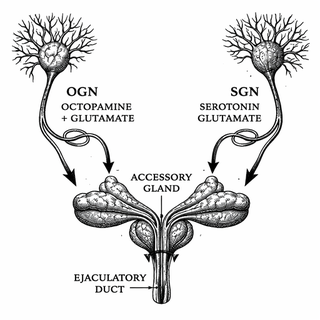
The team found two major classes of multi-transmitter motor neurons. Multi-transmitter means a neuron can release more than one chemical messenger. Think of it as a neuron texting in two languages because even cells enjoy making group chats complicated.
One class co-expressed octopamine and glutamate. The authors call these OGNs. Octopamine is an invertebrate neuromodulator often compared, loosely, to norepinephrine. The other class co-expressed serotonin and glutamate. These are SGNs. Glutamate often acts fast at fly neuromuscular junctions, while serotonin and octopamine can tune tissue responses more slowly.
The map was not random. SGNs mostly innervated the accessory glands. OGNs showed up strongly in the ejaculatory duct. The seminal vesicles received a more even mix. In other words, the reproductive tract is not getting one generic "contract now" signal. It gets organ-specific wiring with a chemical accent.
The Plot Twist Has Serotonin In It
Then came the functional tests. If the researchers silenced or disrupted the serotonergic-glutamatergic neurons, male fertility suffered. That points to SGNs as necessary players. But the octopaminergic-glutamatergic neurons, despite their prominent innervation of the ejaculatory duct, were dispensable for fertility in the tested conditions.
Even stranger, glutamatergic transmission from these classes also appeared dispensable for fertility. That does not mean glutamate is doing nothing. Biology rarely leaves a molecule standing around like an intern with no badge. It may shape timing or robustness under conditions the lab assays did not stress. But the headline is still inconvenient: the expected main motor signal was not the make-or-break factor here.
That is science at its best. You build a careful map, ask the obvious question, and the organism replies, "Cute theory."
Why Flies Are Not Just Tiny Lab Confetti
Fruit flies earn their reputation because researchers can label neurons, switch them on or off, trace anatomy, and test behavior with a precision that would be much harder in mammals. They are also not little humans in Halloween costumes, so we should not overclaim. This is not a new infertility treatment. Nobody should ask their doctor about octopamine levels.
But the broader idea matters. Human fertility also depends on coordinated neural, muscular, glandular, and hormonal systems. Problems can arise not only in sperm production, but in transport, emission, secretion, and timing. The fly gives researchers a tractable ecosystem where those moving parts can be separated and tested.
Recent work keeps showing that reproduction is an active conversation between nervous systems, organs, sperm, seminal fluid, and environment. One PNAS study followed how Drosophila sperm carry molecular signatures through male and female reproductive tracts. A 2024 Nature Communications paper found that males transfer a sugar-like seminal substance that helps tune female reproductive responses under nutritional stress. Even fly mating comes with metabolic fine print.
The Bigger Weather System
What I like about this study is that it makes fertility feel less like a switch and more like a season. Organs respond to chemical weather. Neurons send fast signals and slow moods. Receptors decide what each message means. The same molecule can be thunder in one place and drizzle in another.
If these findings hold up and expand, they give scientists a cleaner way to ask how reproductive motor programs adapt to age, nutrition, stress, competition, and disease. They also remind us that the nervous system does not stop at thought, sensation, or movement. It reaches into the private machinery of life itself, coordinating the old biological work of making the next generation. Quietly. Precisely. With a number of fruit flies involved that none of us should ponder before dinner.
References
Chaverra M, Toney JP, Dardenne-Ankringa LD, Knee JT, Morris AR, Wadhams JB, Certel SJ, Stowers RS. Two classes of amine/glutamate multi-transmitter neurons innervate Drosophila internal male reproductive organs. eLife. 2026;14:RP108225. DOI: 10.7554/eLife.108225.3
McCullough EL, Whittington E, Singh A, Pitnick S, Wolfner MF, Dorus S. The life history of Drosophila sperm involves molecular continuity between male and female reproductive tracts. Proceedings of the National Academy of Sciences. 2022;119(11):e2119899119. DOI: 10.1073/pnas.2119899119. PMCID: PMC8931355
Kim SJ, Lee KM, Park SH, et al. A sexually transmitted sugar orchestrates reproductive responses to nutritional stress. Nature Communications. 2024;15:8477. DOI: 10.1038/s41467-024-52807-3
Devineni AV, Scaplen KM. Neural circuits underlying behavioral flexibility: insights from Drosophila. Frontiers in Behavioral Neuroscience. 2022;15:821680. DOI: 10.3389/fnbeh.2021.821680. PMCID: PMC8770416
Disclaimer: The image accompanying this article is for illustrative purposes only and does not depict actual experimental results, data, or biological mechanisms.