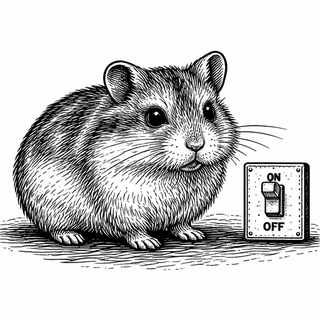
There's a word in German that has no English translation: Zeitgeber, meaning a "time-giver," the outside cue that tells a body what hour, or season, it is. Let me show you something: in a Djungarian hamster, winter is not just cold weather and a new coat. It is a wiring job. Short days hit the brain like a shop light clicking off early, and deep in the hypothalamus, a gene called Dio3 helps set the length of the whole seasonal program.
The Brain's Seasonal Tape Measure
You know the daily body clock, the circadian one. That is the 24-hour clock that makes coffee feel like medicine at 7 a.m. But animals also run longer timers. Circannual clocks help them handle seasons: breeding, weight changes, fur color, food use, and in some species, torpor or hibernation.
Djungarian hamsters are a good model because they do the winter routine with visible commitment. Under short winter-like days, they lose body mass, eat less, grow a pale coat, and can enter torpor. That is energy management with a clipboard.
The question was simple in the way a table saw is simple: obvious from a distance, dangerous up close. How does the brain measure a season?
Meet Dio3, the Hormone Dimmer Switch
The team sampled several hypothalamic regions and the pituitary gland across 32 weeks of short-day exposure. They found three broad waves of gene activity: induction, maintenance, and recovery. Start the machine, hold the setting, then back it out.
The early standout was Dio3, short for deiodinase type 3. Deiodinases adjust thyroid hormone signals inside tissues. Think of thyroid hormone as electrical current and deiodinases as breakers and dimmers. DIO2 tends to increase active T3 hormone locally. DIO3 does the opposite: it inactivates T3 and lowers the local thyroid-hormone signal.
That matters because the hypothalamus does not just read hormones in the blood like a lazy dashboard gauge. It makes local decisions. Specialized cells called tanycytes, which line the third ventricle, translate day-length signals into thyroid-hormone changes. They are the folks behind the wall who labeled every wire correctly, and therefore secretly run the building.
The Knockout Test: Cut the Wire, Watch the Clock
Correlation is nice, but biology has fooled better people than us before breakfast. So the researchers used CRISPR-Cas to target Dio3-expressing tanycyte cells in the mediobasal hypothalamus, then watched the hamsters go through short-day conditions.
The result: the animals still showed seasonal responses, but the timing changed. Mutating Dio3 shortened the period of the circannual interval timer. If the brain's seasonal timer were a kitchen timer, Dio3 was not just a decorative knob. It helped set how long the ding takes.
They also looked at hamsters that naturally do not respond to short photoperiods. These non-responders did not show the usual Dio3 increase, and they did not shift body mass or coat color into winter mode. When the Dio3 switch does not flip, the winter workshop does not open.
Why This Is Bigger Than One Very Organized Hamster
No, this does not mean your winter snack habits are controlled by a single hamster gene wearing a tiny hard hat. Humans are not Djungarian hamsters. Anyone selling you "Dio3 optimization" by Tuesday should be escorted away from the fuse box.
But the larger machinery is worth caring about. Human medical records reveal small but coordinated seasonal patterns in pituitary and peripheral hormones. Rhesus monkey data show broad seasonal gene-expression shifts across many tissues, including genes tied to metabolism, immunity, and drug handling. The body appears to keep seasonal notes, even if modern lighting and year-round strawberries have made the notes harder to read.
This paper adds a stronger part number to the seasonal timing diagram. Dio3 activity helps determine the period of a mammalian seasonal interval timer.
What Breaks, What Gets Built
The current challenge is that seasonal timing sits between neuroscience, endocrinology, ecology, and genetics. That is four toolboxes on one bench, how you lose the 10 mm socket. Researchers need to connect Dio3 to tanycytes, T3, body mass, and torpor.
If the findings hold up across species, this could sharpen how we think about seasonal physiology in wildlife, livestock, and eventually human health. It may help explain why timing matters for reproduction and metabolism, and why seasonal changes can affect mood, sleep, immune function, or medication response.
The big takeaway is clean: the brain does not just notice winter. In these hamsters, it builds winter with molecular switches, local hormone dimmers, and a timer that changes when one gene gets altered. Measure twice, cut once, and never assume the hypothalamus is just sitting there. It has a calendar, and apparently it keeps better records than most of us.
References
- Stewart C, Liddle TA, Tolla E, Lewis JE, Marshall C, Evans NP, Morgan PJ, Ebling FJP, Stevenson TJ. Hypothalamic deiodinase type-3 establishes the period of circannual interval timing in mammals. eLife. 2026;14:RP106383. doi: 10.7554/eLife.106383. PMID: 41527434. PMCID: PMC12799211.
- Melum VJ, Sáenz de Miera C, Markussen FAF, et al. Hypothalamic tanycytes as mediators of maternally programmed seasonal plasticity. Current Biology. 2024;34(3):632-640.e6. doi: 10.1016/j.cub.2023.12.042. PMID: 38218183.
- Tendler A, Bar A, Mendelsohn-Cohen N, et al. Hormone seasonality in medical records suggests circannual endocrine circuits. PNAS. 2021;118(7):e2003926118. doi: 10.1073/pnas.2003926118. PMCID: PMC7896322.
- Chen J, Okimura K, Ren L, et al. Non-human primate seasonal transcriptome atlas reveals seasonal changes in physiology and diseases. Nature Communications. 2025;16:3906. doi: 10.1038/s41467-025-57994-1. PMID: 40295482. PMCID: PMC12037758.
- Wirth EK, Schweizer U, Köhrle J. Thyroid hormone deiodinases: dynamic switches in developmental transitions. Endocrinology. 2021;162(8):bqab091. doi: 10.1210/endocr/bqab091. PMID: 33963379. PMCID: PMC8248586.
Disclaimer: The image accompanying this article is for illustrative purposes only and does not depict actual experimental results, data, or biological mechanisms.