
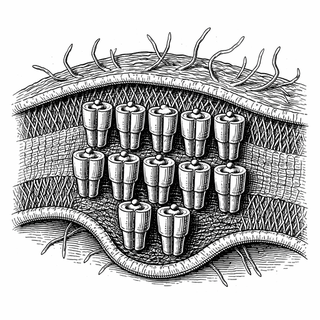
The surprise was hiding in the floor plan: when Arnould and colleagues got a clean look at P2X7 receptors on living microglia-like cells, the receptors did not sit there like polite doorbells. Under inflammatory conditions, they multiplied and bunched into nanoscale clusters, like a work crew dragging every smoke alarm into one corner because somebody smelled trouble.
Meet P2X7, the Panic Hardware
P2X7 is a receptor, which means it sits in a cell membrane and waits for a chemical knock. Its favorite knock is ATP, the molecule your cells use as energy money. Inside cells, ATP is payroll. Outside cells, it is a busted water main.
That matters because injured or stressed tissue can spill ATP outside cells. Microglia, the brain's resident immune inspectors, read that spill as damage. P2X7 helps them decide whether to roll a truck, put up cones, and start inflammatory repair work.
The problem is that P2X7 has been hard to watch at the single-molecule level in native cells. Antibodies can be fussy. Overexpressed tagged receptors can behave like contractors who show up with seven extra cousins and ruin the headcount. So the team built X7-uP, a chemical labeling tool that binds P2X7 and attaches biotin. Add fluorescent streptavidin, use super-resolution imaging, and the receptor map gets sharp enough to inspect the studs.
The Cell Membrane Has a Seating Chart
In resting BV2 cells, a mouse microglial cell line, P2X7 receptors appeared as individual units across the membrane. Not empty. Not chaotic. More like tools hung neatly on a pegboard.
Then the researchers activated the cells with lipopolysaccharide, or LPS, a bacterial molecule biologists use when they want immune cells to stop sipping coffee and start flipping tables. Add ATP, and the response got louder. P2X7 levels rose, receptors clustered, and the cells released more interleukin-1 beta. That is rewiring the alarm panel while the siren is already screaming.
The paper's main win is the method and the view it gives. X7-uP let the authors label endogenous P2X7, then use dSTORM-style super-resolution microscopy to see receptor organization below the usual blur limit. For a membrane protein, that is like replacing a blurry satellite photo with a tape measure and a hard hat.
Why Clustering Could Matter
Cells are not bags of soup. They are job sites with zoning rules. Where a receptor sits, how many neighbors it has, and whether it clusters near other machinery can change the outcome. Put one emergency exit in a warehouse and you have a code violation. Put twenty in the right places and everybody gets out before the popcorn machine catches fire.
For P2X7, clustering may help explain why activated microglia respond so strongly to extracellular ATP. P2X7 activation can help drive NLRP3 inflammasome signaling and release of IL-1 beta, a pathway repeatedly linked to neuroinflammation. Recent human microglia work also found that ATP-driven IL-1 beta release required P2X7 activity, while another channel, THIK-1, shaped the inflammatory response in a more microglia-specific way Rifat et al., 2024. Translation: P2X7 is a big switchboard, but it is not the only breaker in the room.
That nuance matters for therapy. Reviews connect P2X7 signaling to Alzheimer's disease, Parkinson's disease, multiple sclerosis, and ALS, while warning that P2X7 can play different roles depending on timing, cell type, and disease stage Liu et al., 2024. Biology loves fine print. It is basically a legal department with mitochondria.
The Real-World Angle, If This Holds Up
If these findings reproduce in primary microglia, animal models, and human tissue, they could give researchers a better way to measure inflammatory readiness at the membrane itself. Not just "is P2X7 present?" but "is P2X7 arranged like a calm neighborhood or like scaffolding around a five-alarm renovation?"
That could help drug developers. P2X7 antagonists have been explored for inflammatory and neurodegenerative conditions, but targeting this receptor is tricky because it appears across immune and nervous-system contexts. A nanoscale map could show when P2X7 is merely installed, when it is mobilized, and when blocking it might prevent cytokine release instead of just swinging a hammer at the wall.
There are caveats. BV2 cells are useful, but they are still a model, not a full brain with neurons, astrocytes, blood vessels, and tenants arguing over thermostat settings. LPS and ATP are strong triggers. Clustering does not prove causation. It points to a mechanism worth testing with sturdier beams.
The Bottom Line
This study gives P2X7 researchers a sharper inspection tool and shows that microglial activation can rearrange P2X7 at nanoscale resolution. The receptor does not just answer the ATP alarm. It may change its layout as inflammation ramps up.
For a tiny membrane channel, that is a lot of attitude. But in brain inflammation, layout is load-bearing.
References
Arnould B, Martz A, Belzanne P, Peralta FA, Cevoli F, Hovhannisyan V, Goumon Y, Hosy E, Specht A, Grutter T. Affinity-guided labeling reveals P2X7 nanoscale membrane redistribution during BV2 microglial activation. eLife. 2026;14:RP106096. https://doi.org/10.7554/eLife.106096. PMCID: PMC12788799.
Rifat A, Ossola B, Bürli RW, et al. Differential contribution of THIK-1 K+ channels and P2X7 receptors to ATP-mediated neuroinflammation by human microglia. Journal of Neuroinflammation. 2024;21:58. https://doi.org/10.1186/s12974-024-03042-6. PMCID: PMC10895799.
Liu X, Li Y, Huang L, et al. Unlocking the therapeutic potential of P2X7 receptor: a comprehensive review of its role in neurodegenerative disorders. Frontiers in Pharmacology. 2024;15:1450704. https://doi.org/10.3389/fphar.2024.1450704. PMCID: PMC11319138.
Huang Q, Ying J, Yu W, et al. P2X7 Receptor: an Emerging Target in Alzheimer's Disease. Molecular Neurobiology. 2024;61:2866-2880. https://doi.org/10.1007/s12035-023-03699-9. PMCID: PMC11043177.
Bianchi C, Alvarez-Castelao B, Sebastián-Serrano Á, et al. P2X7 receptor inhibition ameliorates ubiquitin-proteasome system dysfunction associated with Alzheimer's disease. Alzheimer's Research & Therapy. 2023;15:105. https://doi.org/10.1186/s13195-023-01258-x. PMCID: PMC10245610.
Oliveira-Giacomelli Á, Petiz LL, Andrejew R, et al. Role of P2X7 Receptors in Immune Responses During Neurodegeneration. Frontiers in Cellular Neuroscience. 2021;15:662935. https://doi.org/10.3389/fncel.2021.662935. PMCID: PMC8187565.
Disclaimer: The image accompanying this article is for illustrative purposes only and does not depict actual experimental results, data, or biological mechanisms.