
The researchers kept staring at the scans, half-expecting the pattern to dissolve if they blinked. In the adult brains, two weeks after learning, the memory traces had thinned out exactly the way the textbooks promised. But in the children, something stranger had crept in overnight. Where the fine grain of a specific memory should have lived, a vaguer shape had quietly taken its place, like fog rolling in to fill the outline of a house. The kids hadn't just forgotten less precisely. They had remembered differently.
That uncanny little fog bank is the heart of a study from a team led by Iryna Schommartz and Yee Lee Shing, published in eLife. They wanted to know something most of us never think to ask: when a memory gets older, does it age the same way in a six-year-old as it does in a grown-up? Spoiler from the night shift of the brain: absolutely not.
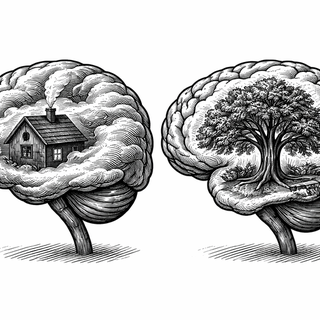
What they actually did
Forty-nine children between five and seven, and thirty-nine young adults, learned a set of object-scene pairings. A toy here, a beach there. The trick is in the spacing. The team tested memory three times: right after learning, after one night of sleep, and again two full weeks later. While people lay in an fMRI scanner trying to recall their pairs, the researchers ran something called representational similarity analysis, which is a fancy way of eavesdropping on whether the brain replays the same exact pattern it produced during learning. Think of it as checking whether the brain is humming the original song or just the general melody.
The kids forgot faster, and that part isn't surprising
Children lost memories more steeply than adults, especially the older, two-week-old ones. Anyone who has watched a kindergartener swear they have never seen broccoli before in their life will find this unremarkable. Memory consolidation, the slow process by which fragile new memories get filed into long-term storage, is still under construction in young brains. The hardware is being soldered together while it's running.
The interesting part is where the wiring lagged. When adults reached back for an older memory, regions like the posterior parahippocampal gyrus, the lateral occipital cortex, and the cerebellum lit up more, the brain leaning harder on cortex to hold a remote memory in place. In children, that upward shift barely happened. Their neocortical filing cabinet wasn't refusing to open so much as it hadn't finished being built.
Here's the plot twist
Both groups showed the same sad, universal trend: the scene-specific detail, that precise neural fingerprint of this beach with that toy, faded with time. Memories lose their resolution as they age. We all become impressionist painters of our own past.
But only in the children did something new bloom to take its place. In two prefrontal regions, the medial and ventrolateral prefrontal cortex, the kids' brains started producing gist-like representations by day fourteen. Not "the red ball on the blue rug," but a smudgier, more categorical "ball, rug, something like that." The adults weren't doing this. The children's brains, unable to keep the high-resolution copy, seemed to be sketching a rough draft and calling it a day.
It's tempting to read this as a deficit, and partly it is. But there's an elegant logic to it. A young brain has barely any scaffolding to hang specific memories on, so it may hoard the gist first, the general shape of how the world works, and worry about the fine print later. The forest before the trees. It may even be a clue to childhood amnesia, that strange fog over our earliest years that almost none of us can see through.
Why you should care, even if you're not five
If detailed and gist-based memories follow different developmental timelines, then how we teach, test, and trust the memories of young children deserves a rethink. A child recounting an event may genuinely hold the emotional and categorical truth of it while losing the specifics, which matters enormously in classrooms and, more soberly, in courtrooms. And understanding how the healthy young brain transforms memory gives us a baseline for spotting when development goes sideways.
The brain, it turns out, doesn't simply store the past. It renovates it, and the youngest renovators have their own peculiar style.
References
Schommartz, I., Lembcke, P. F., Ortiz-Tudela, J., Bauer, M., Kaindl, A. M., Buss, C., & Shing, Y. L. (2025). Neural correlates and reinstatement of recent and remote memory in children and young adults. eLife. https://doi.org/10.7554/eLife.89908 (PMCID: PMC12680376)
Schommartz, I., et al. (2022). Distinct multivariate structural brain profiles are related to variations in short- and long-delay memory consolidation across children and young adults. Developmental Cognitive Neuroscience. https://pubmed.ncbi.nlm.nih.gov/36566622/
Dudai, Y., Karni, A., & Born, J. (2015). The Consolidation and Transformation of Memory. Neuron. https://doi.org/10.1016/j.neuron.2015.09.004
Sekeres, M. J., Winocur, G., & Moscovitch, M. (2018). The hippocampus and related neocortical structures in memory transformation. Neuroscience Letters. https://doi.org/10.1016/j.neulet.2018.05.006
Yonelinas, A. P., Ranganath, C., Ekstrom, A. D., & Wiltgen, B. J. (2019). A contextual binding theory of episodic memory: systems consolidation reconsidered. Nature Reviews Neuroscience. https://doi.org/10.1038/s41583-019-0150-4
Disclaimer: The image accompanying this article is for illustrative purposes only and does not depict actual experimental results, data, or biological mechanisms.