
Step 1: a signal fires. Step 2: nothing happens. Step 3: everything happens. Ladies and gentlemen of the readership, the evidence is in: a leech crawling across a surface is not just a tiny wet accordion with ambition. It is a courtroom drama in miniature, where neurons argue over timing, inhibition objects at exactly the right moment, and the final verdict is movement.
Exhibit A: The Crawl Is Not Chaos
Leeches crawl by alternating elongation and contraction. Front end anchors, body stretches, rear end catches up, repeat. Elegant? In its own squishy, pond-adjacent way, yes.
The new eLife study by Radice and colleagues asks a deceptively simple question: when a rhythmic motor pattern is already running, how do premotor signals tune the actual motoneurons that make muscles contract? The team used the leech nervous system because it offers a rare legal advantage: identified neurons you can record from and manipulate directly, instead of squinting at a billion-cell mammalian circuit and muttering, "Objection, too many suspects."
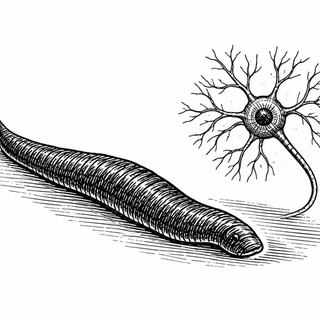
The star witness is a nonspiking premotor neuron called the NS neuron. It forms a recurrent inhibitory circuit, meaning motor-related activity loops back to restrain motor output. Vertebrates have a famous version of this idea in Renshaw cells, spinal interneurons that help regulate motoneuron firing. Think of recurrent inhibition as the courtroom bailiff: not running the trial, but very invested in keeping the shouting under control.
Exhibit B: Timing Is the Trick
The key twist is that the NS neuron did not simply press a universal "quiet down" button. The researchers evoked fictive crawling in isolated leech ganglia, recorded motor activity, and manipulated the NS neuron electrically. They also compared the isolated ganglion rhythm with behavior, showing that the motor pattern preserved phase relationships seen during real crawling.
Motor circuits are not just about which neurons connect. They are about when those connections matter. A signal that helps during elongation may hinder during contraction. Same wire, different courtroom context. Ask during opening arguments and you are strategic; ask while the judge reads the verdict and you are being escorted out.
NS activity changed motoneuron excitation in a phase-specific way. The study points especially to reduced firing in motoneurons recruited during the contraction phase. So the NS neuron looks less like a crude brake and more like a timing-sensitive volume knob, turning down selected output when the crawl cycle says, "Not now, counselor."
Cross-Examination: Why Should We Care About a Leech?
Fair question, juror number seven. Leeches are not tiny humans in trench coats. But simple nervous systems expose principles that bigger systems bury under biological paperwork.
Central pattern generators, or CPGs, are neural circuits that can produce rhythmic outputs such as walking, swimming, breathing, and crawling. Recent reviews frame CPGs not as rigid metronomes but as adaptable systems shaped by feedback, descending signals, motor neurons, and sensory context. In other words, the nervous system does not merely hit "play" on a movement playlist. It DJs live, occasionally with questionable lighting.
This leech study adds a sharp piece of evidence: premotor inhibition can tune motor output according to phase. That supports a broader idea in motor neuroscience: movement depends on dynamic circuit state, not just a static wiring diagram. The connectome tells you who can talk to whom. It does not tell you who is whispering, interrupting, or quietly sabotaging the meeting with a spreadsheet.
The Real-World Brief
If findings like this replicate and expand across systems, they could help explain how nervous systems make rhythmic movement stable but flexible. That has relevance for spinal cord injury research, neuromodulation, rehabilitation, and bio-inspired robotics. The practical dream is not "put leech neurons in a walking robot," which sounds like a grant proposal written during a fever. The dream is to learn control rules: when to inhibit, where to inhibit, and how to tune output without freezing the whole system.
Current challenges are stubborn. Motor circuits must coordinate muscles, adapt to terrain, recover from perturbations, and avoid turning movement into either jelly or lockjaw. Inhibition is central to that balancing act. Too little restraint and the system overfires. Too much and nothing moves. The nervous system, like a good trial lawyer, wins by controlling timing.
Closing Argument
Radice and colleagues give us a clean case study in motor control. A premotor inhibitory neuron in the leech does not merely dampen activity. It modulates motoneurons according to crawl phase. That is a small animal with a big lesson: movement is not commanded by brute force. It is negotiated through circuits that know when to speak and when to shut up.
The verdict: inhibition is not the villain. It is the editor. And sometimes the whole story works because one neuron knows exactly when to cut a line.
References
- Radice M, Sanchez Merlinsky A, Yulita F, Szczupak L. Phase-specific premotor inhibition modulates leech rhythmic motor output. eLife. 2026;14:RP104921. doi:10.7554/eLife.104921. PMCID: PMC12782552
- El Manira A. Redefining the central pattern generator for vertebrate locomotion. Nature Reviews Neuroscience. 2026;27:327-344. doi:10.1038/s41583-026-01029-1
- Calabrese RL, Marder E. Degenerate neuronal and circuit mechanisms important for generating rhythmic motor patterns. Physiological Reviews. 2025;105:95-135. doi:10.1152/physrev.00003.2024
- Braun J, Hurtak F, Wang-Chen S, et al. Descending networks transform command signals into population motor control. Nature. 2024;630:686-694. doi:10.1038/s41586-024-07523-9
- Ashaber M, Tomina Y, Kassraian P, et al. Anatomy and activity patterns in a multifunctional motor neuron and its surrounding circuits. eLife. 2021;10:e61881. doi:10.7554/eLife.61881. PMCID: PMC7954528
Disclaimer: The image accompanying this article is for illustrative purposes only and does not depict actual experimental results, data, or biological mechanisms.