
If this were a movie, afadin would be the foreman who never appears on screen but keeps the whole assembly line in spec. It's a small adaptor protein, the kind of part nobody asks about until it's missing. It clips the nectin adhesion molecules to the actin cables that run through a cell's frame, and in doing so it tells developing neurons where to park. Pull that foreman off the floor, and you'd expect the line to seize up entirely. A new study in eLife yanked afadin out of the mouse retina and found something stranger: the factory built a crooked, half-assembled product, and the thing still partially worked.
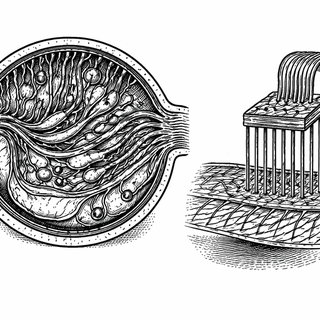
What the retina is supposed to look like under the hood
A healthy retina is laid out like a layered transmission. Photoreceptors sit up top catching light, bipolar cells pass the signal down the middle, and retinal ganglion cells at the bottom ship the data out the optic nerve to the brain. Clean layers, called lamination, keep the wiring short and the synapses where they belong. The whole stack is held in alignment by adherens junctions, the spot welds between neighboring cells. Afadin is part of what lays those welds during construction.
So when this team knocked afadin out of mouse retinas, they essentially removed the jig that holds the panels square while everything sets. Predictably, the outer layers came out warped. Photoreceptors went missing or ended up in the wrong bay. Their outer segments, the part that actually does the light-catching, were sparse and scattered. The photoreceptor synapses, where the signal hands off to the next cell, were both reduced in number and bolted in the wrong locations. By every structural measure, this was a retina that failed inspection.
The part where it should have died but didn't
Here's where the engine cough turns interesting. You'd assume a retina this disorganized would throw nothing but noise. Instead, the researchers stuck electrodes on the tissue and still picked up small local field potentials, including the a-wave and b-wave. Those are the standard idle signals you measure to confirm photoreceptors are firing and passing current downstream. Weak, but present. The fuel was still reaching the cylinders.
Then they went further. Using a multi electrode array, basically a dense grid of sensors that listens to hundreds of output cells at once, they flashed light at the retina and sorted the ganglion cells by how they responded. They found the full standard set: ON cells that fire when the light comes up, OFF cells that fire when it drops, and ON-OFF cells that react to both. They even mapped receptive fields for some of these cells, meaning the cells still had a defined patch of visual space they cared about. A retina built without its foreman was still running the basic diagnostics a normal one runs.
Why a sloppy build still drives
The takeaway is that lamination and circuit function are not as welded together as the textbooks imply. Tidy layers make for efficient wiring, but the study shows the underlying circuit can limp along even when the chassis is bent and half the synapses are in the wrong place. The signal-processing logic, ON versus OFF, center versus surround, apparently survives a fair amount of physical chaos. This lines up with a companion eLife paper showing afadin's main job is sorting neuron types into their correct layers (Tachibana et al., 2025), and with work on laminin γ3 showing that wrecking lamination wrecks photoreceptor organization too (Hunter et al., 2018).
For anyone trying to repair vision, that's a useful piece of news. Plenty of degenerative eye diseases and any future stem-cell or organoid transplant will produce retinas that are structurally rough around the edges. If a circuit can still process light despite bad lamination and misplaced synapses, then a rebuilt retina doesn't have to be factory-perfect to be worth installing. It just has to get enough current through the line. That changes the bar for what counts as a successful repair, and it's a lower bar than most people assumed.
None of this means crooked retinas see well. The signals were small and the build was genuinely bad. But it does mean the retina is a more forgiving machine than its precision layout suggests, and that the wiring diagram and the floor plan can come apart without the whole thing stalling.
References
- Ueno A, Sakuta K, Ono H, et al. (2025). Afadin-deficient mouse retinas exhibit severe neuronal lamination defects but preserve visual functions. eLife. DOI: 10.7554/eLife.105627. PMC12721710
- Companion study on afadin sorting retinal neuron types into accurate cellular layers. eLife. Article 105575
- Cellular and Molecular Mechanisms Regulating Retinal Synapse Development. Annual Review of Vision Science. DOI: 10.1146/annurev-vision-102122-105721
- Role of laminin γ3 in retinal lamination, photoreceptor organisation and ganglion cell differentiation. PMC5966411
Disclaimer: The image accompanying this article is for illustrative purposes only and does not depict actual experimental results, data, or biological mechanisms.