
Neural development is less like a grand blueprint and more like a rhythm section trying to keep perfect time while half the band is still assembling its instruments. In the developing eye, cells have to arrive on cue, hit the right entrance, and not wander off like the drummer who "just wants to experiment." This new paper suggests retinal microglial precursors do not freelance their route. They follow vascular sheet music, and one of the key notes is a basement-membrane protein called Lamb1 [1].
Tiny immune cells, expensive mistakes
Microglia are the resident immune cells of the central nervous system, including the retina. They are part janitor, part security, part quality-control department. During development, they help clear debris, shape circuits, and support healthy tissue formation.
The economic problem here is simple: getting the right cells to the right place at the right time is cheaper than fixing a badly assembled retina later. The question in this study was blunt and important: how do microglial precursors actually get into the developing retina?
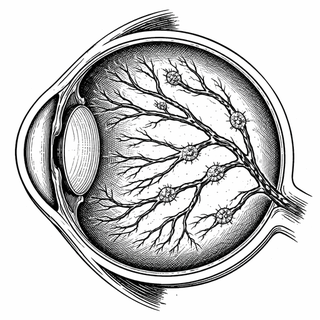
Researchers led by Dan Zhan used zebrafish embryos, where transparent tissues make cell-tracking much easier, plus mouse experiments to test whether the same basic strategy shows up in mammals.
Follow the blood vessels, please
The team found that microglial precursors enter the vitreous space by traveling along blood vessels, especially the ventral radial vessel and hyaloid vein, before moving into the retina itself [1]. Think less random wandering, more airport moving walkway.
But the vessels are not just passive scaffolding. The study argues that vascular Lamb1 acts like a haptotactic cue - a sticky directional signal in the extracellular matrix. Microglial precursors sense that cue through integrin alpha6, or Itga6, which then activates Rac1 signaling inside the cells. Rac1 helps polarize F-actin so the cells can move with a front end and a back end instead of behaving like confused luggage [1].
When the researchers disrupted blood vessels, or interfered with the Lamb1-Itga6 pathway, the microglial precursors had trouble entering the vitreous space and colonizing the retina. In mice, endothelial loss of LAMB1 also impaired precursor settlement, which makes the whole story look less like a zebrafish-only side quest and more like a conserved developmental rule [1].
Why this is sneakily a big deal
On the surface, this sounds niche. But this finding plugs into a bigger theme: microglia and blood vessels coordinate early neural development more tightly than we used to think.
That fits with other recent work. A 2022 Nature Neuroscience paper found an early zebrafish microglia precursor population that depends on lymphatic-associated routes to seed the embryonic brain [2]. A 2022 Progress in Retinal and Eye Research review lays out just how choreographed early retinal development is, and a 2024 Trends in Neurosciences review reinforces that microglia are active regulators of neural circuits rather than decorative immune parsley sprinkled on top of the nervous system [3,4].
In other words, the retina is not built by neurons alone. It is a coordinated market with endothelial cells, matrix proteins, glia, and migrating immune cells all making bids, trades, and occasional regrettable decisions. Lamb1 looks like part of the routing infrastructure.
So what could this matter for in real life?
Not in the "new treatment next Tuesday" sense. Biology hates that kind of optimism and usually sends it an invoice.
But if these mechanisms hold up, they could matter for diseases where retinal immune behavior and vascular biology collide. Recent retinal research has linked microglial migration and state changes to degeneration and protection in conditions like age-related macular degeneration, where specialized microglia can actually help limit damage at atrophic sites [5]. Broader clinical coverage in 2024 and 2025 keeps circling the same pressure point: retinal disease is often a mix of neuronal stress, vascular dysfunction, and immune response, not a one-bad-guy movie.
That makes developmental route-maps valuable. If scientists understand how microglia are normally guided into retinal tissue, they may get better at recognizing what goes wrong in disease, or at designing therapies that encourage protective immune behavior.
The fine print nature always sneaks into the contract
There are obvious caveats. This is developmental biology, not a clinical trial. The core mechanistic work is in zebrafish, with supportive conservation data in mice [1]. Retinal microglia in embryos are not the same thing as microglia reacting inside an aging human eye.
Still, this paper answers a clean question with a clean mechanism: blood vessels do more than carry blood. In the developing retina, they also post directional signs for incoming microglial precursors. One of those signs is Lamb1, read through Itga6 and executed through Rac1. The cells, apparently, prefer infrastructure.
References
- Zhan D, Xu L, Mu W, Jin B, Feng Z, Liu S, Wu C, Luo L, Li L. Vascular Lamb1 guides the migration of retinal microglial precursors via Itga6-Rac1 signaling. Cell Reports. 2025. DOI: https://doi.org/10.1016/j.celrep.2025.116544. PubMed: https://pubmed.ncbi.nlm.nih.gov/41206867/
- Green LA, MacPherson AM, Haugh WE, et al. The embryonic zebrafish brain is seeded by a lymphatic-dependent population of mrc1+ microglia precursors. Nature Neuroscience. 2022;25:992-1005. DOI: https://doi.org/10.1038/s41593-022-01091-9. PMCID: https://pmc.ncbi.nlm.nih.gov/articles/PMC10680068/
- Diacou R, Nandigrami P, Fiser A, et al. Cell fate decisions, transcription factors and signaling during early retinal development. Progress in Retinal and Eye Research. 2022;91:101093. DOI: https://doi.org/10.1016/j.preteyeres.2022.101093. PMCID: https://pmc.ncbi.nlm.nih.gov/articles/PMC9669153/
- Zhao S, Umpierre AD, Wu LJ. Tuning neural circuits and behaviors by microglia in the adult brain. Trends in Neurosciences. 2024;47(3):181-194. DOI: https://doi.org/10.1016/j.tins.2023.12.003. PMCID: https://pmc.ncbi.nlm.nih.gov/articles/PMC10939815/
- Yu C, Lad EM, Mathew R, et al. Microglia at sites of atrophy restrict the progression of retinal degeneration via galectin-3 and Trem2. Journal of Experimental Medicine. 2024;221(3):e20231011. DOI: https://doi.org/10.1084/jem.20231011. PMCID: https://pmc.ncbi.nlm.nih.gov/articles/PMC10826045/
Disclaimer: The image accompanying this article is for illustrative purposes only and does not depict actual experimental results, data, or biological mechanisms.