
We still don't fully understand why some brains slide into addiction and others don't, even when the same drug hits the same circuits. But this paper gets us closer, by diving into a speck of tissue most people have never heard of and watching opioids do something genuinely two-faced down there.
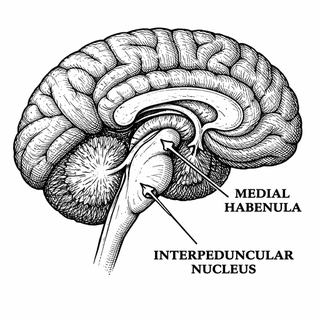
The speck is called the medial habenula, and its downstream partner is the interpeduncular nucleus. Together they form a circuit buried near the center of the brain like a hydrothermal vent on the ocean floor: small, dark, easy to overlook, and quietly running chemistry that the rest of the system depends on. This circuit happens to carry one of the densest concentrations of mu-opioid receptors anywhere in the brain, which is the molecular dock where morphine, heroin, and fentanyl tie up. You'd think we'd have mapped what they do here. We mostly hadn't.
Two Hands on the Same Lever
Here's the strange part. When researchers from the National Institutes of Health activated those opioid receptors in mouse brain slices, the circuit didn't respond with a simple yes or no. It did both at once.
On one channel, opioids turned the volume down. Glutamate, the brain's main "go" signal, got quieter. Standard opioid behavior, nothing shocking.
But on a second channel, the same opioid signal cranked the volume up. A different population of neurons, the ones that release substance P and acetylcholine together (yes, some neurons multitask and fire off two chemical messages in one go), got louder. So opioids weren't dimming the lights. They were rewiring which conversations in the room got heard. Imagine a sound engineer who mutes the lead singer while secretly boosting the backup vocalists nobody was listening to. The song that comes out is not the song that went in.
A Switch That Doesn't Exist in Children
Then it gets unsettling in a way that should make any parent pause. That second effect, the volume-up trick, isn't present in young mice. It only switches on during later adolescence.
Sit with that. The brain builds a brand-new opioid response during the exact developmental window when humans are most likely to first encounter drugs. The circuit isn't born vulnerable in this particular way. It becomes vulnerable, right on schedule, like a trapdoor that only finishes installing itself in your teens.
The Potassium Channel Bouncer
The team also found what was keeping the lid on all this. A class of potassium channels called Kv1 acts like a bouncer on the cholinergic signal, holding nicotinic receptors in check. Opioids could only boost that arm of transmission after the Kv1 brake was released. No brake removal, no potentiation. It's a two-key system, and the brain normally keeps one key locked away.
This matters because nicotinic receptors in this circuit are the same machinery already tied to nicotine addiction and the misery of withdrawal (Frahm et al., 2015; Ciscato et al., 2025). So this little nucleus is a crossroads where opioids and the nicotine system run into each other in the dark, which may help explain why these addictions so often travel together.
Why Bother With a Speck
The honest answer is that the habenula-interpeduncular circuit keeps showing up in the biology of addiction, anxiety, and mood regulation, and we keep underestimating it (McLaughlin et al., 2017). Mu-opioid receptors here have already been linked to the aversive, white-knuckle side of opioid experience (Boulos et al., 2019). Understanding the granular wiring is the part that's been missing.
If this holds up and extends to humans, it reframes how we think about fentanyl and the adolescent brain. The drug isn't just flooding a reward system; it may be hijacking a circuit that only recently grew the receptors to be hijacked. That's a different therapeutic problem, and a more precise one, which is usually good news for the people designing treatments.
None of this fixes the overdose crisis tomorrow. But knowing exactly which lever the drug grabs, and when that lever even appears, is how you eventually build something to block its hand. The vent on the ocean floor turns out to be running the chemistry after all. We're just now learning to read it.
Disclaimer: The image accompanying this article is for illustrative purposes only and does not depict actual experimental results, data, or biological mechanisms.
Reference
Chittajallu R, Vlachos A, Caccavano AP, Yuan X, Hunt S, Abebe D, London E, Pelkey KA, McBain CJ. Complex opioid-driven modulation of glutamatergic and cholinergic neurotransmission in a GABAergic brain nucleus associated with emotion, reward, and addiction. eLife. 2025. DOI: 10.7554/eLife.106062. PMID: 41324357. PMC12668670
Further Reading
- McLaughlin I, Dani JA, De Biasi M. The medial habenula and interpeduncular nucleus circuitry is critical in addiction, anxiety, and mood regulation. J Neurochem. 2017. PMC6740332
- Frahm S, et al. An essential role of acetylcholine-glutamate synergy at habenular synapses in nicotine dependence. eLife. 2015. PMC4718731
- Ciscato M, et al. Nicotinic Receptors in the Medial Habenula to Interpeduncular Nucleus Pathway: Modulators of Reward, Aversion and Emotion. Eur J Neurosci. 2025. DOI: 10.1111/ejn.70352
- Boulos LJ, et al. Mu opioid receptors in the medial habenula contribute to naloxone aversion. Neuropsychopharmacology. 2019. DOI: 10.1038/s41386-019-0395-7