
The paper is called "Strikingly different neurotransmitter release strategies in dopaminergic subclasses." Translated out of journal-speak into something you could say while waiting for the oven timer: two nearly identical brain cells turn out to plate their food from completely different parts of the kitchen, and nobody saw it coming. I promise that's the last time I'll call neurons chefs. (It is not the last time. Sorry in advance.)
First, a word about who's releasing what
Neurons talk to each other by squirting out chemical messengers called neurotransmitters. The classic rulebook says this happens at the axon, the long output cable every neuron is supposed to have. The axon is the takeout window. The dendrites, those bushy branches, are supposed to be the ears, taking orders, not handing out food.
Except brains love breaking their own rules. Plenty of cells release neurotransmitter straight from their dendrites, a back-door delivery service scientists have been chewing on for decades (Ludwig & Pittman, 2003). So the real question was never "can dendrites serve food?" It was "who's using the front door, who's using the back, and do family members even agree on this?"
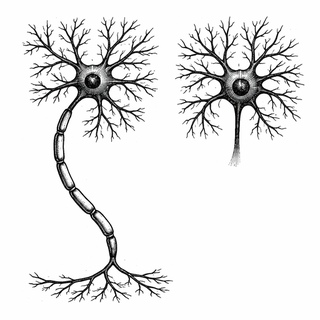
Meet the cousins
Enter the mouse olfactory bulb, the brain's smell-processing station, and a family of dopamine-making interneurons living there. These little cells help season the signal traveling from your nose to your cortex, and they come in two closely related flavors that look like they share a grandmother (Capsoni et al., 2021).
One cousin has an axon. The other cousin has no axon at all. None. It just decided the whole appendage was optional, like a recipe that skips the resting step because who has the patience.
You'd think two cells this related would cook the same way. They do not, and that's the whole delicious point.
Different doors, different dinners
Using careful anatomy and electrophysiology, the team found a clean split. The axon-bearing cousin releases its neurotransmitter exclusively from that axon, which is wrapped in patchy stretches of myelin like a sausage that's only partly in its casing. The axon-less cousin, having no takeout window, serves everything straight from its dendrites.
Same family, same neighborhood, two totally different floor plans. And here's the part that makes it more than a tidy anatomy lesson: the floor plan changes what the cell can actually do.
The self-inhibiting soufflé
The axon-less, dendrite-releasing cousin can do something its relative cannot. It can inhibit itself. It releases its messengers right next to its own receptors, so it essentially tastes its own cooking and turns the heat down in real time, a feedback loop neuroscientists call self-inhibition. The axon-bearing cousin, serving from a window down the hall, doesn't get that instant taste test and can't self-correct the same way.
This fits what we already knew about these cells being dual-transmitter types that release both dopamine and GABA to fine-tune incoming smell signals (Liu et al., 2017). Releasing right onto your own dendrites is a fast, local way to keep yourself from over-salting the dish.
Why this is worth more than a sniff
Here's the bigger flavor. We tend to lump neurons into tidy categories and assume members of a category behave alike. This study is a reminder that two cells can be cousins on paper and run entirely separate operations in practice, just because one kept its axon and one didn't. Polarity, the simple matter of where a cell's input and output ends sit, can completely rewrite its job description (dendritic release review, 2017).
That matters well beyond mouse noses. Dopamine cells are central players in Parkinson's disease, addiction, and mood, and many of them release from dendrites too. If we want drugs that nudge one population without clumsily hitting its look-alike neighbor, we first need to know that the neighbors were never really doing the same job. You can't season selectively if you think every cell is the same ingredient.
So the next time someone tells you brain cells of the same type are interchangeable, you can gently correct them. Some of these cousins are running entirely different kitchens, and one of them is tasting every bite. Okay, now I'm done with the cooking puns. For real this time. Probably.
Disclaimer: The image accompanying this article is for illustrative purposes only and does not depict actual experimental results, data, or biological mechanisms.
References
- Dorrego-Rivas, A., Byrne, D. J., Liu, Y., Cheah, M., Arslan, C., Lipovsek, M., Ford, M. C., & Grubb, M. S. (2025). Strikingly different neurotransmitter release strategies in dopaminergic subclasses. eLife. https://doi.org/10.7554/eLife.105271 (PMID: 41399104)
- Capsoni, S., Fogli Iseppe, A., Casciano, F., & Pignatelli, A. (2021). Unraveling the Role of Dopaminergic and Calretinin Interneurons in the Olfactory Bulb. Frontiers in Neural Circuits, 15, 718221. https://doi.org/10.3389/fncir.2021.718221
- Liu, S., Puche, A. C., & Shipley, M. T. (2017). Presynaptic gain control by endogenous cotransmission of dopamine and GABA in the olfactory bulb. Journal of Neurophysiology. https://doi.org/10.1152/jn.00694.2016
- Ludwig, M., & Pittman, Q. J. (2003). Talking back: dendritic neurotransmitter release. Trends in Neurosciences, 26(5), 255-261. https://doi.org/10.1016/S0166-2236(03)00072-9
- Kennedy, M. J., & Ehlers, M. D. (2017). Dendritic release of neurotransmitters. Comprehensive Physiology. https://www.ncbi.nlm.nih.gov/pmc/articles/PMC5381730/