
A synaptic vesicle is about 40 nanometers across. To put that in perspective, you could line up roughly 2,000 of them across the width of a single human hair and still have room to spare. Your retina is packed with billions of these microscopic bubbles, each one a tiny package of chemical gossip waiting to be dumped into the gap between two cells. And it turns out the way a cell decides to dump those packages, all at once or slowly over time, is the difference between you noticing a tiger lunging at you and you noticing that the lighting in the room is, broadly speaking, fine.
A new study in eLife from Sidney Kuo, Fred Rieke, and their collaborators dug into exactly this, and the answer is more relatable than you'd expect. It's basically a story about two friends who got the identical text and replied in completely different ways.
The Setup: Everybody Gets the Same Message
Here's how vision starts. Light hits your cone photoreceptors, and those cones pass the signal down to a relay layer of neurons called bipolar cells, which then hand it off to retinal ganglion cells, the neurons that actually fire messages to your brain. Think of it as one piece of news traveling through a chain of increasingly chatty group chats.
The clever part is that your retina doesn't send your brain one boring summary of "light: present." It splits the same visual scene into parallel streams, each tuned for something different. Some cells obsess over sudden changes. Others keep a steady running tally of how bright things are. Same scene, different obsessions, like two people watching the same first date and one fixating on the awkward pauses while the other just notes the restaurant was nice.
The researchers zoomed in on two of these output cells: transient ON cells (ON-T) and sustained ON cells (ON-S). Transient cells fire a quick burst when something changes and then go quiet, the friend who texts "OMG DID YOU SEE THAT" and then ghosts. Sustained cells keep responding the whole time the light is on, the friend who is still narrating the event three hours later.
The Plot Twist: It Wasn't the Senders
The obvious guess is that these two output cells behave differently because they're getting different inputs. Maybe the bipolar cells feeding the transient cell are themselves twitchy and brief, while the ones feeding the sustained cell are mellow and persistent.
So the team checked. Using patch-clamp recording, 3D electron microscopy, and a glowing glutamate sensor that lights up wherever neurons release their chemical messages, they compared several bipolar cell subtypes (types 5i, 6, and 7) head to head. The result was almost funny: the bipolar cells responded to light in essentially indistinguishable ways. The senders were all typing the same message.
The split happened at the synapse itself, the actual handoff point. The glutamate signal around the ganglion cell dendrites, and the electrical currents the ganglion cells received, were kinetically distinct even though the upstream responses matched. Same text, wildly different delivery.
It Comes Down to How Big Your Outbox Is
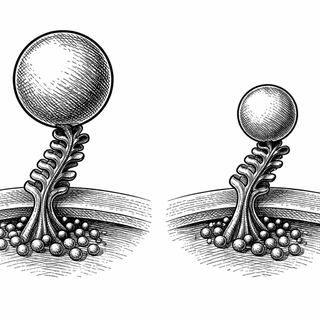
When the team reconstructed the bipolar cell terminals in microscopic detail, they spotted a structural clue. Neurons release their vesicles at little staging docks called synaptic ribbons, which hold a ready-to-go pool of vesicles. The bipolar cells feeding transient cells appeared to have smaller pools, while those feeding sustained cells had larger ones.
A small outbox empties fast and then has to refill, which produces a quick burst followed by silence. A big outbox keeps shipping packages steadily, which sustains the signal. The personality of the message isn't decided by the writer. It's decided by how many words fit in the send box. Honestly, more honest than most of us are about our own texting habits.
Why You Should Care About Your Eye's Group Chat
This matters because parallel processing isn't some quirky retina trick, it's how the entire nervous system pulls off the magic of doing many things at once with the same raw ingredients. Figuring out where one signal becomes many is a long-standing goal in neuroscience, and this study pins a big chunk of that divergence to a single, concrete place: the bipolar cell synapse and the size of its vesicle stash.
If these findings hold up and extend to other circuits, they hand researchers a precise target. Diseases that degrade vision, and any future attempt to build retinal prosthetics or restore sight, will need to recreate not just "light detection" but the timing personalities that make vision useful. You can't just turn the lights on. You have to teach the cells when to shout and when to keep talking.
Your eyeball is running a quiet little study in personality differences, and the lesson is delightfully human: it's not what you say, it's how fast you can hit send.
Disclaimer: The image accompanying this article is for illustrative purposes only and does not depict actual experimental results, data, or biological mechanisms.
References
Kuo SP, Yu WQ, Srivastava P, Okawa H, Della Santina L, Berson DM, Awatramani GB, Wong ROL, Rieke F. Cone bipolar cell synapses generate transient versus sustained signals in parallel ON pathways of the mouse retina. eLife. 2025. DOI: 10.7554/eLife.98817. PMCID: PMC12721711.
Srivastava P, de Rosenroll G, Matsumoto A, et al. Analogous Convergence of Sustained and Transient Inputs in Parallel On and Off Pathways for Retinal Motion Computation. Cell Reports. 2018. PMCID: PMC6404534.
Kim US, Mahroo OA, Mollon JD, Yu-Wai-Man P. On and Off Signaling Pathways in the Retina and the Visual System. Frontiers in Ophthalmology. 2022. PMCID: PMC10016624. DOI: 10.3389/fopht.2022.989002.